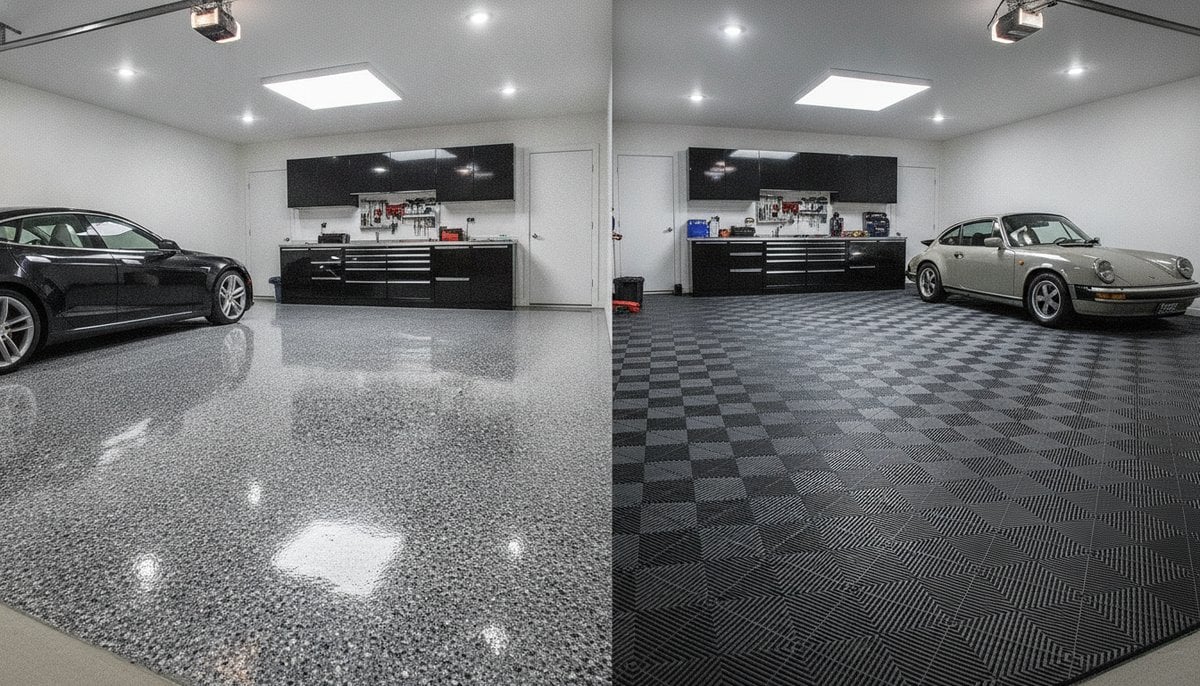
Should you epoxy your Melbourne garage floor or tile it? Both are common upgrades, but they work very differently, cost differently, and suit different situations. This comparison covers real cost, durability, installation, and maintenance so you can make the right call for your garage before spending a cent.
Key takeaways
- Epoxy flooring costs $60–$120 per m² installed. Interlocking garage tiles cost $30–$60 per m² supplied and installed.
- Tiles are cheaper upfront but typically last 5–10 years. A professional epoxy floor lasts 10–20 years.
- Epoxy bonds directly to concrete. It’s seamless, waterproof, and easier to clean.
- Tiles are a better option for garages with known moisture issues, since air can circulate beneath vented tiles.
- For most Melbourne homeowners, epoxy delivers better value over the life of the floor.
Cost comparison: epoxy vs tiles for a Melbourne garage
| Epoxy flooring | Interlocking garage tiles | |
|---|---|---|
| Cost per m² (installed) | $60–$120 | $30–$60 |
| Single garage (20 m²) | $1,200–$2,400 | $600–$1,200 |
| Double garage (40 m²) | $2,400–$4,800 | $1,200–$2,400 |
| Expected lifespan | 10–20 years | 5–10 years |
| Cost per year (double garage) | $150–$320 | $170–$480 |
When you factor in lifespan, the per-year cost of epoxy and tiles is actually similar and epoxy wins if you’re comparing professional-grade systems over a 15-year window.
What are interlocking garage tiles?
Interlocking garage tiles (also called modular floor tiles) are rigid polypropylene panels that click together over your existing concrete. They don’t require adhesive or professional installation. Most homeowners can tile a double garage in half a day. Vented designs allow air to circulate beneath the surface, which helps in garages with moisture coming up through the slab.
The tradeoff is that tiles sit on top of the concrete rather than bonding to it. They can shift, trap grit underneath, and the interlocking joints collect oil and debris over time. They also don’t look as clean or seamless as an epoxy flake floor.
What is epoxy garage flooring?
Epoxy is a chemically bonded multi-layer coating system applied directly to concrete. The installer diamond-grinds the slab, applies a primer, one or more epoxy base coats, and seals it with a polyurethane or polyaspartic topcoat. The result is a seamless, hard, glossy surface that bonds mechanically into the concrete pores.
Because it’s bonded rather than floating, epoxy doesn’t shift, lift, or trap debris underneath. It’s also resistant to oil, chemicals, and hot tyre marks , all common in Melbourne garages.
Durability: which lasts longer?
A professional epoxy floor installed with proper preparation lasts 10–20 years in a residential Melbourne garage. Interlocking tiles last 5–10 years before they start cracking, fading from UV exposure, or developing loose joints that trip people up.
The main durability risk for epoxy is poor preparation: a floor installed without diamond grinding will start delaminating at the edges within 2–4 years. For tiles, the risk is buying thin, low-density polypropylene that cracks under vehicle weight.
Which handles Melbourne’s climate better?
Melbourne’s climate throws temperature swings, damp winters, and occasional extreme heat at garage floors. Here’s how each option responds:
Moisture
Moisture coming up through a concrete slab (called vapour transmission) is the enemy of bonded coatings. If your slab has significant moisture issues, epoxy can blister and delaminate if a moisture barrier isn’t applied first. Vented interlocking tiles sidestep this problem entirely because they float above the concrete and air circulates underneath. For garages known to have rising damp, tiles may be the safer short-term solution or get the moisture issue addressed before laying epoxy.
Temperature and UV
A polyaspartic topcoat handles Melbourne’s UV exposure well. Standard polyurethane topcoats are also UV-stable. Polypropylene tiles can fade and become brittle with prolonged UV exposure, particularly in north-facing garages. Some tile brands are rated for UV, so check the spec sheet before buying.
Hot tyres
Hot tyre pickup where a tyre’s heat bonds to the floor coating and peels it when the car drives off , is a real issue with thin floor paints and DIY epoxy kits. Professional commercial-grade epoxy systems are formulated to resist it. Polypropylene tiles are generally resistant to hot tyres because the plastic doesn’t bond to rubber.
Installation: what’s involved for each?
Epoxy installation
Professional epoxy installation takes 1–2 days for a double garage. Day one is preparation (grinding, crack filling, priming) and the base coat. Day two is the topcoat. Cure time is 24 hours before foot traffic and 5–7 days before vehicle use. You need to clear the garage completely and won’t have access during that window.
Tile installation
Interlocking tiles take 3–5 hours for a double garage. You can do it yourself, and the garage can usually be used the same day. Tiles need to be cut around edges and obstacles, which requires a jigsaw or utility knife depending on the material.
Cleaning and maintenance
Epoxy is the clear winner here. A seamless surface with no joints means there’s nowhere for oil, grit, or dirt to accumulate. A mop and a mild degreaser handles most messes. The only maintenance required is an occasional machine buff if the topcoat starts to dull after many years.
Tiles collect debris in their joints. Oil and brake fluid seep into the gaps and stain the concrete underneath. To clean properly, you often need to remove sections of tile to access the concrete beneath, which defeats part of the convenience argument.
Appearance: which looks better?
This is subjective, but most Melbourne homeowners who see both options side-by-side choose epoxy for the finished look. A full-broadcast epoxy flake floor or a metallic epoxy system looks like a showroom floor. Interlocking tiles look like what they are: a plastic mat over concrete.
Tiles have improved significantly and some patterns do look clean and modern. But they can’t match the seamless, high-gloss finish of a professionally installed epoxy system.
When tiles are the right choice
Despite epoxy being the better long-term option for most Melbourne garages, tiles make sense in specific situations:
- You’re renting and can’t make permanent changes to the floor
- Your slab has severe moisture issues that need to be fixed before any bonded coating
- You need the garage back in use within hours and can’t wait for epoxy to cure
- Budget is very tight and you want a temporary upgrade while saving for epoxy
FAQ: epoxy vs tiles for Melbourne garages
Is epoxy cheaper than tiles for a garage floor?
Epoxy costs more upfront ($60–$120/m² vs $30–$60/m² for tiles), but lasts twice as long. Over a 10-year window the total cost is often similar, and epoxy wins on per-year value over 15+ years.
Can I install epoxy over tiles?
No. Tiles need to be removed before epoxy is applied. Epoxy bonds to bare concrete, not to a tiled surface.
Do interlocking tiles damage garage concrete?
No. They sit on top without adhesive and can be removed without leaving any residue. They’re a fully reversible option.
Which is better for a Melbourne garage used daily?
Epoxy. For a garage that sees daily vehicle use, oil drips, and foot traffic, a professional epoxy system handles the workload better than tiles over the long term.
Get a free epoxy quote for your Melbourne garage
If you’re leaning toward epoxy, the next step is getting an accurate quote based on your actual concrete. Metal and Flake offer free on-site quotes across Melbourne with a full written breakdown. Book your free quote here.
Ready for a Floor That Lasts?
Get a free, no-obligation quote from Melbourne’s trusted epoxy specialists.