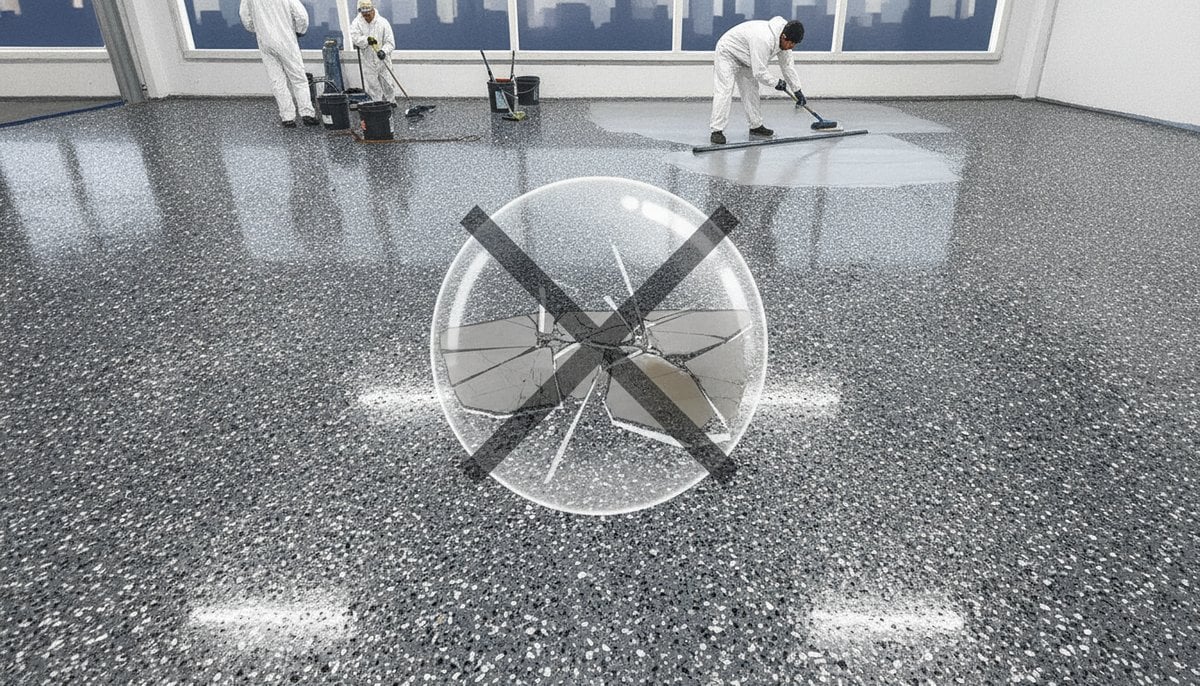
There’s a lot of outdated and incorrect information circulating about epoxy garage flooring. Some of it comes from people who had bad experiences with budget DIY kits a decade ago. Some comes from competitors pushing alternative products. And some is just myth that’s been repeated so often it sounds like fact. Here are 8 of the most common ones, and what’s actually true.
Myth 1: Epoxy floors are slippery when wet
The truth: a smooth, unsealed epoxy surface can be slippery when wet. But a professionally installed garage floor with a full-broadcast flake system has natural texture from the chip surface, and any quality topcoat can have a fine anti-slip aggregate added as standard. This is included in virtually every residential garage installation from a reputable Melbourne installer. A properly specified epoxy floor is not slippery.
If you’ve seen this concern raised, it usually refers to thin, glossy, solid-colour epoxy coatings from DIY kits with no texture or anti-slip additive. That’s a different product from a professionally installed flake or metallic system.
Myth 2: Epoxy floors peel and chip within a few years
The truth: cheap DIY epoxy kits and budget installations do peel. Professional epoxy systems on properly prepared concrete do not. The distinction matters.
Delamination happens when the concrete wasn’t diamond ground before installation, when the surface had contamination (oil, paint, moisture) that wasn’t treated, or when a thin consumer-grade product was used. A professionally installed flake system or metallic epoxy on a properly prepared slab doesn’t peel. The mechanical bond achieved through diamond grinding is far stronger than the coating itself.
When people say “I heard epoxy peels”, they’ve usually heard about a DIY kit or a budget installation. Professional-grade systems on prepared concrete routinely last 15–20 years.
Myth 3: Epoxy floors are too expensive for a standard residential garage
The truth: epoxy flake flooring for a double Melbourne garage costs approximately $2,400–$5,000 installed. Spread over a 15-year lifespan, that’s $160–$333 per year, or under $1 per day. Compared to what most Melbourne homeowners spend on other home improvements, this is modest.
The myth of excessive cost often comes from comparing epoxy to garage floor paint ($200 in materials) without accounting for the fact that paint lasts 1–2 years and has to be redone repeatedly. On a lifetime cost basis, professional epoxy is the more economical choice.
Myth 4: You can apply epoxy yourself and get the same result
The truth: you can apply epoxy yourself. You will not get the same result. The difference isn’t primarily in the application, it’s in the preparation. Professional diamond grinding equipment costs tens of thousands of dollars and takes experience to use correctly. DIY concrete grinders available for hire produce inconsistent surface profiles. The primer and coating products available to consumers are also significantly thinner and less durable than professional-grade materials.
A DIY epoxy kit applied without proper diamond grinding will look fine for 6–18 months and then start peeling. This isn’t a failure of effort, it’s a fundamental mismatch between consumer products, consumer equipment, and a job that requires industrial preparation and professional-grade materials.
Myth 5: Epoxy floors are difficult to maintain
The truth: epoxy garage floors are among the easiest floors to maintain. Sweep weekly. Mop monthly with a pH-neutral cleaner. Wipe chemical spills when they happen. That’s the full routine.
The comparison point is bare concrete, which absorbs everything permanently and can’t be fully cleaned. An epoxy floor is sealed: spills sit on the surface, grit sweeps away, and the floor looks presentable indefinitely with minimal effort.
Myth 6: Epoxy floors are too hot in Melbourne summers
The truth: a cured epoxy floor doesn’t get noticeably hotter than any other hard floor surface in Melbourne’s summer heat. The thermal mass of the concrete beneath means the floor stays relatively cool. The topcoat itself doesn’t absorb heat differently from the underlying concrete.
This myth likely originates from concerns about hot tyre pickup, where vehicle tyres can bond to an uncured or poor-quality epoxy surface and pull it up when the car moves. A fully cured, quality topcoat doesn’t have this problem. Proper cure time (28–30 days) and a quality polyaspartic or polyurethane topcoat eliminates this risk entirely.
Myth 7: All epoxy floors look the same
The truth: epoxy flooring spans a wide range of aesthetics. A charcoal and silver flake floor, a flowing charcoal and gold metallic epoxy, a pearl white broadcast system, and a two-tone marble metallic look nothing alike. The category “epoxy floor” includes everything from industrial grey solid-colour coatings to custom artistic metallic designs.
The visual range of professional epoxy systems is wider than most people realise before they start looking at options. If the aesthetic concern is “I don’t want my garage looking like a factory floor,” the answer is to look at residential epoxy flake and metallic systems rather than the industrial grey that often forms people’s mental image of “epoxy”.
Myth 8: Epoxy flooring is bad for the environment
The truth: epoxy flooring has a mixed environmental picture, but it’s not the problem this myth implies. Professional 100% solids epoxy systems have low volatile organic compound (VOC) content compared to solvent-based paints and coatings. The long lifespan (15–20 years) means fewer replacements and less material use over time compared to shorter-lived alternatives. The sealed surface also reduces concrete dust, which is a fine particulate concern in poorly ventilated garages.
Disposal of an old epoxy floor does require grinding and disposal of the coating material. This is a genuine consideration, but it applies to all floor coatings and is a relatively minor environmental impact in the context of home ownership.
The bottom line
Most myths about epoxy garage flooring trace back to one of two sources: bad experiences with DIY kits or budget installations, or outdated information about older epoxy products from a decade ago. Professional-grade systems installed by experienced Melbourne contractors are a different category of product entirely.
The best way to form an accurate view is to see a completed professional installation in person. The difference between a professional result and what most people picture when they hear “epoxy floor” is significant.
FAQ: epoxy garage flooring myths Melbourne
Is there any truth to the myth that epoxy floors smell bad?
Solvent-based epoxy products have strong odours during application. Professional-grade 100% solids epoxy systems used by Melbourne installers have significantly lower odour. The garage should be ventilated during application and for 24 hours after, but this is a temporary installation consideration, not an ongoing concern with the finished floor.
Is it true epoxy floors can’t be repaired if damaged?
Small areas of damage (chips, scratches, localised delamination) can be repaired by an experienced installer. Widespread failure is better addressed by full removal and reinstallation. Repair feasibility depends on the size and cause of the damage and the quality of the original installation.
Do epoxy floors look cheap?
A professionally installed epoxy floor looks expensive, not cheap. The comparison point that generates this myth is usually DIY kits on unprepared concrete, which do look thin and uneven. A professional installation with proper preparation, a full broadcast flake system, and a gloss topcoat reads as a quality finish.
See a professional result for yourself
Metal and Flake can show you completed residential installations across Melbourne so you can form your own view without relying on myths. Book a free consultation and quote here.
Ready for a Floor That Lasts?
Get a free, no-obligation quote from Melbourne’s trusted epoxy specialists.