The honest answer to how long epoxy garage flooring lasts is: it depends entirely on how it was installed. A well-prepared, professionally applied epoxy system on a Melbourne residential garage lasts 10–20 years. A floor applied over inadequate preparation or with inferior materials can start failing within 2–3 years. This post explains what drives the difference and how to tell which category your floor falls into.
Key takeaways
- Properly installed epoxy garage flooring lasts 10–20 years in residential Melbourne use.
- The single biggest factor in lifespan is surface preparation, specifically diamond grinding before application.
- The topcoat wears before the base coat. A topcoat refresh at 7–12 years extends the floor’s life without full replacement.
- DIY epoxy kits and budget installations typically last 2–5 years before delaminating.
- Melbourne’s climate doesn’t significantly shorten epoxy lifespan when the right system is used.
What determines how long an epoxy floor lasts
1. Surface preparation (the biggest factor)
Epoxy bonds to concrete through mechanical adhesion. For this bond to last decades rather than years, the concrete must be diamond ground to open its pores and create a surface profile the epoxy can grip. Without this, the epoxy sits on top of the concrete rather than bonding into it, and delamination is a matter of time.
Most premature epoxy failures in Melbourne garages trace back to inadequate preparation: no grinding, acid etching instead of grinding, or grinding too lightly. A floor that was properly diamond ground before application is far more likely to still be intact 15 years later.
2. Coating thickness and system quality
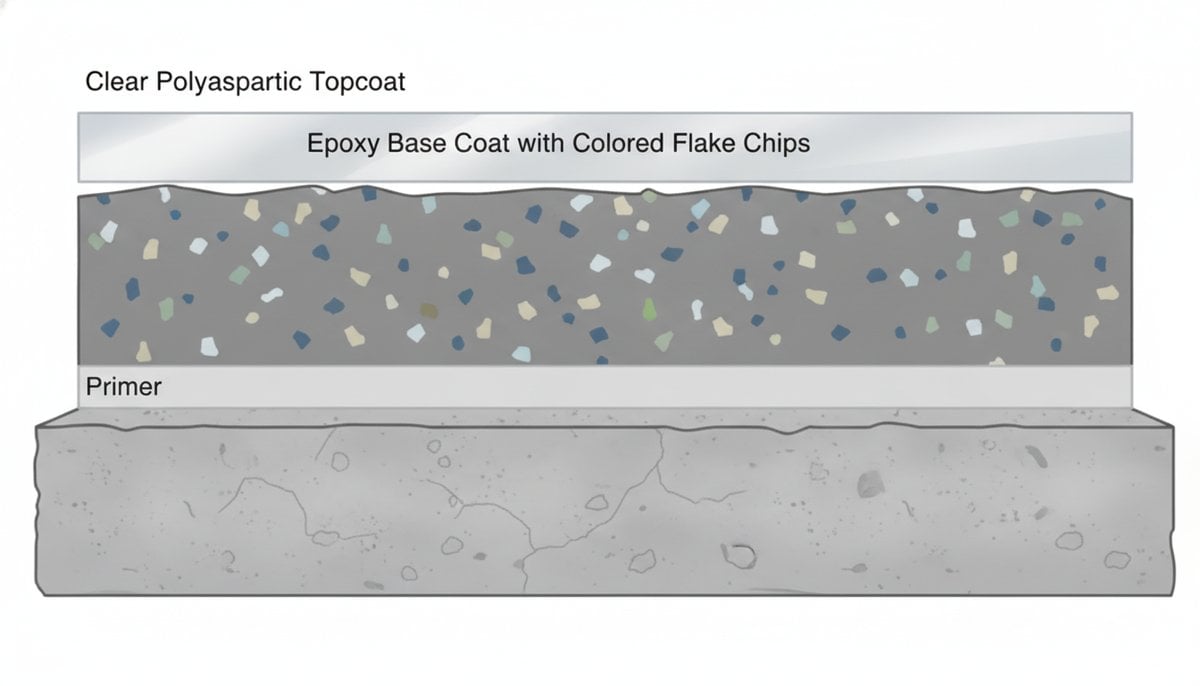
Professional-grade epoxy systems use thicker coatings than consumer products. A professional flake system includes a primer, a base coat with flake, and a clear topcoat, each applied at the correct thickness. Consumer DIY kits are thinner, more diluted systems that simply don’t have the film build to last under vehicle use.
The topcoat is particularly important. A quality polyaspartic or polyurethane topcoat at the correct thickness is the main factor in day-to-day wear resistance. A thin or substandard topcoat wears through faster, and once it’s compromised, the epoxy beneath is exposed to the same UV, chemicals, and abrasion that the topcoat was protecting it from.
3. Moisture in the slab
Melbourne’s clay soils mean many residential slabs have some moisture vapour transmission. If this isn’t addressed before installation (with a moisture-tolerant primer or moisture barrier), the moisture migrating up through the slab creates osmotic pressure that pushes the coating off from below, causing blistering and delamination. A professional installer checks for moisture before applying any coating.
4. How the garage is used
A showpiece garage with one carefully maintained car, rarely driven in or out, will see its floor last 20+ years. A working garage used daily, with oil changes, jack stands, heavy storage, and constant vehicle movement, will wear the topcoat faster. The base system doesn’t fail, but the topcoat shows wear sooner under harder use.
Expected lifespan by installation type
| Installation type | Expected lifespan | Notes |
|---|---|---|
| Professional install, diamond ground, quality topcoat | 15–20+ years | Topcoat refresh may be needed at 10–12 years |
| Professional install, standard preparation | 10–15 years | Adequate for most residential garages |
| Budget professional install, minimal prep | 3–7 years | Delamination often starts at edges first |
| DIY epoxy kit (water-based, thin system) | 1–3 years | Peeling typically starts within 18 months under vehicle use |
| Garage floor paint (latex or acrylic) | 1–2 years | Not an epoxy system; included for comparison |
The two-stage lifespan: topcoat vs base system
It helps to think of an epoxy floor’s lifespan in two stages:
- Stage 1 (years 1–10+): the floor looks and performs as installed. The topcoat maintains its gloss and protects the system beneath. Maintenance is just cleaning.
- Stage 2 (years 10–20): the topcoat gradually shows wear, fine scratches, and gloss reduction from years of use. The system is still structurally sound but looks less fresh. A topcoat refresh at this point extends the floor’s life without full replacement.
The base coat and decorative layer (flake or metallic) are sealed beneath the topcoat and essentially don’t wear. If you maintain and refresh the topcoat, the floor’s practical lifespan is extended significantly beyond what the original installation alone would provide.
Signs that an epoxy floor is failing prematurely
If any of these appear within the first 5 years, it’s a sign of inadequate installation rather than normal wear:
- Delamination at edges or corners (lifting away from the concrete)
- Blistering or bubbling across the surface
- Peeling, particularly in the tyre zones or entry area
- Flaking or chipping in patches across the floor
These failures are almost always preparation-related. Either the concrete wasn’t adequately ground, moisture wasn’t addressed, or the surface had contamination (oil, curing compound, old coating) that prevented proper bonding. None of these are things that happen to a correctly installed floor.
Does Melbourne’s climate affect epoxy lifespan?
Melbourne’s temperature variation (cold winters, hot summers) doesn’t significantly affect a cured epoxy system. Epoxy is thermally stable across Melbourne’s climate range once fully cured. The main climate consideration is UV: prolonged UV exposure from an open garage door can yellow lower-quality polyurethane topcoats over time. Quality UV-stable polyaspartic topcoats don’t have this problem.
The bigger Melbourne-specific concern is installation temperature. Epoxy shouldn’t be applied when temperatures will drop below 10°C during the cure window. Professional installers schedule around Melbourne’s winter temperature minimums to avoid this.
FAQ: how long does epoxy garage flooring last
How long does epoxy flake flooring last vs metallic epoxy?
Both systems have the same expected lifespan when professionally installed, as longevity is driven by preparation and topcoat quality rather than the decorative system. See our epoxy flake page and metallic epoxy page for details on each system.
Is a warranty a reliable indicator of lifespan?
A workmanship warranty from an established Melbourne installer is a meaningful signal. A 2–5 year workmanship warranty means the installer stands behind the installation quality. Be cautious of very long warranties from unfamiliar contractors, as a warranty is only as good as the company standing behind it.
How much does it cost to refresh an epoxy topcoat?
A topcoat refresh on a double Melbourne garage typically costs $800–$1,800 depending on the topcoat product used and the condition of the existing surface. This compares to $2,500–$5,000 for a full new installation, making a refresh a cost-effective way to extend the floor’s life.
Can I repair a small area of delamination rather than redoing the whole floor?
Small localised delamination can sometimes be repaired by an experienced installer. The failed section is ground back to concrete, re-primed, and recoated. Colour and texture matching is the challenge: the repaired area may be slightly visible. Widespread delamination is better addressed by a full redo.
Get a long-lasting epoxy floor for your Melbourne garage
The difference between a floor that lasts 20 years and one that fails in 3 is preparation and installation quality. Metal and Flake diamond grind every floor as standard and use professional-grade systems designed for Melbourne residential garages. Book a free on-site quote here.
Ready for a Floor That Lasts?
Get a free, no-obligation quote from Melbourne’s trusted epoxy specialists.