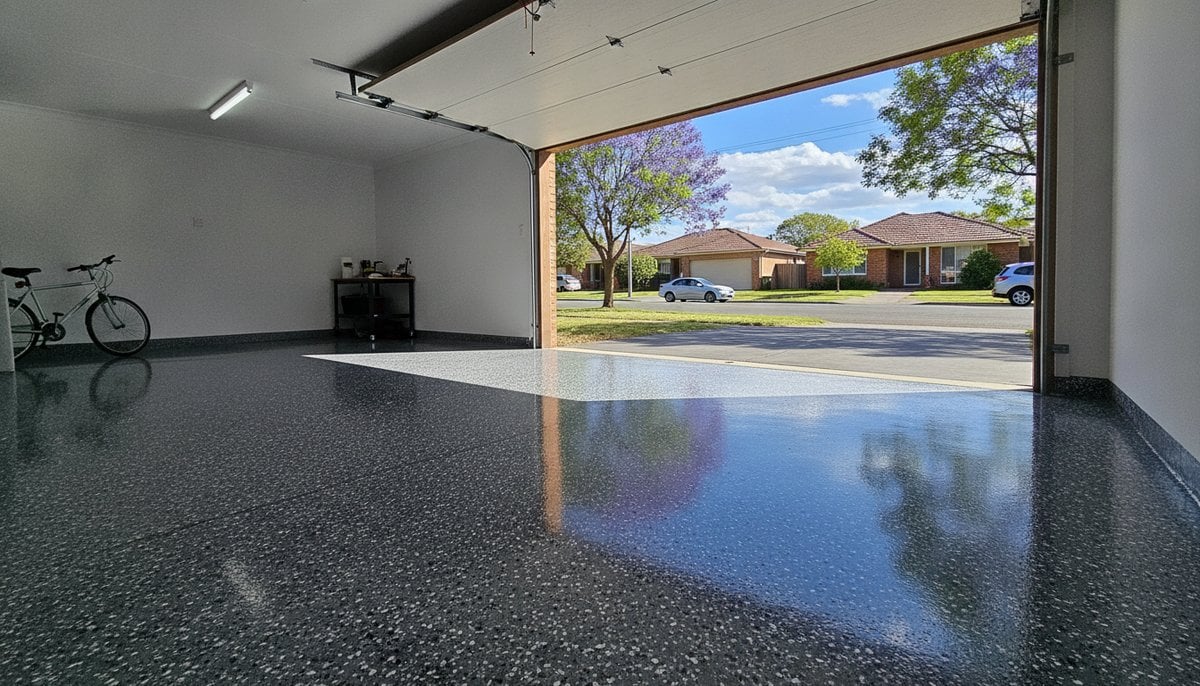
Melbourne’s weather is famously unpredictable: hot summers, cold winters, high UV, frequent rain, and dramatic temperature swings within a single day. If you’re considering epoxy garage flooring, it’s a fair question whether the local climate works for or against the system. This post covers what Melbourne’s climate actually does to epoxy flooring, what to watch for, and why timing your installation matters.
Key takeaways
- A properly installed epoxy system performs well across Melbourne’s full climate range.
- Installation temperature is the critical variable: epoxy shouldn’t be applied when overnight temperatures drop below 10°C.
- UV exposure can yellow low-quality polyurethane topcoats over time. UV-stable polyaspartic topcoats don’t have this problem.
- Melbourne’s clay soils mean moisture vapour in slabs is more common than in drier climates and must be assessed before installation.
- The best time to install epoxy in Melbourne is spring or autumn, when temperatures are stable and humidity is moderate.
How Melbourne’s temperature range affects epoxy
During installation
Temperature matters during application and initial cure, not after. Epoxy cures through an exothermic chemical reaction that requires a minimum ambient temperature. Below 10°C, the reaction slows significantly and may not complete correctly, leaving a soft, tacky surface prone to failure.
Melbourne’s winter overnight temperatures regularly fall to 5 to 8°C from June through August. A professional installer scheduling a winter installation will check the extended forecast and avoid any week where overnight temperatures will drop below 10 to 12°C during the 24 to 48 hour cure window after application.
High temperatures (above 30°C) shorten the working time of epoxy, which can cause issues for less experienced applicators. Metallic epoxy in particular requires manipulation while the material is workable, and hot days compress that window. Experienced Melbourne installers know to start early and work in sections during hot weather.
After installation: the cured floor
Once fully cured (28 to 30 days), epoxy is thermally stable across Melbourne’s climate range. The thermal cycling between Melbourne’s hot summers and cool winters doesn’t cause the coating to crack, delaminate, or fail in a properly prepared and installed system. The bond to the concrete is mechanical and chemical, not dependent on temperature stability the way some adhesives are.
UV exposure: the specific Melbourne risk
Melbourne receives significant UV radiation, particularly in spring and summer. For epoxy garage floors, UV is relevant in two scenarios:
- Garages with open roller doors that face north or west: direct sun exposure during peak hours hits the floor surface and can degrade lower-quality topcoats over time.
- Partially open or semi-outdoor areas: entertaining slabs, carports, and workshop spaces with large openings see significant UV exposure.
Standard polyurethane topcoats are not UV-stable. Under prolonged Melbourne sun exposure, they can amber (yellow) over time. This doesn’t affect structural performance, but it changes the appearance of light-coloured floors noticeably.
Polyaspartic topcoats are UV-stable and don’t amber. For any Melbourne garage with significant sun exposure through the door, a polyaspartic topcoat is worth the additional cost. It’s also worth specifying for garages with north or west-facing orientations, even if the door is typically closed, as UV penetrates and reflects through glass panel doors.
Moisture and Melbourne’s clay soils
Melbourne’s geology is predominantly reactive clay. This means soil moisture levels change significantly with rainfall and drought cycles, causing ground movement and, relevantly for garage floors, moisture vapour migration through concrete slabs.
Moisture vapour transmission occurs when moisture in the soil beneath the slab migrates upward through the concrete as vapour. On the surface, the slab may look perfectly dry. But if epoxy is applied over a slab with active moisture transmission, the vapour creates osmotic pressure beneath the coating, causing blistering and delamination over months to years.
Professional Melbourne installers test for moisture before installation. The simplest field test is taping a sheet of plastic to the concrete for 16 to 24 hours: if condensation forms on the underside, the slab has active moisture transmission. High readings require either a moisture-tolerant primer or a dedicated moisture barrier coat before the epoxy system is applied.
This is a Melbourne-specific consideration that matters more here than in drier cities. Any professional installer should include this step in their assessment.
Rain during installation
Rain itself isn’t an issue for a garage installation, as the garage is enclosed. What matters is humidity. High ambient humidity (above 80 to 85%) during application can cause epoxy to “blush”: a whitish, hazy surface film that forms as atmospheric moisture reacts with the curing epoxy. Blushing reduces gloss and adhesion of subsequent coats.
Professional installers monitor humidity forecasts and schedule installations during lower-humidity windows. Melbourne’s autumn and spring typically offer the most reliable low-humidity conditions for installation.
Best and worst times to install epoxy in Melbourne
| Season | Temperature | Humidity | Rating for installation |
|---|---|---|---|
| Spring (Sep, Nov) | 15 to 25°C, stable | Moderate | Excellent |
| Autumn (Mar, May) | 15 to 22°C, stable | Moderate to low | Excellent |
| Summer (Dec, Feb) | 20 to 40°C, variable | Low to moderate | Good (early starts, avoid heatwave days) |
| Winter (Jun, Aug) | 5 to 15°C, overnight lows critical | Higher | Challenging (schedule carefully, check overnight lows) |
Does frost affect epoxy floors?
Melbourne doesn’t experience significant ground frost in suburban areas, but outer suburban and hillside locations can see brief frost periods. Frost on a curing epoxy surface causes irreversible surface defects. A professional installer will not apply epoxy if frost is forecast during the cure window. Once the floor is fully cured, frost doesn’t affect it.
FAQ: epoxy flooring and Melbourne’s climate
Can epoxy be installed in a Melbourne winter?
Yes, with careful scheduling. An installer needs at least 48 to 72 hours of temperatures staying above 10°C after application. In Melbourne winters, this is achievable on the right weeks. Discuss timing with your installer and check the extended forecast together.
My garage faces west and gets afternoon sun. Is epoxy still suitable?
Yes, but specify a UV-stable polyaspartic topcoat rather than standard polyurethane. The polyaspartic won’t amber under the UV exposure and costs roughly 15 to 25% more. It’s a worthwhile investment for west-facing garages.
Will Melbourne’s variable weather cause the floor to crack?
No. The coating itself doesn’t crack from thermal cycling. Cracks in the concrete beneath can telegraph through the coating over time if they’re active (moving) cracks that weren’t treated correctly during installation. An experienced installer identifies and treats these appropriately during preparation.
How soon after rain can a new epoxy floor get wet?
After full cure (5 to 7 days for the topcoat to reach vehicle-use hardness, 28 to 30 days for full chemical cure), the floor handles water normally. Water is not a threat to a cured epoxy system. During the initial cure period, keep the floor dry.
Get your Melbourne garage floor done at the right time of year
Metal and Flake schedule installations to suit Melbourne’s seasonal conditions and won’t compromise a job by pushing ahead in unsuitable weather. If you’re planning a flake system or metallic epoxy installation, get in touch to discuss the right timing for your project.
Ready for a Floor That Lasts?
Get a free, no-obligation quote from Melbourne’s trusted epoxy specialists.
Get a Free Quote +61 485 031 001