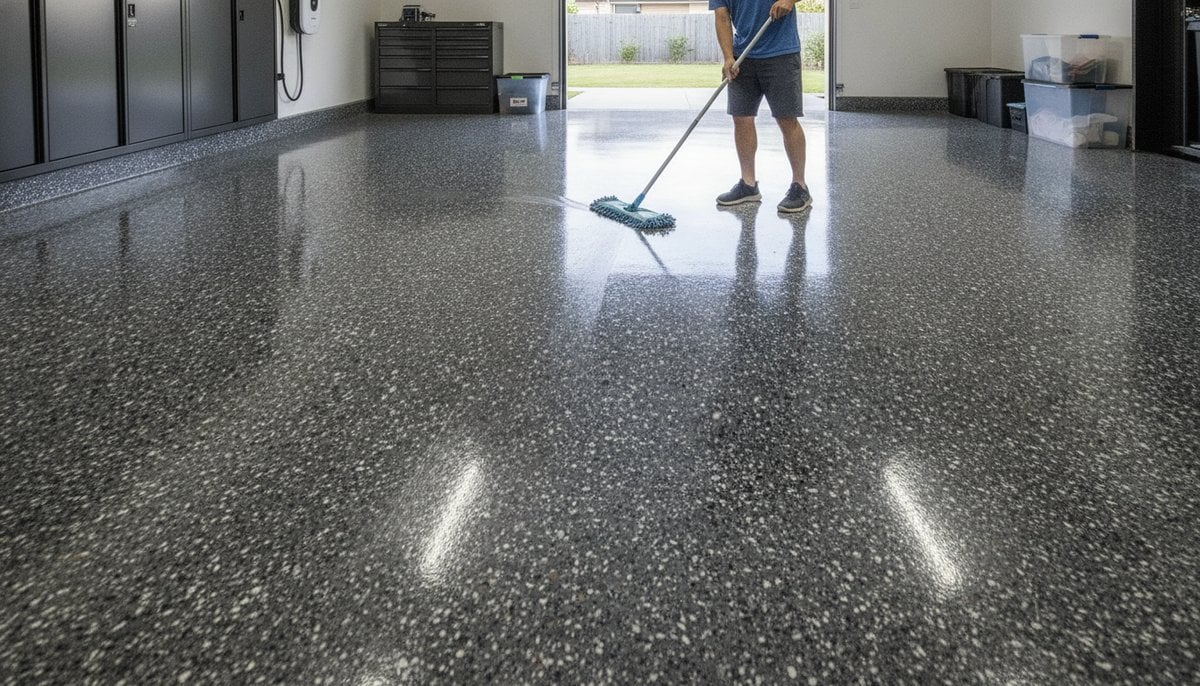
A professionally installed epoxy garage floor is low-maintenance by design, but “low-maintenance” doesn’t mean no maintenance. Melbourne’s climate, vehicle use, and the occasional chemical spill all take a toll over time. This guide covers exactly what to do, how often, and what to avoid so your floor looks good for 15 years, not 5.
Key takeaways
- Weekly sweeping and monthly mopping is all most Melbourne epoxy garage floors need.
- The topcoat is the wear surface, not the epoxy itself. Protect it and the floor lasts much longer.
- Acidic cleaners, citrus degreasers, and abrasive pads are the main things to avoid.
- Wipe chemical spills promptly, especially petrol, brake fluid, and battery acid.
- A topcoat refresh every 7 to 10 years extends the floor’s life without redoing the full system.
Understanding your floor’s structure
Before getting into maintenance, it helps to understand what you’re maintaining. A professionally installed epoxy garage floor has multiple layers:
- Concrete slab: the foundation; fully sealed beneath the system
- Primer coat: penetrates and bonds to the concrete
- Epoxy base coat: the structural layer, often with decorative flake broadcast into it
- Clear topcoat: polyurethane or polyaspartic, this is the wear surface you walk and drive on
When you clean the floor, you’re cleaning the topcoat. When the floor shows wear over years of use, it’s the topcoat wearing. The epoxy and decorative layer beneath are fully sealed and protected as long as the topcoat is intact.
Weekly maintenance: sweeping
The single most important thing you can do for an epoxy floor is sweep or vacuum it regularly. Grit and fine aggregate tracked in from outside acts like sandpaper under foot traffic and tyres. Over time, this abrasion dulls the topcoat and reduces the gloss.
A soft-bristle broom or a vacuum with a hard floor attachment removes grit before it can cause damage. In Melbourne garages that see daily vehicle use, once a week is the minimum. High-traffic garages benefit from more frequent sweeping.
Monthly maintenance: mopping
A monthly mop with warm water and a pH-neutral cleaner keeps the surface clean and maintains the gloss. The key points:
- Use a pH-neutral cleaner, diluted as directed. Dedicated epoxy floor cleaners are ideal but not required.
- Use a microfibre mop rather than a string mop. Microfibre picks up fine particles without scratching.
- Avoid leaving pooling water to sit. Mop and let it dry naturally, or use a squeegee for larger volumes of water.
- Don’t use steam mops. The high heat and pressure can damage the topcoat over time.
What cleaners to use (and what to avoid)
Safe to use
- Warm water alone, for light cleaning
- pH-neutral floor cleaner (Simple Green diluted 1:10 is a popular choice)
- Mild dish soap diluted in water for spot cleaning
- Isopropyl alcohol for small spot cleaning of stubborn marks
Avoid these
- Acidic cleaners (vinegar, citrus degreasers, muriatic acid): acid etches and dulls the topcoat over time
- Bleach or chlorine-based cleaners: can discolour the coating and weaken the surface
- Abrasive scrubbing pads or steel wool: scratches the topcoat permanently
- Solvent-based cleaners (acetone, MEK, xylene): can soften and damage the topcoat
- Oil-based soaps: leave a residue that makes the floor slippery
Dealing with spills: the most important rule
Wipe spills as soon as you notice them. This applies to everything, but especially:
- Petrol and oil: both will eventually soften the topcoat if left to sit. Blot with a rag and clean the area with diluted pH-neutral cleaner.
- Brake fluid: highly aggressive to epoxy topcoats. Wipe immediately and clean the area thoroughly.
- Battery acid: similarly aggressive. Neutralise with a baking soda solution if you suspect a battery has leaked, then clean.
- Antifreeze and coolant: less damaging than brake fluid but still clean promptly.
Most of these spills cause no lasting damage if cleaned within a few hours. Left overnight or over a day, they can etch or soften the topcoat locally.
Protecting the floor from physical damage
Tyres
Vehicle tyres on an epoxy floor can cause “hot tyre pickup” if the topcoat isn’t fully cured or is of poor quality. A properly cured, quality polyaspartic or polyurethane topcoat doesn’t have this problem. If your installer used a quality system and the floor is fully cured (28 to 30 days after installation), tyre contact is not a concern.
Heavy items and floor jacks
Use plywood or rubber pads under car ramps and floor jacks to distribute weight and prevent point damage. Steel edges can chip epoxy if concentrated on a small area.
Furniture and shelving
Add felt pads or rubber feet to shelving units, workbench legs, and heavy storage items. This prevents scratching when items are moved and distributes weight on the topcoat.
Grit mats at the entry
A rubber mat or grit trap at the garage entry point captures the coarse grit that does the most abrasion damage. This single addition significantly extends topcoat life in high-traffic garages.
Seasonal considerations in Melbourne
Melbourne’s climate doesn’t cause problems for a cured epoxy floor, but a few seasonal habits help:
- Summer: UV exposure from an open garage door can yellow lower-quality topcoats over time. Quality polyaspartic topcoats are UV-stable. If you notice yellowing, it’s the topcoat, not the epoxy beneath.
- Winter: wet cars tracked into the garage increase moisture on the floor. More frequent sweeping helps prevent grit from wet tyres accumulating.
- Autumn: leaf debris tracked in from the driveway can be abrasive. Regular sweeping during autumn keeps this in check.
When to consider a topcoat refresh
The topcoat is the sacrificial wear layer. Over 7 to 15 years of use, it gradually dulls, loses gloss, and may show fine scratches from years of grit. When this happens, the solution is a topcoat refresh, not a full floor replacement.
A topcoat refresh involves lightly abrading the existing surface and applying a new clear coat over the existing system. This restores the gloss and protection without touching the base coat or flake layer beneath. It costs roughly 40 to 60% of the original floor cost and extends the life of the system by another 10+ years.
Signs that a topcoat refresh is due:
- The floor looks dull even after cleaning
- Fine scratches are visible across the surface
- The gloss no longer returns after mopping
- Localised areas of wear near the entry or main traffic paths
FAQ: maintaining an epoxy garage floor in Melbourne
Can I use a pressure washer on my epoxy floor?
Yes, at low to moderate pressure (under 1500 PSI). Keep the nozzle moving and avoid concentrating high pressure in one spot for extended periods. A garden hose with a spray head is generally sufficient for rinsing the garage floor.
How do I remove tyre marks from the floor?
Tyre rubber deposits respond well to a diluted degreaser or isopropyl alcohol applied and scrubbed with a non-abrasive pad. Most marks come off without much effort if they haven’t been there for extended periods.
My floor has lost its gloss in one area. What happened?
Localised gloss loss is usually caused by a chemical spill that was left too long, concentrated cleaning product, or abrasion from a stationary object. For small areas, a touch-up topcoat can be applied by a professional. For widespread dullness, a full topcoat refresh is the right solution.
Is a polyaspartic topcoat easier to maintain than polyurethane?
Both are easy to maintain with the same routine. Polyaspartic is more chemically resistant and UV-stable, which means it handles spills and sun exposure better long-term. Day-to-day maintenance is essentially the same for both.
Keep your Melbourne garage floor looking its best
Metal and Flake install epoxy flake and metallic epoxy systems across Melbourne and provide care instructions with every installation. If your floor needs a topcoat refresh or assessment, get in touch here.
Ready for a Floor That Lasts?
Get a free, no-obligation quote from Melbourne’s trusted epoxy specialists.
Get a Free Quote +61 485 031 001