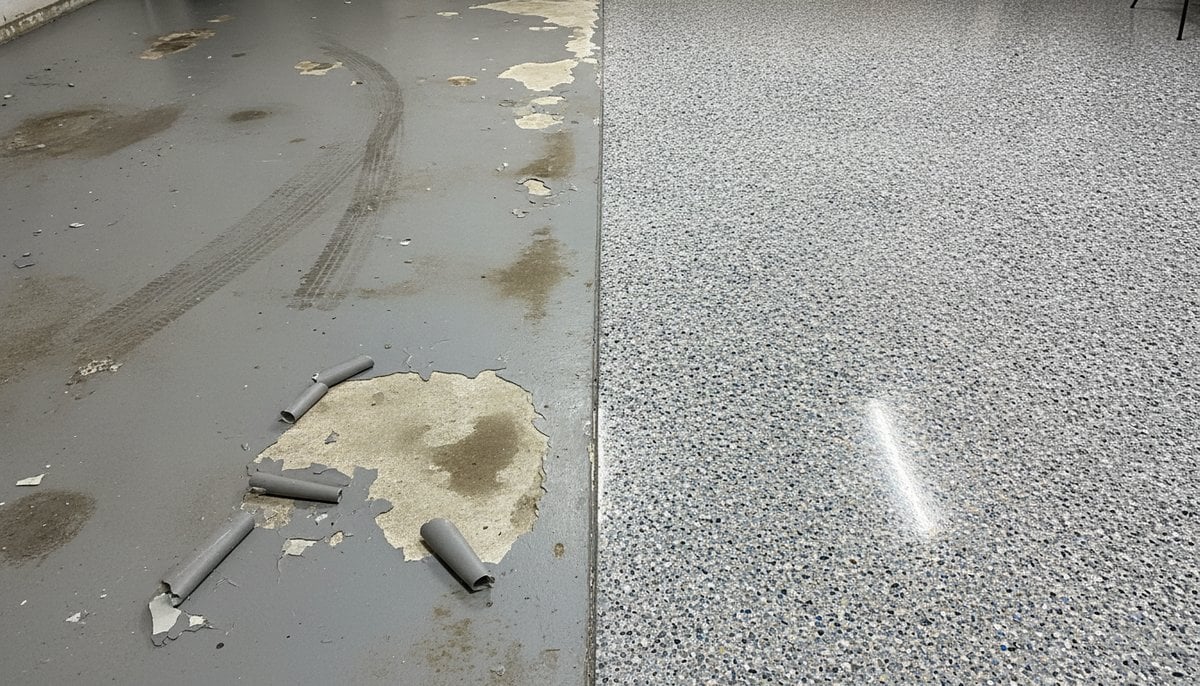
Garage floor paint is cheap and easy to apply. Epoxy coating costs more and takes longer. But if you’re weighing up the two for your Melbourne garage, the decision isn’t really about upfront cost , it’s about what you want the floor to do in five years’ time. This guide explains the real differences so you can choose the right option for your situation.
Key takeaways
- Garage floor paint costs $15, $35 per m² (or less DIY). Epoxy coating costs $60, $120 per m² installed.
- Floor paint lasts 2 to 4 years under normal garage use. Epoxy lasts 10 to 20 years.
- Paint sits on the surface. Epoxy bonds chemically into the concrete pores.
- Hot tyres, oil, and chemicals will destroy floor paint within months. Epoxy resists all three.
- On a per-year cost basis, epoxy is significantly cheaper than repainting every few years.
Cost comparison: epoxy vs floor paint
| Garage floor paint | Professional epoxy coating | |
|---|---|---|
| Cost per m² | $15, $35 (professional) / $5, $12 (DIY) | $60, $120 |
| Double garage upfront | $600: $1,400 professional / $200, $480 DIY | $2,400: $4,800 |
| Expected lifespan | 2 to 4 years | 10 to 20 years |
| Cost over 20 years (double garage) | $3,000: $14,000 (repainting 5 to 10 times) | $2,400: $4,800 (once) |
Over a 20-year window, floor paint often costs more than a single epoxy installation , before you factor in the time and disruption of repainting every 2 to 3 years.
What is garage floor paint?
Garage floor paint is a water-based acrylic or latex coating that air-dries on the surface of the concrete. It doesn’t bond chemically with the concrete , it sits on top like a layer of regular wall paint. It’s easy to apply with a roller, dries quickly, and is available from any hardware store for $40: $80 per tin.
The problem is that concrete floors take heavy abuse: vehicle tyres, dropped tools, oil and chemical spills, moisture, and the grinding action of foot traffic carrying grit. Floor paint isn’t formulated to handle any of these well. It starts peeling, chipping, and staining within 12 to 24 months under normal garage use.
What is epoxy coating?
Epoxy is a two-part coating system (resin plus hardener) that chemically bonds into the prepared concrete surface. It cures into a hard, thick, plastic-like film that is resistant to vehicle tyres, oil, chemicals, abrasion, and moisture. Unlike paint, it doesn’t just sit on top , it penetrates and bonds mechanically into the concrete pores after diamond grinding.
Professional epoxy systems use 100% solids commercial-grade product. DIY epoxy kits from hardware stores use water-based epoxy with around 50% solids , better than paint, but significantly less durable than a professional system. The epoxy flake systems installed by Metal and Flake use commercial-grade product with a polyaspartic or polyurethane topcoat.
The key difference: surface bonding vs chemical bonding
This is the most important thing to understand. Floor paint air-dries. It doesn’t react with the concrete , it just sticks to the surface like paint on a wall. Concrete is porous and constantly expanding and contracting with temperature changes. Paint can’t keep up, so it cracks, peels, and lifts.
Epoxy resin and hardener mix together and undergo a chemical reaction that produces a cross-linked polymer. When applied to properly prepared (ground) concrete, this polymer bonds into the pores of the slab at a mechanical level. It becomes part of the floor rather than a coating sitting on top of it. That’s why it lasts 10 to 20 years instead of 2 to 4.
Hot tyres: the most common cause of paint failure
Hot tyre pickup is the biggest killer of garage floor coatings. When you park a car after driving, the tyres are warm. If the coating has limited heat resistance, the tyre surface bonds slightly to the floor. When the car drives off, it pulls the coating away with it , leaving bare patches within months.
Floor paint has essentially no hot tyre resistance. DIY water-based epoxy has limited resistance. Professional commercial-grade epoxy, with a proper topcoat, is specifically formulated to resist hot tyre contact. If you park vehicles in your garage, this distinction matters a great deal.
Oil and chemical resistance
Melbourne garages regularly see engine oil, brake fluid, petrol, degreasers, and cleaning chemicals. Floor paint absorbs these. Oil stains are nearly impossible to remove from painted concrete, and some chemicals actively break down the paint film.
Epoxy is chemically resistant. Oil and most common garage chemicals bead on the surface and wipe off cleanly. The topcoat (polyurethane or polyaspartic) provides an additional chemical barrier over the epoxy base.
Can you paint over epoxy, or epoxy over paint?
You can paint over epoxy, but there’s rarely a good reason to. If your epoxy floor is worn, a professional can assess whether a topcoat refresh is appropriate.
You cannot epoxy over existing paint. The paint needs to be fully removed (usually by grinding) before epoxy can be applied. If someone tells you they can epoxy over your painted floor without grinding it off first, that’s a red flag , the epoxy won’t bond to paint and will fail quickly.
When floor paint is the right choice
Despite the performance gap, there are situations where paint makes sense:
- You’re a renter and need a temporary improvement
- The garage is purely for storage with no vehicle use
- You’re selling the property soon and want a quick cosmetic refresh
- Budget is extremely tight and you accept you’ll need to redo it in 2 to 3 years
For a garage that parks vehicles, sees regular use, or is part of a home you plan to stay in for years, paint is a false economy. The disruption of repainting every few years costs more in time and money than investing in epoxy once.
FAQ: epoxy vs garage floor paint Melbourne
Can I apply epoxy myself instead of paint?
DIY epoxy kits exist, but they use water-based product with lower solids content than professional systems. Without diamond grinding, the adhesion is also compromised. DIY epoxy is better than paint but won’t last as long as a professional installation. For a floor you want to last 10+ years, professional installation is worth it.
How long does epoxy take to dry vs paint?
Paint dries in 1 to 4 hours and can be walked on the same day. Epoxy takes 24 hours before light foot traffic and 5 to 7 days before vehicle use (or as little as 24 hours with a polyaspartic topcoat). The longer cure is a one-time inconvenience for a floor that lasts 10 to 20 years.
Will floor paint peel if I park my car on it?
Almost certainly, within 1 to 2 years. Hot tyre pickup and the mechanical stress of tyres rolling on painted concrete are the most common causes of failure. If you’re parking a car, epoxy is the appropriate solution.
Does epoxy look better than painted concrete?
Significantly. A plain painted floor looks like painted concrete. An epoxy flake system or metallic epoxy looks like a showroom floor. The visual upgrade is one of the main reasons Melbourne homeowners choose epoxy.
Get a free quote for your Melbourne garage
If you’re ready to stop repainting and invest in a floor that lasts, Metal and Flake offer free on-site quotes across Melbourne. Book your free measure and quote here.
Ready for a Floor That Lasts?
Get a free, no-obligation quote from Melbourne’s trusted epoxy specialists.
Get a Free Quote +61 485 031 001