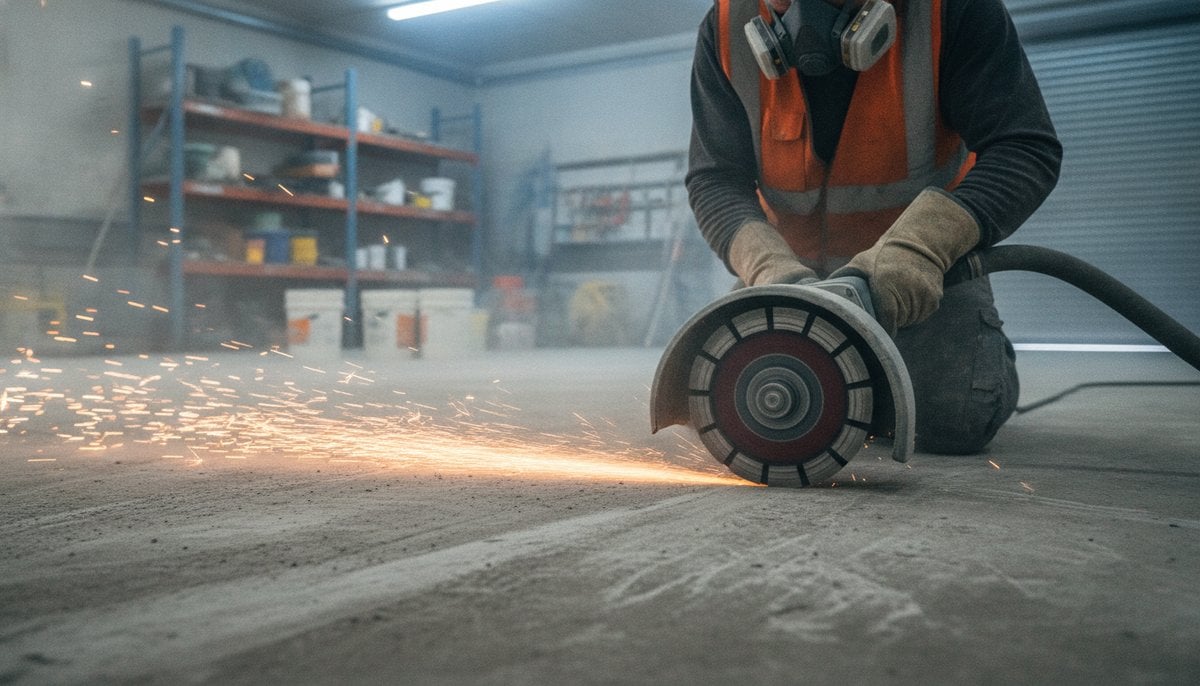
The short answer is yes , if you want the epoxy to last. Grinding concrete before epoxy flooring is not a premium add-on or an optional extra. It’s the single most important step in the whole installation process. This post explains why, what happens when it’s skipped, and how to tell whether your installer is doing it properly.
Key takeaways
- Diamond grinding creates the mechanical bond between epoxy and concrete. Without it, most floors fail within 1–3 years.
- Acid etching is not an equivalent substitute for grinding on Melbourne residential slabs.
- Grinding removes oil contamination, old coatings, and the weak surface layer of concrete.
- A properly ground floor feels like 40–60 grit sandpaper , slightly rough but uniform.
- Any installer who skips grinding or substitutes acid etching is cutting a corner that will cost you later.
Why epoxy needs a prepared concrete surface
Epoxy doesn’t work like paint. Paint air-dries on whatever surface you apply it to. Epoxy undergoes a chemical reaction that produces a cross-linked polymer , and for that polymer to adhere permanently, it needs to grip into the pores of the concrete at a mechanical level.
New, untouched concrete usually has a smooth trowelled surface. The pores are partially closed. Concrete that’s been sealed or coated has the pores blocked entirely. Oil-contaminated concrete has a layer of hydrocarbons that physically prevents bonding. In all these cases, epoxy applied without preparation will delaminate , sometimes within weeks, almost always within 2 years.
Grinding solves all of these problems at once. It opens the pores, removes contamination, strips old coatings, and creates a uniform rough profile (called CSP , Concrete Surface Profile) that gives the epoxy something to grip.
What is diamond grinding?
Diamond grinding uses a machine fitted with diamond-tipped segments to shave the top 1–2mm off the concrete surface. The diamonds are embedded in metal bonds and rotate at high speed across the floor, producing a consistent, controlled profile. Professional installers use walk-behind grinders for open floor areas and angle grinders with diamond cups for edges and corners.
The process generates a significant amount of concrete dust, which is why professional equipment includes dust shrouds connected to industrial vacuums. A correctly set up grinding job produces very little visible dust , most is captured at the point of generation.
What profile should the concrete be ground to?
The target for most residential epoxy systems is CSP 2–3 on the International Concrete Repair Institute scale. CSP 2 looks and feels like fine sandpaper. CSP 3 is slightly rougher. Either profile provides enough mechanical key for standard epoxy flake or metallic epoxy systems.
Grinding too aggressively (CSP 4–5) creates too much surface profile and can cause pinholes in thinner coating systems. Grinding too lightly (CSP 1) doesn’t open the pores adequately. A skilled installer knows the right machine settings and diamond grit for your specific slab.
Can you use acid etching instead of grinding?
Acid etching (applying diluted hydrochloric or muriatic acid to the concrete) is sometimes offered as a cheaper preparation alternative. It does open concrete pores to some degree on new, clean, uncoated slabs. But it fails in the most common Melbourne garage scenarios:
| Slab condition | Diamond grinding | Acid etching |
|---|---|---|
| New, clean, porous concrete | Works well | Adequate |
| Trowelled hard finish | Works well | Inadequate |
| Oil or grease contamination | Works well | Does not remove oil |
| Previous paint or sealer | Removes it | Cannot remove it |
| Old failed epoxy | Removes it | Cannot remove it |
| Aged or hardened concrete | Works well | Inadequate bond profile |
Melbourne garages are typically older slabs with some combination of oil staining, a previous coating, and a trowelled finish. Acid etching is not appropriate for most of them. If an installer quotes you a price that seems unusually low and mentions acid etching rather than grinding, that’s why , and it’s a risk to the floor’s longevity.
What happens if grinding is skipped?
The failure pattern is consistent: the floor looks excellent for 6–18 months. Then delamination starts, usually at the edges first or around the entry point where foot traffic concentrates. Chips or bubbles appear. Within 2–3 years the floor needs to be stripped and redone , at full cost again, plus the cost of grinding out whatever is left of the failed coating.
The grinding that should have been done the first time now has to be done anyway, plus remediation of the failed epoxy. Skipping preparation is never actually cheaper in the long run.
How to check if your installer is grinding properly
You don’t need to be on-site during grinding to verify it was done. After prep and before the epoxy goes down, look at the concrete surface:
- It should look uniformly lighter in colour than the original slab , grinding removes the surface skin and exposes fresh concrete aggregate
- It should feel like rough sandpaper, not smooth
- Any oil stains should be reduced or gone
- Old paint should be removed, not just scuffed
If the floor still looks shiny, smooth, or has visible oil patches, preparation was not adequate. Raise this with the installer before the epoxy goes down , not after.
FAQ: concrete grinding before epoxy Melbourne
Does every garage floor need to be ground before epoxy?
Yes, for any professional system designed to last 10+ years. The only exception might be brand-new, perfectly clean, highly porous concrete , but even then, grinding produces a better result than etching alone.
How much does concrete grinding add to the cost?
Grinding is typically included in a professional epoxy quote rather than being a separate line item. If you see a quote that itemises grinding at $15–$25/m², that’s normal and expected. A quote with no mention of preparation at all is missing a critical component.
Can I rent a grinder and do it myself?
Hire centres do rent concrete grinders. However, achieving a consistent CSP 2–3 profile without experience is difficult, and inadequate grinding still leads to adhesion failure. Preparing the floor incorrectly yourself doesn’t reduce the risk , it just means the failure is on your account rather than the installer’s. For a floor you’re investing $3,000–$5,000 in, professional preparation is worth it.
How long after grinding before epoxy can be applied?
Usually the same day or the next morning. The ground surface should be clean, dry, and free of dust. Some installers prime the same day as grinding; others wait until the following morning to ensure any residual moisture from the vacuum process has dissipated.
Talk to a Melbourne installer who grinds every floor
Metal and Flake diamond grind every garage floor before installation as standard , not as an upgrade. If you want a floor that lasts 10–20 years rather than 2–3, start with the right preparation. Book a free on-site quote across Melbourne and see exactly what’s included before you commit.
Ready for a Floor That Lasts?
Get a free, no-obligation quote from Melbourne’s trusted epoxy specialists.