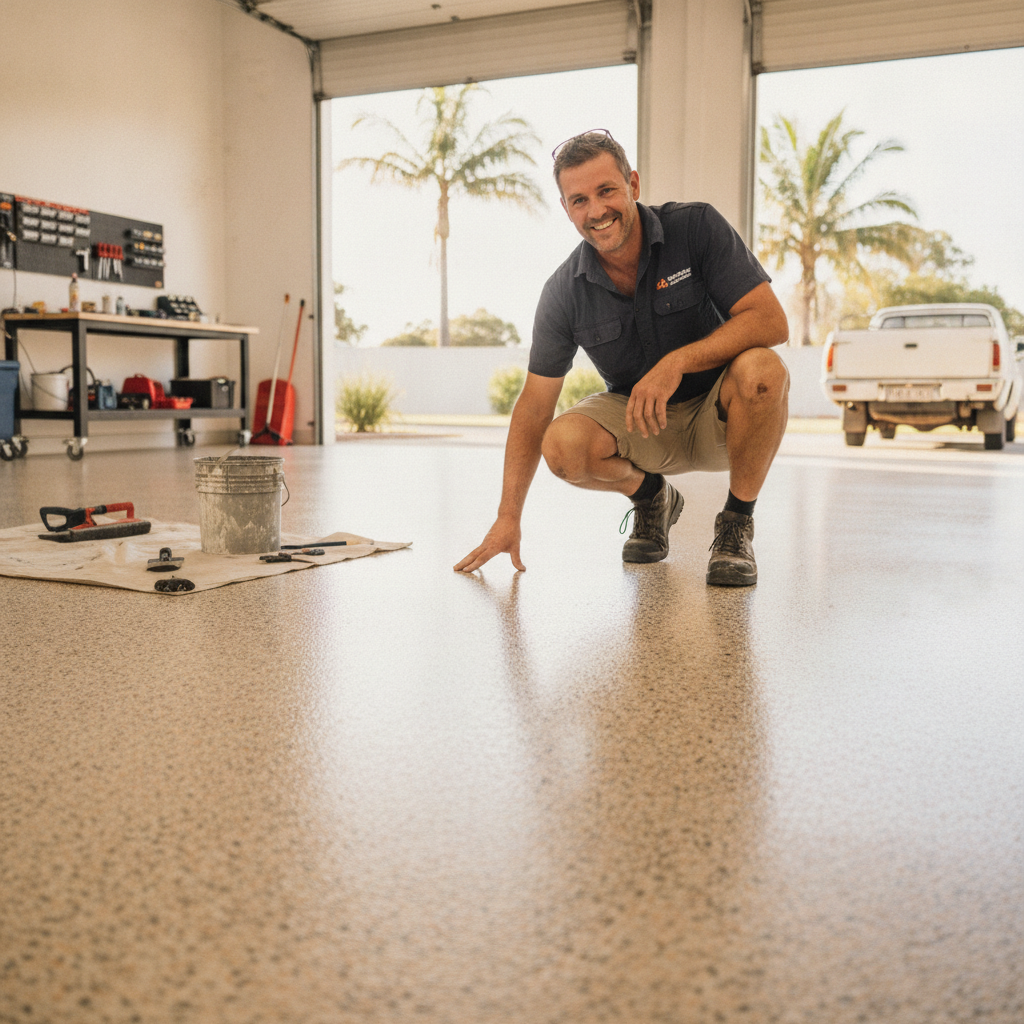
Garage Floor Coating in Sunbury: Your Best Options Explained

Garage Floor Coating in Sunbury: Your Best Options Explained

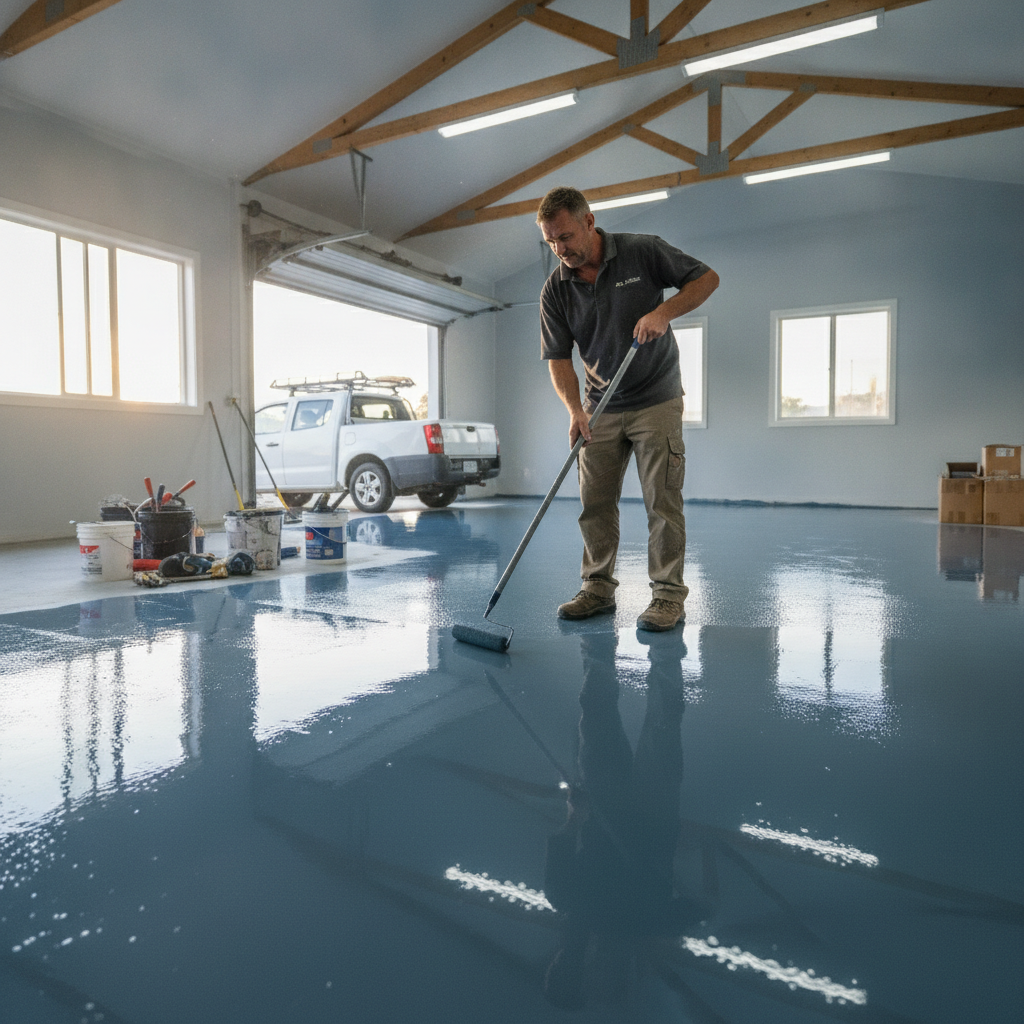
Garage floor coating in Sunbury typically comes down to three main systems: solid epoxy, decorative flake (also called chip or broadcast), and metallic epoxy. Each one suits a different combination of budget, foot traffic, moisture exposure and the look you want to wake up to every morning when you open the garage door.

Why does garage floor coating matter so much in Sunbury?

Sunbury sits on the north-western fringe of Melbourne, where summer heat pushes concrete to expand and cool winters pull it back again. Bare concrete that is cycled through that stress year after year absorbs oil, salt and moisture, eventually cracking and spalling. A quality garage floor coating seals the slab, stops that cycle of damage and turns what is usually dead space into one of the best-looking parts of the home.

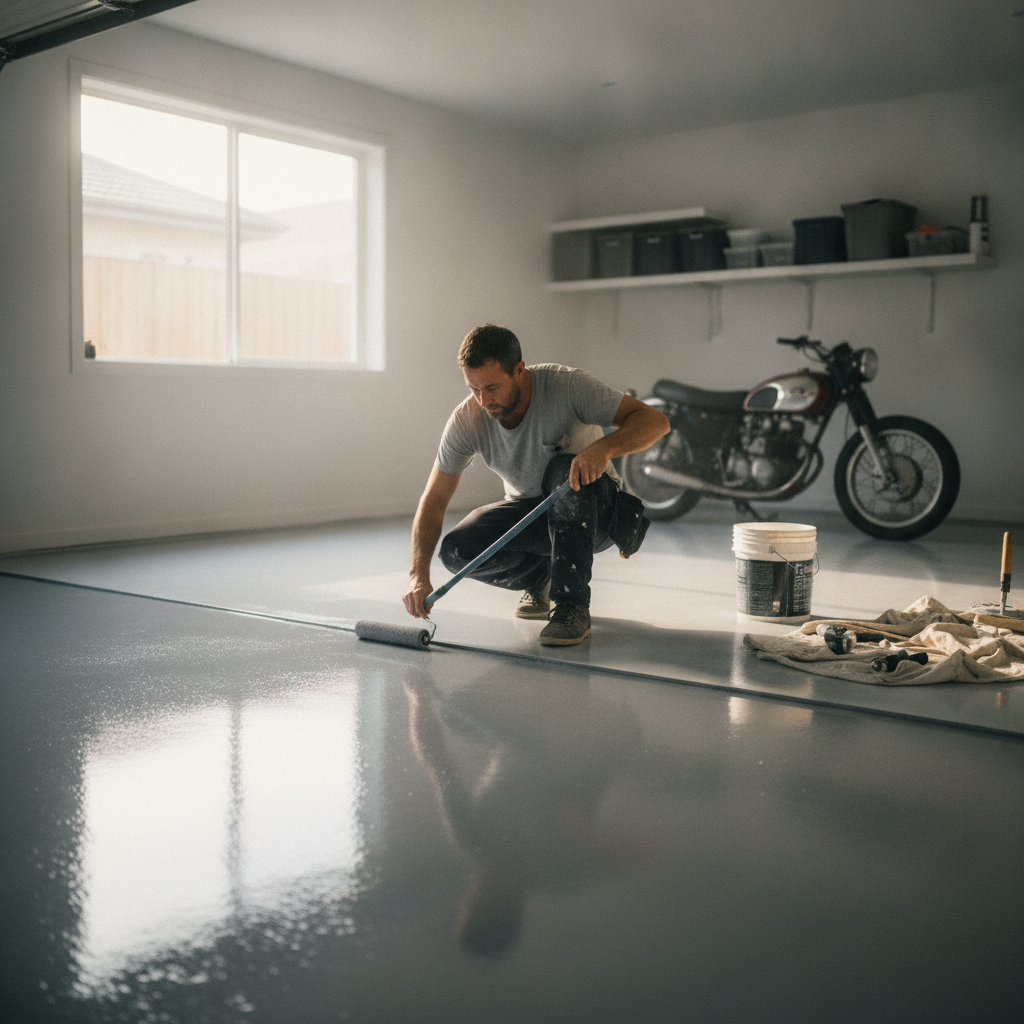
Beyond protection, there is a real lifestyle argument for coating your garage floor. Sunbury families increasingly use the garage as a workshop, a home gym or an overflow living space. A coated floor is far easier to sweep and mop than raw concrete, resists tyre marks and is noticeably brighter because it reflects light rather than absorbing it. That single change can make a double garage feel like a genuinely usable room rather than a storage dump.

What are the main types of garage floor coating available in Sunbury?

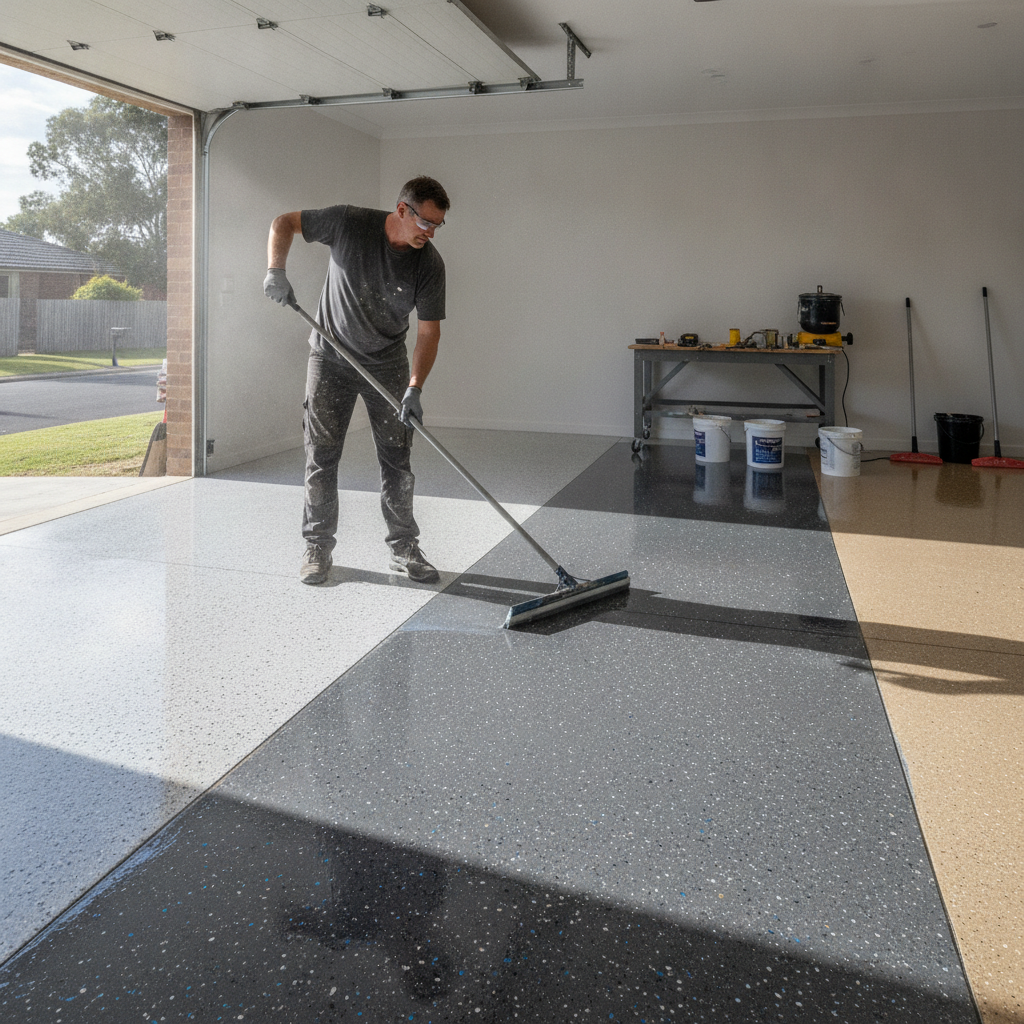
The three most common garage floor coating systems are solid-colour epoxy for a clean, commercial look; decorative flake systems that broadcast coloured vinyl chips into the basecoat for texture and depth; and metallic epoxy, which uses pigment and a translucent topcoat to create flowing, three-dimensional patterns. Each system varies in cost, slip resistance and visual effect.

Here is how each one breaks down in practice:

Solid-colour epoxy is the entry-level professional option. It is a two-part resin and hardener system that bonds chemically to the concrete rather than simply sitting on top of it. Once cured, a solid epoxy floor is hard-wearing and resistant to petrol, brake fluid and most household chemicals. The finish is smooth and glossy, which makes it easy to clean but can be slippery when wet if no anti-slip additive is broadcast into the surface.

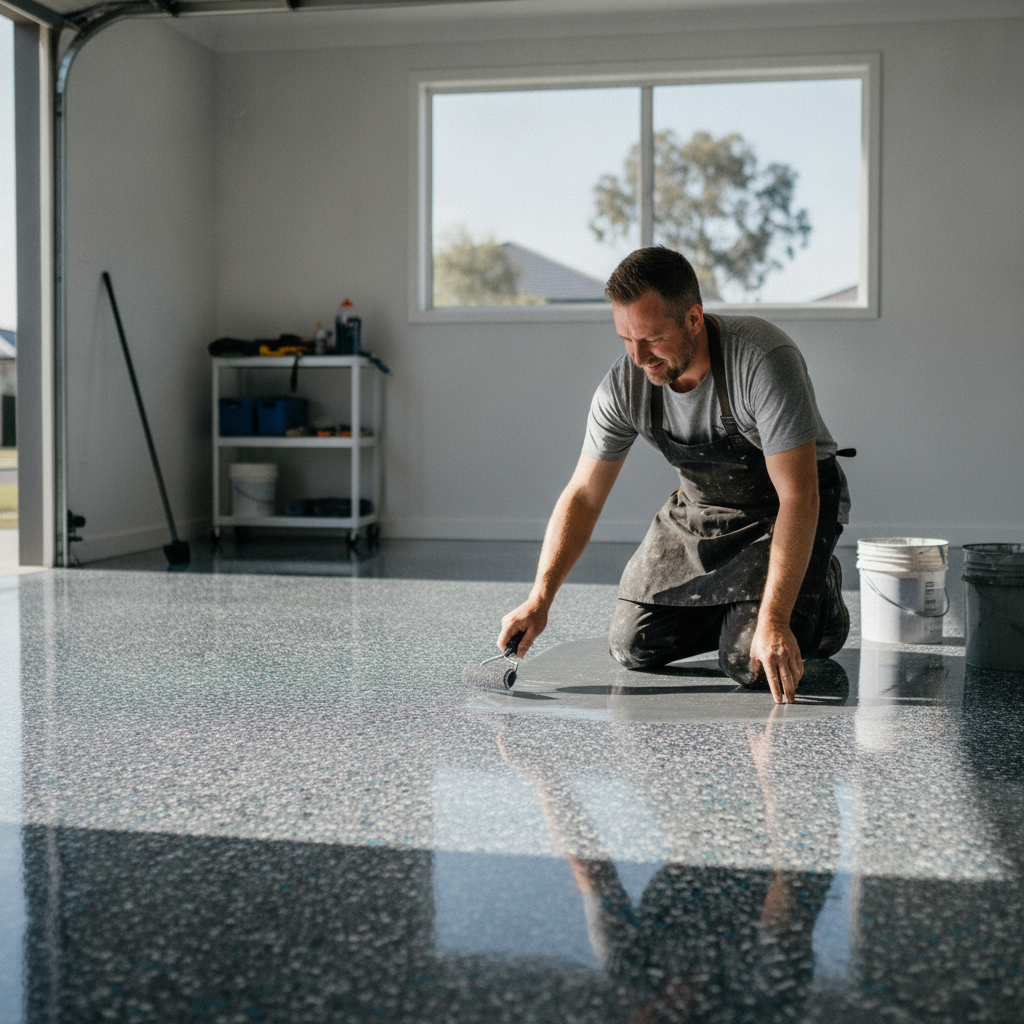
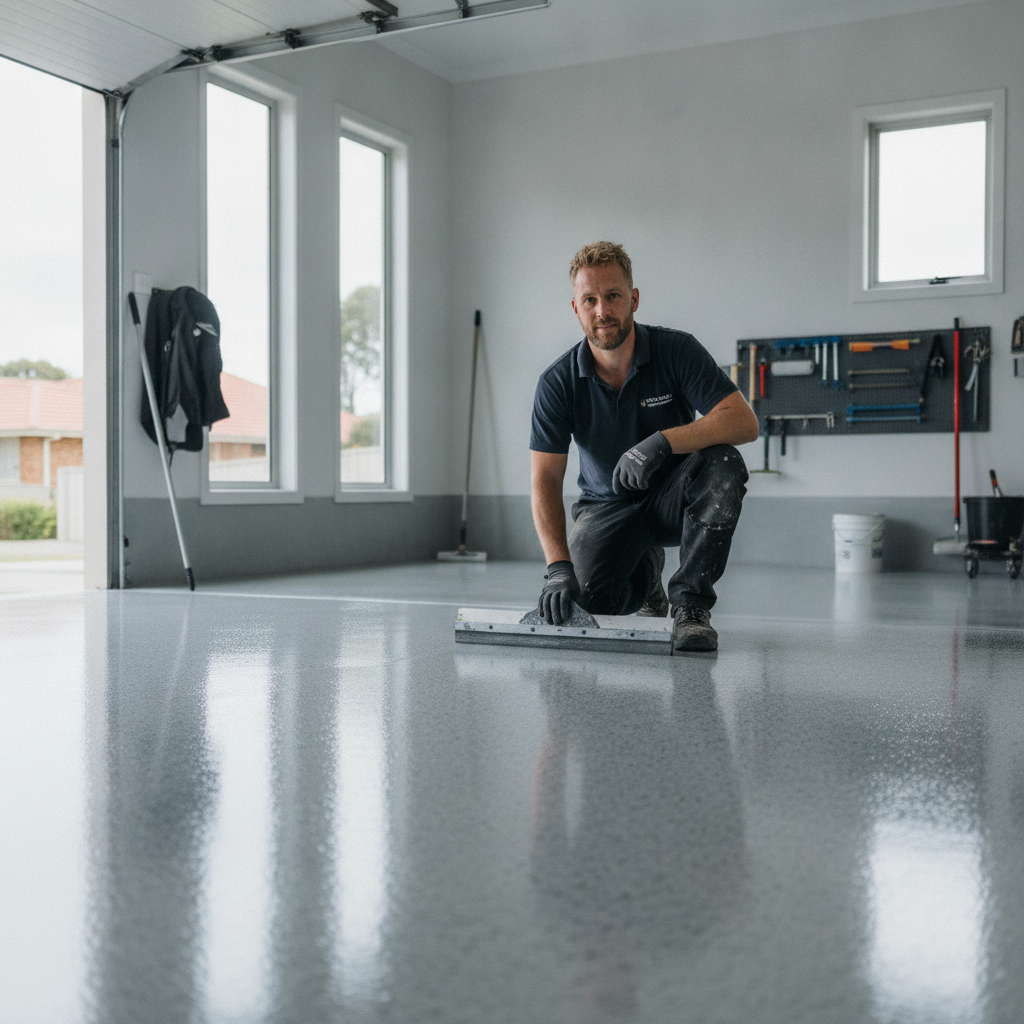
Decorative flake systems are the most popular choice for residential garages right now, and it is easy to see why. Coloured vinyl flakes are broadcast into the wet basecoat, then locked in with a clear polyaspartic or polyurethane topcoat. The result is a floor with visible texture, which adds natural slip resistance, and a finish that hides the occasional scuff or dropped tool far better than a solid colour. Flake blends range from subtle neutrals to bold contrasting chips, so there is a palette to suit every home aesthetic.

Metallic epoxy is the premium end of the residential market. Metallic pigments suspended in a clear or lightly tinted epoxy base create swirling, pearlescent effects that look more like decorative stone or water than a painted floor. No two metallic floors are identical, which is part of the appeal. This system requires more skill to apply because the pigment movement has to be guided by the installer, and it is typically finished with a high-build topcoat for durability.

How do you choose the right garage floor coating for your Sunbury home?

The right garage floor coating for your Sunbury home depends on three factors: how the space is used, how much natural or artificial light the garage receives, and your long-term maintenance expectations. High-traffic workshops suit flake systems for their texture and durability; showpiece garages or gym conversions suit metallic finishes for their visual impact; and solid epoxy works well in clean, low-traffic spaces.

Start by thinking honestly about how the garage is used. If there are kids’ bikes, a ride-on mower and weekend mechanical work happening on that slab, a flake system is almost certainly the smartest call. The textured surface hides imperfections, the topcoat handles chemical spills, and the floor cleans up with a quick mop. Installers commonly recommend a minimum of 300 microns of total coating thickness for a working garage, with the clear topcoat making up at least a third of that.

If the garage is a conversion, a showroom for a car collection, or simply a space where you want to make a strong first impression, metallic epoxy is worth the additional investment. The depth of the finish photographs beautifully and holds its lustre for years when a quality polyurethane or polyaspartic topcoat is applied over it.

Lighting matters more than most homeowners realise. A garage with minimal natural light will look dramatically different under a gloss finish compared to a matte one. Gloss amplifies whatever light exists, making the space feel larger and brighter. If your Sunbury garage faces south or has a single small window, a higher-gloss topcoat can genuinely change the feel of the room.

What should you expect during a professional garage floor coating installation?

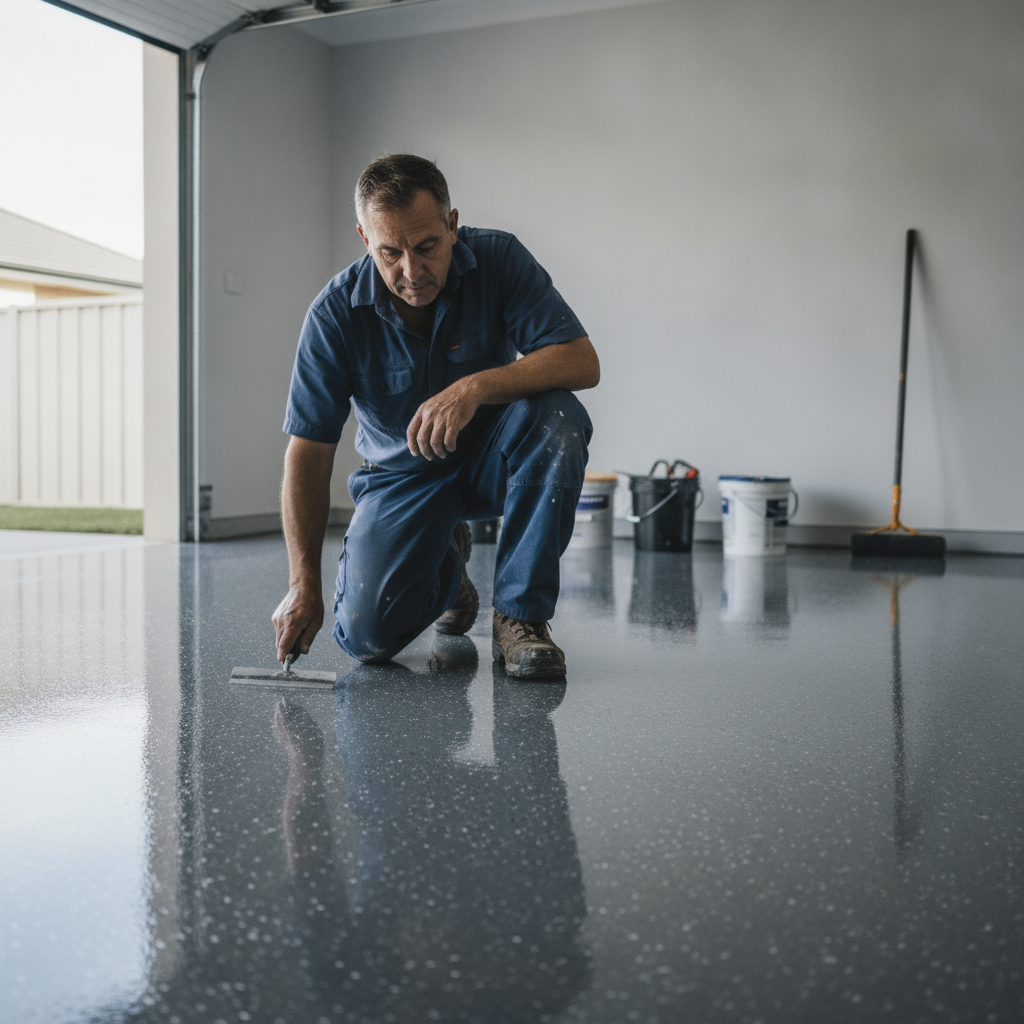
A professional garage floor coating installation typically takes one to two days from surface preparation to final topcoat, with a further 24 to 72 hours of cure time before you can drive on the floor. The longest and most critical stage is concrete preparation: grinding or shot-blasting the slab opens the surface profile so the epoxy bonds mechanically as well as chemically.

Skipping or rushing surface preparation is the single most common reason garage floor coatings fail prematurely. Peeling, bubbling and delamination are almost always a preparation problem rather than a product problem. A reputable installer will grind the entire slab, repair any cracks or divots with a suitable filler, and check the moisture content of the concrete before a single drop of coating is applied. Concrete with a moisture vapour emission rate above a certain threshold needs a moisture-tolerant primer or the coating will eventually lift.

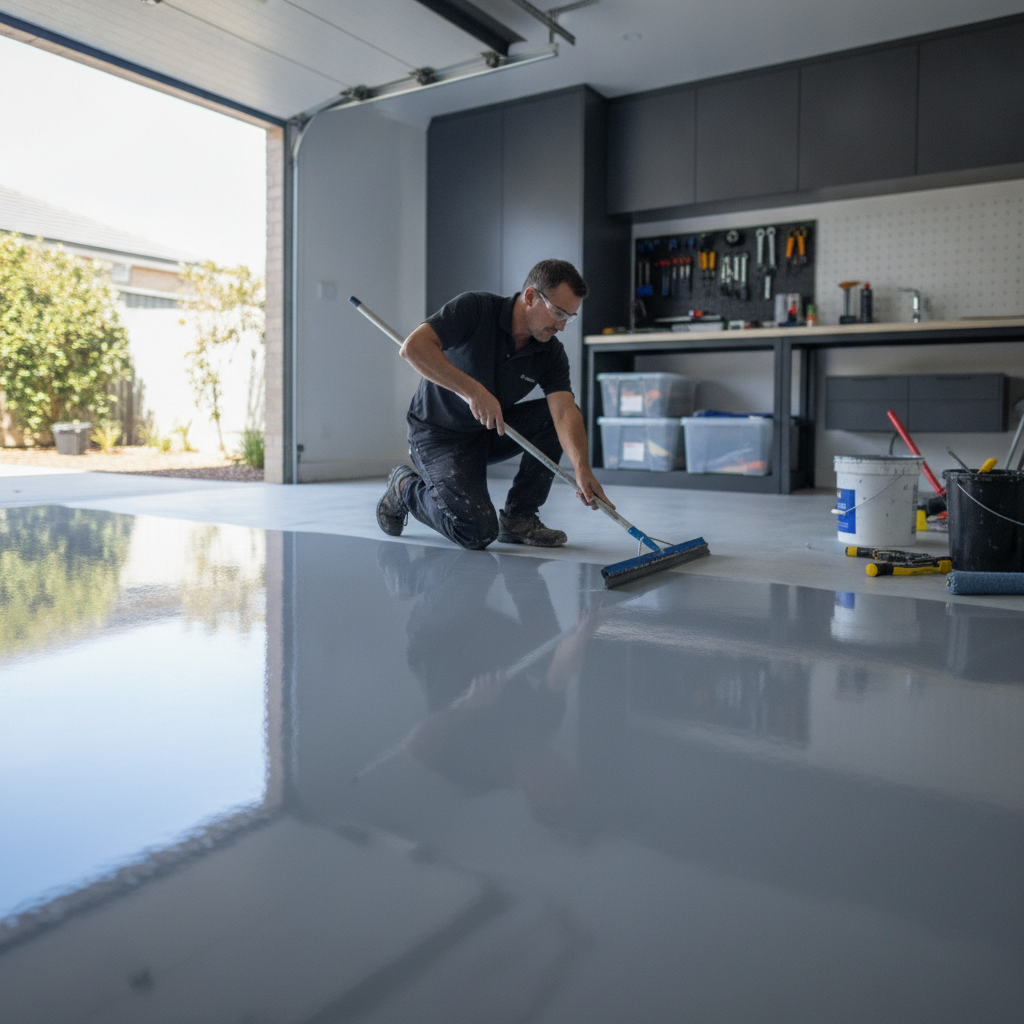
Once the slab is prepared, the basecoat goes down, the decorative element (flake, metallic pigment or solid colour) is applied, and then one or two topcoats seal everything in. The whole system needs time to reach full chemical cure, which is why most installers recommend keeping cars off the floor for at least 48 hours, even when the surface feels hard to the touch after 24.

How long does a garage floor coating last in Sunbury conditions?

A professionally installed garage floor coating in Sunbury can last 10 to 20 years with basic maintenance, assuming the concrete was properly prepared, a quality coating system was used, and the floor is not subjected to prolonged standing water or heavy point loads like motorbike stands without pads. Polyaspartic topcoats are particularly resistant to UV yellowing, which matters in a west-facing Sunbury garage that catches the afternoon sun.

Maintenance is genuinely straightforward. A weekly sweep and a monthly mop with a pH-neutral cleaner is all most coated garage floors need. Avoid dragging sharp or heavily abrasive objects across the surface, and clean up petrol and oil spills promptly rather than letting them sit. With that level of care, a well-installed flake or metallic system will still look sharp a decade after it went down.

One practical note worth keeping in mind: the concrete under a coated floor continues to move slightly with temperature changes. Expansion joints should never be filled with rigid epoxy. A professional installer will bridge them with a flexible sealant and, if anything, highlight them as part of the design rather than try to disguise them.

Sunbury homeowners who are serious about their garage space deserve a floor that performs as well as it looks. The coating system you choose sets the tone for everything else in the room, and getting it right from the start saves the cost and disruption of doing it twice.

Book Metal and Flake for garage floor coating in Sunbury
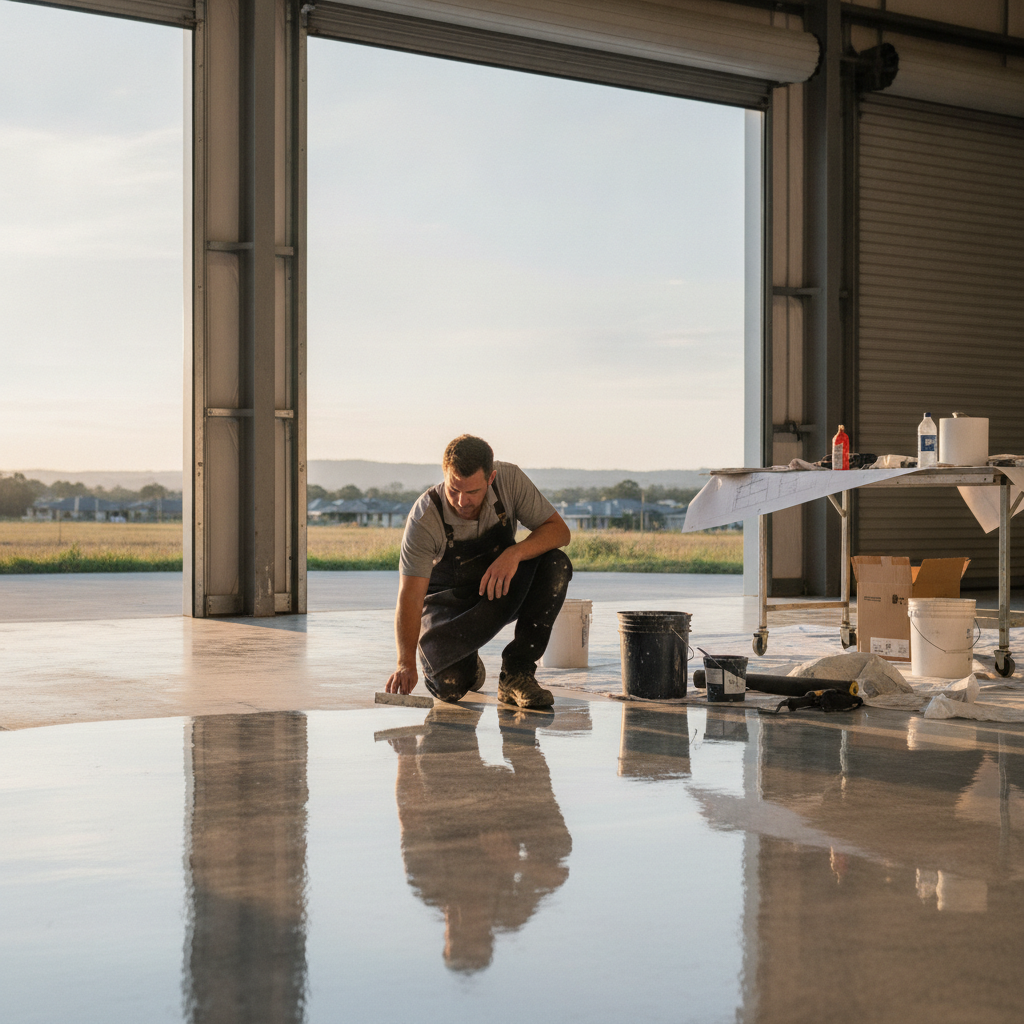
Epoxy Floor Cost in Sunbury: What to Budget in 2026

Epoxy Floor Cost in Sunbury: What to Budget in 2026

Epoxy floor cost in Sunbury typically ranges from $50 to $150 per square metre, depending on the system chosen, the condition of the existing concrete, and the size of the space. A standard garage runs between $1,500 and $4,500, while larger commercial or decorative metallic finishes sit toward the higher end of that scale. Getting a site-specific quote is the only way to pin down your exact number.

What factors affect epoxy floor cost in Sunbury the most?

The biggest drivers of epoxy floor cost in Sunbury are the condition of your concrete slab, the type of epoxy system you choose, and the total area being coated. A slab with cracks, oil staining, or moisture issues will need extra preparation work before any product goes down, and that preparation is labour-intensive. The finish itself, whether a solid colour, a flake broadcast system, or a full metallic pour, also carries a very different price tag because the materials and application time differ substantially.

Here is a practical breakdown of the main cost variables:

  • Concrete preparation: Diamond grinding and shot-blasting open the concrete profile so epoxy bonds properly. Skipping this step is a false economy. Expect preparation to account for 30 to 40 percent of the total job cost on most residential floors.
  • Coating system: A single-colour, two-coat epoxy is the most affordable option. Decorative flake systems add texture and hide imperfections. Metallic epoxy, with its swirling three-dimensional appearance, requires skilled application and premium pigments, placing it at the top of the price range.
  • Number of coats and topcoat type: A polyurethane or polyaspartic topcoat adds cost but significantly extends the floor’s service life, which is worth accounting for in any honest budget.
  • Access and site conditions: Tight garage entries, multiple vehicles to relocate, or a workshop full of equipment all add time and therefore cost.

How much does a garage epoxy floor cost in Sunbury?

A standard single-car garage in Sunbury, around 18 to 22 square metres, typically costs between $1,500 and $2,800 for a quality flake or solid-colour epoxy system including surface preparation. A double garage of 36 to 44 square metres generally lands between $2,800 and $4,500, again depending on the system and slab condition. These figures assume a sound concrete slab with no major remediation required.

It is worth knowing that the price-per-square-metre often drops as the area increases. A small job carries a minimum call-out component that spreads across fewer square metres, so larger floors tend to be better value on a rate basis. If you have a garage, a workshop and a laundry all needing floors, bundling them into one visit almost always saves money compared to booking them separately.

One concrete detail to keep in mind: most professional installers apply a diamond grinder at 25 to 40 microns of surface profile (commonly called a CSP 2 to CSP 3 finish) to ensure the epoxy achieves its full adhesion strength. If a quote skips this step entirely and comes in suspiciously cheap, the floor is likely to peel within a year or two.

What is the cost difference between epoxy systems, and which suits Sunbury homes?

Solid-colour epoxy is the most budget-friendly system at roughly $50 to $70 per square metre installed. Decorative flake systems, the most popular choice for garages and alfresco areas, sit in the $70 to $100 per square metre range because they use multiple product layers and a broadcast flake blend. Metallic epoxy finishes, which produce a high-gloss, almost liquid appearance, typically cost $110 to $150 per square metre given the material cost and the skill required to manipulate the pigment while it cures.

For Sunbury homeowners, flake systems are particularly well suited to the climate. The UV-stable polyaspartic topcoats used over flake floors handle Melbourne’s temperature swings well, and the texture provided by the flakes adds slip resistance, which matters for driveways and outdoor-adjacent spaces. Metallic finishes tend to be chosen for interior showrooms, home gyms, and living spaces where the visual impact is the priority.

Are there hidden costs to watch out for when budgeting for epoxy flooring?

Yes, a few cost items catch homeowners off guard when they receive their first epoxy floor quote. Being aware of them upfront means no surprises on invoice day.

Crack and joint repairs are the most common add-on. Small shrinkage cracks can be filled with epoxy mortar as part of prep, but structural movement cracks may need a flexible polyurethane filler, and that material costs more. If your slab has been previously sealed or painted, the existing coating must be stripped before the new system goes down, which adds labour hours.

Moisture testing is another item that responsible installers will carry out before quoting on the work. Sunbury sits on the fringe of Melbourne’s north-west, where older slabs on ground can carry residual moisture. If a moisture vapour emission rate test returns a result above 3 pounds per 1,000 square feet per 24 hours (a widely accepted industry threshold), a moisture-mitigation primer is required. That primer adds to the cost but protects the entire investment.

Finally, moving heavy shelving, gym equipment, or stored goods is usually the homeowner’s responsibility. Clearing the space before the crew arrives avoids hourly delays that can affect the final price.

How does Metal and Flake approach epoxy floor pricing in Sunbury?

Metal and Flake is a Melbourne-based epoxy flooring specialist serving Sunbury and the surrounding north-west corridor. Every quote starts with a proper assessment of the slab, not a guessed rate over the phone. That means the number you receive reflects the actual work involved: the preparation required, the system that suits the space, and the topcoat that will keep that floor looking sharp for years to come.

The team works across residential garages, commercial warehouses, showrooms, and everything in between. Whether you are after a clean metallic finish for a home gym or a tough flake floor for a tradie’s workshop, the focus is always on getting the preparation right and applying a system that earns its cost over time.

There is no single right answer to what your floor will cost until someone looks at it properly. Prices in the $50 to $150 per square metre range are a reasonable planning guide, but the only number that actually matters is the one written on your quote after a real inspection.

Get a free quote from Metal and Flake for epoxy floor installation in Sunbury.

Epoxy Garage Floors in Hoppers Crossing: Local Installer Guide

Epoxy Garage Floors in Hoppers Crossing: Local Installer Guide

An epoxy garage floor in Hoppers Crossing transforms a dull concrete slab into a durable, easy-clean surface that handles daily vehicle traffic, oil spills and Melbourne’s humidity swings without fading or peeling. Professionally installed systems typically bond at a thickness of 3 to 5 mm, resist abrasion far better than bare concrete, and last well over a decade with minimal upkeep.

Why is Hoppers Crossing a great fit for epoxy garage flooring?

Hoppers Crossing sits in Melbourne’s outer west, where suburban homes are built on large blocks with double and triple garages that see real daily use. The local climate, with warm summers and cool, wet winters, causes concrete slabs to expand and contract. A properly prepared and primed epoxy system accommodates that movement, forming a seamless surface that won’t let moisture wick through and lift the coating the way cheaper DIY kits often do.

Homes in the area also tend to have generous garage footprints, which means there is plenty of room to showcase a premium finish. A flake or metallic epoxy coating does not just protect the slab; it genuinely elevates the look of the whole space, making it feel less like storage and more like a functional extension of the home. That matters when you are maintaining or increasing property value in a suburb where presentation counts.

What does the epoxy garage floor installation process actually involve?

The installation process for an epoxy garage floor starts with surface preparation and finishes with a clear topcoat, typically spanning two to three days from start to full cure. Each stage is non-negotiable: skipping or rushing any one of them is the primary reason coatings delaminate within the first year.

Here is what a professional residential installation looks like step by step.

Diamond grinding the concrete. Before any product touches the slab, the surface is mechanically ground using industrial diamond tooling. This opens the pores of the concrete, removes any existing sealer or paint, and creates the profile the epoxy needs to bond correctly. Hand-rolled acid etching, which is the shortcut used in many retail kits, simply cannot achieve the same adhesion surface.

Crack and joint repair. Existing cracks are filled with a flexible polyurea or epoxy filler and allowed to cure. Control joints are either filled or left as stress-relief lines depending on how the slab was poured and how much movement is expected.

Primer coat. A penetrating epoxy primer is rolled out to seal the concrete and prevent air bubbles (also called outgassing) from forming in the base coat. Outgassing is a common culprit in failed DIY jobs, particularly in warmer months.

Base coat and decorative layer. The coloured epoxy base coat goes down next. If a flake finish is chosen, vinyl flakes are broadcast into the wet coat until full saturation is reached, then excess flake is swept back and reclaimed. For a metallic finish, pigmented metallic powders are worked into the base coat with rollers and squeegees to create the flowing, three-dimensional effect that has become a signature of high-end residential garages.

Grout coat and topcoat. On flake systems, a grout coat locks the chips in place before the final clear topcoat is applied. The topcoat, usually a polyaspartic or urethane product, adds UV stability, chemical resistance and the sheen level of your choice, from satin through to high gloss.

How do metallic and flake finishes compare for a residential garage?

Metallic and flake epoxy coatings both outperform plain grey epoxy on durability, but they suit different tastes and spaces. Flake systems hide dirt and minor scuffs more readily day to day, while metallic systems deliver a one-of-a-kind visual depth that makes a garage feel more like a showroom. The right choice depends on how the space is used and how you want it to look.

Flake, sometimes called chip or broadcast systems, is the more forgiving finish. The multi-tonal pattern of the chips breaks up any unevenness in the slab visually, and the texture from the chips adds a slight grip underfoot, which is useful in a working garage where wet boots and tyres are common. Popular colour combinations for Hoppers Crossing homes include charcoal and white blends that complement the grey render exteriors that are common in the area.

Metallic epoxy creates a seamless, glassy surface with swirling tones that are genuinely unique to each pour. No two floors look exactly alike because the metallic pigments move and settle differently every time. This finish suits garages that double as workshop showrooms, home gyms or entertainment spaces where the floor is part of the overall design statement. It is also a popular choice for homeowners who have invested in quality cabinetry and LED lighting and want the floor to match that level of finish.

Both systems are available with anti-slip additives mixed into the topcoat, a worthwhile upgrade for any residential garage in a climate that delivers wet winters.

What should Hoppers Crossing homeowners budget for an epoxy garage floor?

For a professionally installed residential epoxy garage floor in Melbourne’s west, most homeowners budget between $40 and $80 per square metre depending on the system chosen, the condition of the existing slab and the complexity of the finish. A standard double garage of around 36 square metres typically falls in the $1,500 to $2,800 range for a quality flake system, with metallic finishes sitting toward the upper end of that scale.

That figure is meaningfully higher than a hardware-store DIY kit, which typically runs $300 to $500 for the same area. But the comparison is not straightforward. DIY kits use water-based products applied over unground concrete. Professional systems use 100-percent-solids epoxy applied over mechanically ground concrete. The adhesion, thickness and longevity are entirely different products. A professional coating installed correctly should not need replacement for 10 to 15 years. A DIY kit applied without proper surface prep commonly fails, bubbles or peels within two to three years, particularly in garages that see hot tyre traffic.

When you factor in the cost of stripping a failed coating and re-doing the job properly, the professional option is consistently the more economical choice over a five-year horizon.

How long does it take to get back into the garage after installation?

Most professional epoxy garage floor installations in Hoppers Crossing are completed over two days, with foot traffic possible at the 24-hour mark and vehicle traffic safe at the 72-hour mark. Full chemical cure, where the coating reaches its maximum hardness and chemical resistance, takes approximately seven days, though normal residential use can resume well before that point.

Planning is straightforward: most homeowners empty the garage, park vehicles on the driveway for three days, and return to a fully transformed space by the weekend. The installer will give you specific walk-on and drive-on times based on the exact products used and the temperature forecast for the cure window, since cooler conditions extend cure times slightly and warmer conditions accelerate them.

If you are considering new garage cabinetry or shelving at the same time, it is always better to complete the floor coating first and install the cabinetry after, so every centimetre of the slab is coated and protected before anything is fixed to the wall.

Ready to get started? Book Metal and Flake for residential garage floor coating in Hoppers Crossing.

Epoxy Garage Floors in Essendon: Options for Every Home

Epoxy Garage Floors in Essendon: Options for Every Home

An epoxy garage floor in Essendon transforms a dull concrete slab into a hard-wearing, easy-clean surface that lifts the whole feel of your home. Depending on the finish you choose, a professionally applied coating resists oil, tyre marks and moisture while lasting well over a decade with minimal upkeep. This guide walks through every main option so you can make the right call for your space.

Why is epoxy such a popular garage floor coating in Essendon?

Epoxy bonds directly to concrete at a chemical level, creating a surface that is dramatically harder and more resistant to impact than bare concrete. For Essendon homeowners, that means a garage that holds up to daily parking, weekend projects and the occasional dragged toolbox without chipping, staining or absorbing spilled fuel. It is also far simpler to hose down than raw concrete.

Essendon’s housing stock is a real mix: Federation-era homes with older slabs, post-war brick veneer garages, and newer double-storey builds with polished double garages. That variety is exactly why no single off-the-shelf product suits everyone. The right system depends on the condition of the existing slab, how the space is used, and the finish you want to wake up to every morning.

Beyond looks, epoxy flooring adds genuine value. A clean, well-finished garage is increasingly something buyers notice at inspection. Whether you are renovating to stay or to sell, the investment tends to repay itself in both livability and perceived property quality.

What are the main epoxy garage floor options available to Essendon homeowners?

The four most common systems for residential garages are solid-colour epoxy, metallic epoxy, flake (broadcast) epoxy and polyaspartic topcoats. Each has a different look, texture and performance profile, so the best choice comes down to your priorities around aesthetics, slip resistance, cure time and budget. Most professional installers combine elements from more than one system.

Solid-colour epoxy is the clean, contemporary option. A single pigmented coat creates a smooth, uniform finish in any colour from warm grey to deep charcoal. It suits homeowners who want something tidy and minimal without a lot of visual texture. The trade-off is that swirl marks and fine scratches can show up on high-gloss versions over time, so a matte or satin topcoat is often the smarter call for a working garage.

Metallic epoxy uses pigment blends and a manipulation technique during application to produce a flowing, three-dimensional effect. No two floors look identical. The result can evoke polished stone, molten metal or ocean waves depending on the palette. This finish is increasingly popular in Essendon’s renovated Federation homes where owners want something that feels considered rather than industrial. Because metallic epoxy is applied in a single layer of variable thickness, surface preparation is critical: any crack or hollow will telegraph through the finished coat.

Flake epoxy, sometimes called chip or broadcast flooring, is the workhorse of the residential garage market. Coloured vinyl flakes are scattered across a wet epoxy base coat, then sealed with a clear topcoat. The flakes do two important things: they add grip underfoot, and they hide the scuffs and tyre marks that accumulate in a real working garage. Full-broadcast flake (where the base coat is completely covered) is particularly forgiving in daily use, which is why it accounts for a large share of garage floors installed across Melbourne’s northern suburbs.

Polyaspartic coatings are technically a separate chemistry from epoxy but are almost always discussed alongside it. They cure faster (a single-car garage can be done in one day and driven on within 24 hours), handle UV exposure better, and tend to resist yellowing. Many professionals apply a polyaspartic topcoat over an epoxy or flake base to get the best of both worlds: epoxy’s adhesion and build, polyaspartic’s clarity and durability at the surface.

How does surface preparation affect the result of an epoxy garage floor?

Surface preparation is the single biggest factor separating a floor that lasts fifteen years from one that peels within two. Before any coating goes down, the concrete must be profiled so the epoxy has a mechanical key to grip. Diamond grinding is the industry standard for residential garages, opening the concrete’s pores evenly across the full slab rather than just etching the surface with acid.

Cracks, control joints and surface defects need to be assessed and filled before coating begins. A hairline crack in raw concrete can become a visible fault line in a finished floor if it is simply coated over. Moisture is the other hidden risk: concrete that transmits ground moisture will eventually lift any coating applied on top of it, regardless of product quality. A moisture test before work starts is not optional; it is essential.

Older Essendon garages, particularly those attached to homes built before the 1980s, sometimes have contamination from decades of oil, fuel and cleaning chemicals. These need to be degreased and, in some cases, mechanically removed before any primer is applied. Skipping this step is the most common reason a DIY epoxy kit fails within months of application.

What should Essendon homeowners expect to spend on a garage floor coating?

Cost varies with floor size, the system chosen and the amount of preparation required. As a general guide, a standard double garage in Melbourne’s northern suburbs (roughly 35 to 45 square metres) with a full flake system professionally installed sits in a range that reflects both the materials and the labour-intensive preparation that good work demands. Metallic finishes typically cost more per square metre than flake because the application is more time-sensitive and less forgiving of error.

It is worth being cautious of very low quotes. A price that undercuts the market by a significant margin usually means one of three things: thinner product, skipped preparation steps, or a coating that will need to be replaced in three to five years rather than ten to fifteen. When comparing quotes, ask specifically what preparation method will be used, how many coats are being applied, and what the topcoat product is. Those three questions will tell you almost everything you need to know about the quality on offer.

A well-applied professional coating on a properly prepared slab is genuinely a long-term investment. The concrete underneath is protected from spills, abrasion and moisture ingress. The surface stays cleanable for years without special treatments. And the garage simply looks like part of a well-kept home rather than an afterthought bolted onto the back of it.

How long does an epoxy garage floor installation take in Essendon?

A standard residential garage installation typically takes one to two days on site, with a further curing period before the floor is ready for foot traffic and then vehicle traffic. Diamond grinding and preparation usually occupy the first part of the job, with coating applied in sequence once the slab is confirmed clean, dry and profiled. Flake systems with a polyaspartic topcoat can be walked on in as little as 12 to 16 hours and driven on within 24 hours. Traditional epoxy systems are generally more conservative, with full cure taking up to seven days for maximum chemical resistance.

Weather plays a role, particularly in Melbourne’s changeable climate. Temperature and humidity affect how epoxy flows, levels and cures, which is one reason professional installers pay close attention to conditions before and during application. A floor laid in ideal conditions will look and perform noticeably better than one rushed through in extremes of heat or cold.

Planning ahead matters. If you are renovating a garage to use as a home workshop, gym or extra living space (a trend that has accelerated significantly across Melbourne’s inner north), booking the floor coating early in the project timeline means it can cure fully before other trades come through and introduce traffic and dust.

Metal and Flake works across Essendon and Melbourne’s broader northern suburbs, applying the kind of considered, properly prepared coatings that hold up through years of real use. Whether you are after a clean solid colour, a show-stopping metallic finish or a practical full-broadcast flake system, the options are wider than most people realise until they sit down and talk it through.

Get a free quote from Metal and Flake for garage floor coating in Essendon.

Epoxy Garage Floors in Brunswick: Inner-North Melbourne Guide

Epoxy Garage Floors in Brunswick: Inner-North Melbourne Guide

An epoxy garage floor in Brunswick transforms a dull, dusty concrete slab into a sealed, hardwearing surface that handles daily traffic, oil spills and Melbourne’s seasonal moisture swings. A professionally installed system typically comprises a primer coat, a coloured base, a decorative layer (flake or metallic) and a clear topcoat, delivering a finish that can last a decade or more with minimal upkeep.

Why is epoxy such a popular choice for Brunswick garage floors?

Epoxy suits Brunswick garages because the suburb sits in Melbourne’s inner north, where older homes often have porous concrete slabs that absorb oil and moisture readily. A full epoxy system seals that porosity, prevents dusting, resists petrol and brake-fluid stains, and reflects light in spaces that can be naturally dim. The result is a floor that looks sharp and actually cleans up in minutes rather than hours.

Brunswick is a suburb of contrasts: Federation-era terraces share streets with converted warehouses and new-build townhouses. That mix means garages come in all shapes and ages. Some slabs date back fifty or sixty years and carry the cracks, oil stains and surface contamination that accumulate over decades. Others are relatively fresh pours in new developments. Either way, the inner-north climate adds a particular wrinkle. Brunswick averages around 650 mm of rainfall per year, and the temperature swings between cold, damp winters and hot, dry summers cause concrete to expand and contract noticeably. A quality epoxy system is formulated to flex with that movement rather than delaminate or crack.

Beyond performance, aesthetics matter in Brunswick. Homeowners here tend to care about how their spaces look and feel. A full-flake finish in charcoal and white, or a metallic swirl that catches the light, lifts a utilitarian garage into something worth showing off. That is exactly the kind of finish Metal and Flake specialises in across Melbourne’s inner north.

What does surface preparation actually involve for an epoxy garage floor in Brunswick?

Surface preparation for an epoxy garage floor involves mechanically profiling the concrete, typically through diamond grinding or shot blasting, to open the slab’s pores so the epoxy can bond at depth rather than just sitting on the surface. Any cracks, spalling or contamination must be addressed before a single drop of epoxy is applied, because the system is only as good as what it bonds to.

This is the step that separates a floor that lasts from one that peels within a year. Grinding removes the carbonated surface layer, laitance and any previous coatings or sealers. For older Brunswick slabs, this stage can also reveal hidden issues: hairline cracks from settlement, moisture vapour transmission from below, or patches of old oil that have penetrated deeply. Each of those problems has a specific solution, whether that is crack injection, a moisture-tolerant primer or targeted degreasing, and each needs to be handled before the epoxy goes down.

A professional installer will also test the moisture content of the slab with a moisture meter or calcium chloride test before priming. Concrete in Brunswick’s inner-north can hold more moisture than expected, particularly in older homes with limited sub-floor ventilation. Applying epoxy over a slab that is reading above the acceptable moisture threshold is the single most common cause of premature delamination. Getting this right at the start is not optional.

Which epoxy finish works best for a Brunswick garage?

For most Brunswick garages, a full-broadcast vinyl flake system over a solid epoxy base is the most practical and visually versatile choice. It provides a non-slip texture, hides minor imperfections in older slabs, and comes in dozens of colour blends to suit everything from a restored terrace to a contemporary townhouse. Metallic epoxy is a strong second option for homeowners who want a bold, one-of-a-kind look.

The flake system works by broadcasting vinyl flake chips across a wet epoxy base coat until the surface is fully covered, then scraping back the excess and sealing the whole floor with one or two coats of a clear polyurethane or polyaspartic topcoat. That topcoat is where UV stability and chemical resistance live. A polyaspartic topcoat cures faster than a standard polyurethane (often in as little as a few hours), which matters when you need the garage back in service quickly.

Metallic epoxy uses pigmented metallic powders suspended in a clear or lightly tinted epoxy base to create depth and movement in the floor. No two metallic floors look exactly the same, which appeals strongly to Brunswick homeowners who want something distinctly their own. The trade-off is that metallic finishes show scratches more readily than flake, so they are better suited to garages used for parking and light storage rather than heavy workshop use.

Colour choice is worth thinking through carefully. Light blends, such as silver and white flake mixes, make a garage feel significantly larger and brighter. Darker blends in charcoal, slate or graphite give a more dramatic, workshop-inspired feel. Either way, the clear topcoat should carry at least a satin sheen to make mopping effortless.

How long does an epoxy garage floor installation take in Brunswick?

A standard single-car garage in Brunswick typically takes one to two days to install: day one for grinding, crack repairs and priming, day two for the base coat, flake broadcast and topcoat. Larger double garages or those requiring extensive repairs may need an additional day. Most polyaspartic topcoats allow light foot traffic within four to six hours of application.

Planning around the weather is part of the job. Epoxy and polyaspartic products have temperature and humidity windows within which they cure correctly. Applying in very cold, damp conditions (common in Brunswick winters) or during an extreme heat event can affect pot life and final film build. A good installer schedules around those windows rather than pushing through regardless, because the curing conditions directly affect how the finished floor performs over its lifetime.

Once the floor is fully cured, generally 24 to 72 hours for full chemical cure depending on the product, vehicles can be driven back in and normal use can resume. Light shelving and storage can often go back sooner. The patience required at the end of installation is minor compared to years of a floor that stays bonded, sealed and clean.

What should Brunswick homeowners look for when choosing an epoxy installer?

Brunswick homeowners should prioritise installers who use professional-grade diamond grinding equipment, apply a genuine multi-coat system (primer, base, broadcast and topcoat rather than a single rolled product), and can show examples of completed work in similar inner-north settings. Transparent, itemised quotes and a clear surface preparation process are the strongest indicators of quality workmanship.

Be cautious of quotes that seem unusually low. Single-coat roll-on epoxy products sold at hardware stores and the professional systems used by specialist installers are not the same product. The hardware-store approach skips mechanical preparation and uses a thinner formulation that may look fine initially but tends to peel within two to three years, particularly on Brunswick slabs that see temperature and moisture variation. The cost of removing a failed coating and starting again almost always exceeds the original saving.

Ask any prospective installer about their preparation method (grinding versus acid etching), the specific products they use (commercial-grade two-part epoxy versus single-part), the number of coats in their system, and whether the topcoat is UV-stable. A UV-stable topcoat matters even in a garage, because doors are open regularly and sunlight exposure will yellow a non-UV-stable finish over time.

Local knowledge counts too. An installer who works regularly across Brunswick and Melbourne’s inner north understands the soil types, slab ages and building styles common to the area. That experience shapes how they approach preparation and product selection on each job.

Book Metal and Flake for epoxy garage floor installation in Brunswick.

Epoxy Garage Floors in Epping: Costs, Options and Local Tips

Epoxy Garage Floors in Epping: Costs, Options and Local Tips

An epoxy garage floor in Epping typically costs between $30 and $80 per square metre depending on the system chosen, the condition of the existing concrete and the finish selected. Most residential garages in the area fall between 30 and 60 square metres, putting total project costs anywhere from around $1,200 to well over $3,500 for a premium decorative system with metallic or flake finishes.

Why are so many Epping homeowners choosing epoxy for their garage floors?

Homeowners in Epping are choosing epoxy garage floors because the finish is dramatically more durable, more hygienic and more visually appealing than bare concrete. Epoxy seals the porous surface of concrete, resisting oil, tyre marks, chemical spills and moisture. It also reflects light back into the garage, making the space feel larger and brighter without any structural changes.

Epping sits in Melbourne’s northern growth corridor, and the suburb has seen a strong wave of house builds and renovations over the past decade. With double and triple garages becoming a standard feature in newer homes along streets off Cooper Street and the surrounding estates, floor presentation has become a genuine priority. A clean, coated floor signals a well-maintained home, which matters whether you are living in it long-term or thinking about resale value down the track.

Beyond aesthetics, the practical case for epoxy is compelling. Bare concrete absorbs oil drips and becomes increasingly difficult to clean over time. An epoxy coating creates a non-porous membrane that wipes clean with a mop. For households using the garage as a workshop, a home gym or extra living space, that difference is felt every single day.

What epoxy garage floor options are available in Epping?

The most common epoxy garage floor options available to Epping homeowners are solid colour epoxy, decorative flake broadcast systems and full metallic epoxy systems. Each varies in thickness, visual complexity and price point. Solid colour is the most straightforward and budget-friendly entry point, while metallic systems offer a high-gloss, one-of-a-kind marbled appearance that is increasingly popular in premium renovations.

Here is a quick breakdown of the three main directions:

  • Solid colour epoxy: A clean, single-tone finish in any custom colour. Hardwearing, easy to maintain and the most cost-effective option for homeowners who simply want to protect and seal their concrete.
  • Flake broadcast systems: Coloured vinyl flake chips are broadcast into a wet epoxy base coat and then sealed with a topcoat. The flake hides minor surface imperfections, adds texture for slip resistance and comes in a wide range of colour blends. This is one of the most popular choices for residential garages because it balances looks, practicality and price.
  • Metallic epoxy: A pigmented metallic system poured and worked to create flowing, three-dimensional visual effects. No two floors look identical. Metallic epoxy is a premium product, used in garages where the floor is as much a feature as the car sitting on it.

All three systems can be finished with a polyaspartic or polyurethane topcoat for additional UV stability and abrasion resistance, which matters in a space that sees regular foot traffic, rolling tyre loads and direct sunlight through the garage door.

How does the condition of Epping concrete affect epoxy coating costs?

The condition of the existing concrete slab directly affects both the preparation work required and the final cost of an epoxy garage floor in Epping. Slabs with significant cracking, spalling, moisture issues or previous sealers need more preparation time and potentially remedial products before the epoxy can be applied, adding to the overall project price.

Concrete preparation is the single most important step in any epoxy installation. A professionally applied coating that bonds to poorly prepared concrete will peel, bubble or delaminate within months. That is why reputable installers always grind the surface with diamond tooling rather than simply applying epoxy over the top of raw or sealed concrete. Diamond grinding opens the concrete’s pores and creates the mechanical profile the epoxy needs to form a lasting bond.

A few specific factors worth checking before requesting a quote for an Epping property:

  • Moisture in the slab: Homes built on the clay-heavy soils common in Epping’s northern suburbs can experience seasonal moisture movement. A moisture vapour test before coating is standard practice and saves significant cost if an issue is identified early.
  • Previous coatings or sealers: Paint or penetrating sealers applied by a previous owner must be removed in full before any new system goes down.
  • Cracks and surface defects: Hairline cracks can usually be ground through. Larger structural cracks may need to be filled with a flexible epoxy filler prior to coating.

A site inspection before quoting is not a formality. It is the only accurate way to scope the work and give a figure you can actually rely on.

How long does an epoxy garage floor last in Epping’s climate?

A professionally installed epoxy garage floor in Epping will typically last 10 to 20 years with basic maintenance, depending on the system used and how the floor is used day to day. Polyaspartic topcoats offer enhanced UV resistance and are a smart choice for garages with wide-opening doors that admit significant sunlight across the floor surface.

Melbourne’s climate is relatively forgiving for epoxy coatings compared to more extreme environments, but temperature swings between summer and winter do cause concrete slabs to expand and contract. This is another reason proper surface preparation matters. A well-bonded system moves with the slab rather than separating from it.

Maintenance is genuinely minimal. A soft mop with a pH-neutral cleaner is all most floors need on a regular basis. Avoid dragging sharp metal objects across the surface and clean up acidic spills (battery acid in particular) promptly. Follow those two simple rules and a quality epoxy floor will still look sharp well into its second decade.

What should Epping homeowners look for when choosing an epoxy flooring contractor?

Epping homeowners should look for an epoxy flooring contractor who performs diamond grinding as standard, offers a written warranty on both labour and materials, and can show a portfolio of completed residential garage projects with finishes similar to what you have in mind. Price is one consideration, but the quality of the preparation and the products used matter far more to the long-term result.

A few practical checkpoints worth working through before committing:

  • Ask specifically how the surface will be prepared and what equipment will be used. Diamond grinding with a commercial grinder is the industry benchmark.
  • Confirm the epoxy system being used, including the base coat, any broadcast material and the topcoat product. Reputable contractors are transparent about the brands and products they specify.
  • Check whether the quote includes moving any items stored in the garage, or whether that is the homeowner’s responsibility before the crew arrives.
  • Ask about cure and recoat windows. A standard epoxy system is typically walkable within 24 hours and ready for vehicle traffic within 72 hours, though some premium systems differ.

Word of mouth still carries real weight in tighter-knit northern suburbs like Epping. Asking a neighbour or searching for locally completed projects is a reasonable starting point, but seeing finished work in person gives you a far better sense of quality than any photograph.

Metal and Flake is a Melbourne epoxy flooring specialist serving Epping and the surrounding northern suburbs, delivering solid colour, flake broadcast and metallic epoxy systems for residential garages. Request a quote from Metal and Flake for epoxy garage floor coating in Epping.

Epoxy Garage Floors in Craigieburn: A Local Installer’s Guide

Epoxy Garage Floors in Craigieburn: A Local Installer’s Guide

An epoxy garage floor in Craigieburn transforms a plain concrete slab into a durable, dust-free surface that handles daily traffic, oil spills and Melbourne’s temperature swings without breaking a sweat. A professionally installed system typically lasts 10 to 20 years, adds instant visual polish to any home, and costs a fraction of tearing out and replacing concrete. Here is everything you need to know before you book.

Why are Craigieburn homeowners choosing epoxy garage floors right now?

Craigieburn’s rapid residential growth means thousands of homes built in the last decade are sitting on builder-grade concrete slabs. Those slabs are functional but porous, prone to staining and dusty underfoot. Epoxy seals the surface completely, making the garage genuinely usable as a workshop, gym or showroom-quality parking space. Local homeowners are also finding that a finished garage floor adds real perceived value when homes go to market in this competitive northern corridor.

There is another practical reason that comes up again and again on jobs in this part of Melbourne’s north: temperature. Craigieburn sits far enough from the bay that summer days regularly push past 38°C, and winter mornings can drop to single digits. Untreated concrete expands, contracts and eventually dusts. A quality epoxy system, properly applied with the right primer and broadcast aggregate, flexes with the slab rather than fighting it. That means fewer cracks in the coating and a surface that stays looking sharp season after season.

The aesthetic shift is significant too. Metallic and flake finishes have moved well beyond the utilitarian grey look most people associate with older epoxy systems. A full-flake broadcast, for example, creates a terrazzo-like surface that hides tyre marks and light scratches naturally. Metallic pigment swirled into a clear base coat produces a depth of colour that genuinely turns heads. These are finishes homeowners are proud to show off, not just practical surfaces to walk on.

What does epoxy garage floor preparation actually involve in Craigieburn?

Surface preparation is the single most important stage of any epoxy garage floor installation. On a Craigieburn slab, preparation means grinding the concrete with a diamond-head grinder to open the surface profile so the epoxy bonds at a mechanical level. Any cracks are chased out and filled, oil spots are treated with a penetrating degreaser, and the slab is checked for moisture before a single drop of product goes down.

This is where DIY kits from hardware stores tend to fail. A slab that looks clean to the naked eye can still hold enough residual moisture or surface laitance to prevent a proper bond. When that bond fails, the coating peels, usually within the first twelve months, and the job has to be stripped and redone from scratch. Professional diamond grinding, rather than acid etching, creates a consistent surface profile (measured in CSP, or Concrete Surface Profile, on a scale set by the International Concrete Repair Institute) that gives the epoxy chemistry the grip it needs to last.

On a standard double garage slab of around 36 square metres, preparation alone typically takes two to four hours. That time investment is not optional. It is the difference between a floor that performs for a decade and one that starts lifting at the edges before summer is out.

How many coats does an epoxy garage floor in Craigieburn need?

A professionally installed epoxy garage floor in Craigieburn generally uses three to four distinct layers: a penetrating primer, a pigmented base coat, a decorative layer (flake, metallic pigment or both), and a clear polyurethane or polyaspartic topcoat. Each layer serves a specific purpose, and skipping any one of them compromises the system’s durability and longevity.

The primer soaks into the open concrete and chemically bonds the system to the slab. The base coat provides colour, build and an even surface for the decorative layer. The flake or metallic stage is where the visual character of the floor comes to life. A full-flake broadcast, where vinyl chips are thrown until they completely cover the wet base coat, creates a non-slip texture that is also easy to sweep and mop. The topcoat locks everything in and determines the final sheen level, from a satin finish that shows fewer footprints to a high-gloss coat that amplifies depth and colour.

Polyaspartic topcoats are worth mentioning specifically because they cure faster than traditional polyurethane, meaning the garage can be walked on in as little as four hours and returned to full vehicle traffic within 24 hours. For a busy household in Craigieburn where the garage doubles as the main entry point to the home, that reduced downtime is a genuine practical advantage.

What should Craigieburn homeowners expect on installation day?

On the day of installation, the garage needs to be completely cleared. That means vehicles, shelving, tools and anything stored on the floor. A two-car garage usually takes one full day from arrival to the final topcoat being applied. The installer will arrive with a grinder, a commercial vacuum, mixing equipment and all products pre-calculated for the specific slab area.

Ventilation matters during the application process. Windows and doors should be left open where possible, and it is a good idea to keep children and pets away from the space for the duration of the job and through the initial cure period. Most professional-grade systems off-gas less than older solvent-based products, but fresh air circulation is still best practice.

The floor will be ready for foot traffic the following morning, and ready for your car within 24 to 48 hours depending on the topcoat used and the ambient temperature on the day. In Craigieburn’s warmer months, cure times tend to be faster. In colder winter conditions, the installer may adjust product ratios to compensate.

Once cured, maintenance is straightforward: a weekly sweep and an occasional mop with a pH-neutral cleaner is all the floor needs. Oil drips wipe up easily, winter grit brushes away without scratching, and the surface does not require resealing the way bare concrete or paint-style coatings do.

How much does an epoxy garage floor cost in Craigieburn?

The cost of an epoxy garage floor in Craigieburn depends on the slab size, the condition of the concrete, the system specified and the finish chosen. As a general guide, a professionally installed full-flake or metallic epoxy system for a double garage runs between $2,500 and $4,500 installed. Single garages and smaller areas naturally sit at the lower end; premium metallic finishes or extensive crack repairs push costs toward the upper range.

That figure covers diamond grinding, crack repair, primer, base coat, flake or metallic layer and a durable topcoat. It does not cover structural concrete repairs if the slab has significant movement damage, though surface-level cracks and spalling are standard inclusions in most professional quotes.

The value calculation tends to be straightforward for most homeowners. Replacing a damaged concrete slab costs considerably more, and a quality epoxy system installed correctly will outlast a decade of hard use before any maintenance is needed. When you factor in the visual upgrade and the practical benefits of a sealed, dust-free surface, the return on investment is clear.

Ready to get a proper quote for your garage? Book Metal and Flake for epoxy garage floor installation in Craigieburn.

Epoxy Garage Floors in Sunbury: What Homeowners Need to Know

Epoxy Garage Floors in Sunbury: What Homeowners Need to Know

An epoxy garage floor in Sunbury gives homeowners a hard-wearing, chemical-resistant surface that transforms a raw concrete slab into something genuinely good-looking. The coating bonds directly to the concrete, seals out moisture and stains, and can last well over a decade with basic care. It is one of the most cost-effective upgrades a Sunbury home can get.

Why are Sunbury homeowners choosing epoxy garage floor coatings right now?

Sunbury homeowners are choosing epoxy garage floors because new residential estates in the area pair large double and triple garages with plain grey slabs that attract oil stains and dust almost immediately. A quality coating addresses all of that in a single installation, and the visual upgrade adds genuine kerb appeal when it comes time to sell.

Sunbury has grown quickly over the past decade. Suburbs like Sunbury itself, and the surrounding growth corridors stretching toward Diggers Rest and Bulla, are filling with homes where the garage doubles as a workshop, a home gym or simply an extra living space. That versatility raises the bar for what the floor needs to do. A bare concrete slab is porous, it holds tyre marks, soaks up grease and turns chalky underfoot. An epoxy system addresses every one of those problems at once.

Beyond practicality, the visual difference is striking. A metallic epoxy or flake broadcast finish turns an ordinary garage into a space people actually want to spend time in. Visitors notice it. Real estate agents notice it. And the homeowner notices it every single time the garage door goes up.

What does the epoxy garage floor installation process actually involve?

The installation process for an epoxy garage floor starts with mechanical preparation of the concrete slab, typically diamond grinding or shot blasting, which opens the surface profile so the coating bonds at depth rather than sitting on top. The epoxy is then applied in layers, usually a primer coat followed by a broadcast of vinyl flakes or a metallic pigment layer, and sealed with a durable topcoat.

Surface preparation is the part most homeowners underestimate. It accounts for the majority of the job’s labour time, and it is the single biggest factor separating a coating that lasts fifteen years from one that peels inside eighteen months. A concrete grinder removes laitance (the weak surface layer that forms as concrete cures), creates a consistent surface profile measured in CSP (Concrete Surface Profile) units, and exposes any cracks or low spots that need repair before coating begins.

Once the slab is prepared, the sequence runs roughly like this: moisture testing, crack and joint repair, primer coat, base colour coat or metallic pour, full vinyl flake broadcast if that system is chosen, and finally one or two layers of polyaspartic or polyurethane topcoat. Polyaspartic topcoats cure rapidly, which means a garage can often be walked on within hours and returned to vehicle use within 24 hours. That quick turnaround matters a lot to busy households.

Temperature and humidity affect cure times, and Melbourne’s north-western corridor, where Sunbury sits, can see significant temperature swings between seasons. A good installer accounts for that in their product selection and scheduling, choosing systems formulated for the ambient conditions on the day.

How long does an epoxy garage floor last in Sunbury’s climate?

A professionally installed epoxy garage floor in Sunbury can last 10 to 20 years with routine cleaning and the occasional topcoat refresh. The key factors are preparation quality, the coating system selected, and how the floor is used day to day. UV-stable topcoats and polyaspartic finishes hold up particularly well in garages with good natural light exposure.

Sunbury sits roughly 40 kilometres north-west of Melbourne’s CBD. Summer temperatures regularly push above 38°C, and concrete slabs in full-sun garages absorb and radiate considerable heat. That thermal cycling, slab expanding in the heat and contracting at night, puts stress on any coating. Systems with a flexible topcoat layer handle this better than brittle alternatives. It is one of the practical reasons why a locally experienced installer who understands the regional climate is worth choosing over a generic provider.

Regular maintenance is straightforward. A weekly sweep and an occasional mop with a pH-neutral cleaner keeps most epoxy floors looking sharp for years. Avoiding dragging sharp metal objects across the surface and placing felt pads under heavy shelving units are the two most common pieces of advice installers give homeowners post-installation.

What should Sunbury homeowners look for when choosing a garage floor coating specialist?

Sunbury homeowners should look for a specialist who uses mechanical diamond grinding (not acid etching alone) for surface preparation, can show a portfolio of completed local work, provides a written warranty, and is transparent about the specific coating systems they use. The difference between a premium polyaspartic topcoat and a budget water-based epoxy is significant in terms of longevity and finish quality.

Ask the right questions before you commit. What CSP does the grinder achieve? What is the recoat window between layers? Is the topcoat UV-stable? What is the minimum cure time before vehicle traffic? A specialist who answers these confidently, and without hesitation, has done the work enough times to know the detail. One who deflects or speaks only in vague generalities is worth being cautious about.

Also worth checking: does the installer carry public liability insurance, and do they clean up after themselves? Grinding and flake broadcast creates fine dust and debris. A professional crew treats your garage with the same respect they would want shown to their own home.

Finish options matter too. Vinyl flake systems, sometimes called chip or broadcast flake, are popular for their practicality. The texture provides slip resistance, and the multi-colour pattern hides minor surface imperfections better than a solid colour. Metallic epoxy systems, which use pigmented swirls to create a flowing, three-dimensional appearance, are increasingly popular with homeowners who want something genuinely distinctive. Both systems are available in a wide range of colour palettes, so the floor can complement the home’s interior or exterior palette rather than clashing with it.

Cost is a real consideration. For a standard double garage in Sunbury, a professionally installed flake or metallic epoxy system represents a meaningful investment, but one that pays back in durability, reduced maintenance and property appeal. Cutting corners on preparation to bring the price down is a false economy. The coating will fail earlier, and the remediation cost of stripping and recoating a delaminated floor is higher than doing it right the first time.

Metal and Flake is a Melbourne epoxy flooring specialist serving residential customers across the north-west including Sunbury, with a focus on premium flake and metallic coating systems installed on properly prepared concrete. Book Metal and Flake for residential garage floor coating in Sunbury.

Epoxy Floor Cost in Melbourne: 2026 Pricing Breakdown by Suburb

Epoxy Floor Cost in Melbourne: 2026 Pricing Breakdown by Suburb

Epoxy floor cost in Melbourne typically ranges from $50 to $150 per square metre depending on the system chosen, the condition of the existing concrete, and the suburb you are based in. Decorative finishes such as metallic and flake systems sit at the higher end, while single-coat garage coatings start lower. Travel, prep work and floor size all shift the final number.

What factors drive the epoxy floor cost in Melbourne the most?

The biggest cost drivers for epoxy flooring in Melbourne are concrete preparation, the coating system selected, and the total floor area. Surface grinding and crack repairs can add $10 to $25 per square metre before a single coat goes down. Larger floors benefit from economies of scale, which is why a 200 m² warehouse floor often costs less per square metre than a 25 m² garage.

Here is a plain breakdown of the variables that matter most when you are trying to build an accurate budget:

  • Concrete condition. Slab age, moisture levels, existing coatings and the presence of oil stains all affect how much mechanical grinding and repair is needed before coating. A freshly poured slab in a new build suburb like Clyde North will generally need less prep than a 1970s industrial floor in Dandenong.
  • Coating system. A single-broadcast vinyl flake system uses more material and more labour time than a plain pigmented epoxy. Metallic epoxy systems with their hand-worked, poured finishes are among the most labour-intensive products on the market, which is reflected in the price.
  • Floor area. Mobilisation costs (travel, equipment, setup) are largely fixed. Spreading them across 150 m² rather than 30 m² cuts the per-square-metre price noticeably.
  • Topcoat selection. Polyaspartic and polyurethane topcoats add durability and UV stability, but they carry a cost premium over standard epoxy clears.

How does pricing vary by suburb across Melbourne?

Epoxy floor pricing across Melbourne suburbs is influenced by travel time from the installer’s base, local demand, and the typical property type in each area. Inner-city and bayside suburbs tend to attract slightly higher rates due to parking restrictions and access challenges, while outer-growth corridors in the south-east and north often offer more competitive pricing because jobs cluster geographically.

As a general guide for 2026, here is how pricing tends to land across different parts of Melbourne:

  • Inner suburbs (Fitzroy, Collingwood, Richmond, South Melbourne). Expect $90 to $150 per m² for decorative systems. Access fees and limited parking add to the cost of moving grinding equipment in and out.
  • Bayside (Brighton, Sandringham, Cheltenham, Mentone). Residential garages and living space extensions are common here. Budget $80 to $130 per m² for a flake or metallic finish.
  • South-east corridor (Dandenong, Hallam, Cranbourne, Pakenham). Industrial and commercial demand is high. Competitive rates of $55 to $100 per m² are achievable at scale.
  • North and north-west (Campbellfield, Broadmeadows, Sunbury, Melton). Warehouse and workshop floors dominate. Pricing follows industrial rates of $50 to $90 per m².
  • Eastern suburbs (Knox, Ringwood, Boronia, Bayswater). A mix of residential garages and small commercial spaces. Typical range is $70 to $120 per m².

These are indicative ranges. The only number that matters for your project is a firm, site-specific quote.

What does each type of epoxy floor system cost in Melbourne?

Different epoxy floor systems carry different price points because of the materials involved and the installation time required. A standard solid-colour epoxy with a clear topcoat is the most budget-friendly option at around $50 to $70 per m², while full metallic poured systems can reach $120 to $150 per m² or more for complex, multi-layer work. Flake systems sit comfortably in the middle ground.

Breaking it down by system:

  • Solid colour epoxy. One or two coats of pigmented epoxy with a polyurethane seal. Practical, durable and well suited to workshops, warehouses and commercial kitchens. Roughly $50 to $80 per m².
  • Vinyl flake (chip) systems. Decorative vinyl chips broadcast into a wet epoxy base, then sealed with a clear topcoat. Excellent slip resistance and a clean residential look. The Metal and Flake signature. Typically $70 to $110 per m².
  • Metallic epoxy. Pigmented metallic powders worked into a poured epoxy base to create a flowing, three-dimensional finish. Each floor is genuinely one-of-a-kind. Pricing sits at $100 to $150 per m² reflecting the craft involved.
  • Polyaspartic coatings. Fast-cure, UV-stable systems often used as a topcoat or standalone finish. They can be installed and walked on in a single day, which suits tight commercial timelines. Expect a 10 to 20 per cent premium over comparable epoxy systems.

Are there hidden costs to watch for when budgeting for epoxy flooring?

The most common hidden costs in an epoxy flooring project are concrete repairs, moisture mitigation and moving costs. Quotes that look low upfront sometimes exclude diamond grinding, filling control joints, or treating rising damp, and those line items can add hundreds to thousands of dollars to a job. Always ask for a fully itemised quote that covers prep, product and clean-up.

A few specific items worth confirming before you sign anything:

  • Concrete grinding and preparation. This is non-negotiable for a long-lasting result. Any quote that does not include it should raise a question.
  • Crack and joint repairs. Hairline cracks can be filled with epoxy filler at minimal cost. Structural movement cracks may need a flexible polyurethane repair, which takes longer and costs more.
  • Moisture testing. Melbourne slabs, particularly in older homes and industrial estates, can hold more moisture than they appear to. A moisture barrier primer adds cost but prevents delamination down the track.
  • Furniture and equipment removal. Some installers include this; most do not. Clearing a garage or workshop yourself saves time on the day and can reduce your quote.
  • Re-coating or multiple coats. A system quoted at one coat may not perform as well long-term as a two-coat build with a dedicated topcoat. Ask what is included at each layer.

How long does an epoxy floor last, and how does that affect value for money?

A professionally installed epoxy floor in Melbourne typically lasts 10 to 20 years in a residential setting and 5 to 10 years under heavy commercial or industrial use before refinishing is needed. Compared to painted concrete, which may need recoating every two to three years, the cost per year of a quality epoxy system is often lower even when the upfront price is higher.

The longevity of an epoxy floor comes down to three things: the quality of the surface preparation, the quality of the products used, and how the floor is maintained. A properly ground and primed slab with a two-part commercial-grade epoxy and a UV-stable topcoat will outlast a roll-on DIY product by a wide margin. That gap in performance is most visible in high-traffic zones like garage aprons, workshop benches and showroom entries.

For Melbourne homeowners considering a garage floor, a quality flake system installed once and maintained with occasional mopping will almost always represent better value than repeated applications of cheaper alternatives. The same logic applies to cafes, gyms and retail spaces where floor appearance directly affects the customer experience.

What should you ask for when getting a quote for epoxy flooring in Melbourne?

When getting a quote for epoxy flooring in Melbourne, ask for the full system specification in writing: primer type, epoxy product and thickness, topcoat product, number of coats, and what surface preparation is included. A reputable installer will provide all of this without hesitation, and the detail in their quote tells you a lot about the care they will bring to the job itself.

A few practical questions to put to any installer before committing:

  • What is the product warranty and what does it cover?
  • How many days will the floor need to cure before it can be used?
  • Do you carry public liability insurance?
  • Can you provide before-and-after photos from a recent similar job in Melbourne?
  • What happens if delamination or bubbling occurs after installation?

Getting multiple quotes is sensible, but comparing them is only meaningful when each quote covers the same scope of work. A $60 per m² quote that excludes grinding is not cheaper than an $85 per m² quote that includes full preparation. It just shifts the cost somewhere less visible.

Get an accurate quote from Metal and Flake for your Melbourne epoxy floor project.

Garage Makeover Melbourne: How Epoxy Flooring Transforms Your Space

Garage Makeover Melbourne: How Epoxy Flooring Transforms Your Space

A garage makeover in Melbourne starts from the ground up, and epoxy floor coating is the single upgrade that delivers the biggest visual and practical return. It seals bare concrete against oil, moisture and tyre marks, reflects light to make the space feel larger, and lasts for years under the kind of daily punishment a garage dishes out. Most installs are complete within one to two days.

Why is epoxy flooring the best choice for a garage makeover in Melbourne?

Epoxy flooring bonds directly to concrete at a chemical level, creating a surface that is far harder and more resistant to damage than paint or bare slab. For Melbourne garages, which face everything from summer heat to winter damp, that resilience matters. A properly prepared and applied epoxy system can handle vehicle traffic, dropped tools and chemical spills without chipping, peeling or staining.

Bare concrete is porous. Every litre of oil, every splash of brake fluid and every tracked-in puddle soaks straight in and leaves a mark that no amount of scrubbing fully removes. Epoxy seals that porosity entirely. Spills sit on the surface and wipe away cleanly, which makes maintenance genuinely easy rather than just theoretically easy.

There is also the aesthetic side. A flaked epoxy finish, with its layered colour chips and high-gloss topcoat, looks nothing like a garage floor. It looks like something out of a showroom. That visual lift flows on to the perceived value of the whole property, which matters if you ever plan to sell or lease.

What does the epoxy floor installation process actually involve?

The installation process for an epoxy garage floor typically involves three stages: surface preparation, base coat application and a clear topcoat. Surface preparation, usually diamond grinding the concrete, is the most critical step because epoxy adhesion depends entirely on the profile of the slab beneath it. Skipping or rushing this stage is the most common reason DIY epoxy jobs fail.

Diamond grinding opens the concrete so the epoxy can penetrate and grip. Any existing cracks or control joints are filled at this stage. Once the slab is clean and profiled, the epoxy base coat is rolled on. While it is still tacky, decorative flakes are broadcast across the surface. Those flakes are what give the metal-and-flake finish its characteristic depth and texture.

After the base coat cures, excess flakes are scraped back and a clear polyurethane or epoxy topcoat is applied. This topcoat is the protective layer that takes the daily abuse. It also determines the sheen level, anywhere from a satin finish to a high-gloss mirror coat that reflects the overhead lights and makes even a single-car garage feel noticeably brighter and more spacious.

The full process typically spans two days on site. Day one covers grinding and the base coat. Day two covers the topcoat. Most homeowners can drive on the floor within 24 to 48 hours of that final coat curing, though a full chemical cure takes around seven days. Planning around that cure window is worth doing before the install begins.

How does a garage makeover affect a Melbourne home’s liveability and value?

A transformed garage is no longer dead storage space. Once the floor is sealed, clean and pleasant underfoot, the whole room becomes usable in ways a damp, dusty concrete slab simply is not. Melbourne homeowners routinely repurpose their garages as home gyms, workshops, hobby rooms and even casual entertaining areas once the floor is done, because the environment finally feels finished and intentional.

From a property perspective, buyers and renters notice garages. A clean, coated floor signals that the owners have maintained the property carefully, which builds confidence across the whole inspection. Real estate agents in Melbourne frequently cite a well-presented garage as a detail that helps a property feel move-in ready, a quality that consistently shortens time on market.

There is a practical comfort dimension too. An epoxy-coated floor does not produce the fine concrete dust that bare slabs shed over time. That dust settles on cars, workbenches and stored equipment. Eliminating it reduces cleaning across the whole garage, not just on the floor itself.

What should Melbourne homeowners look for when choosing an epoxy floor installer?

When choosing an epoxy floor installer in Melbourne, look for a team that leads with surface preparation, uses a multi-coat system rather than a single rolled-on layer, and can show you real local projects rather than stock photography. The quality of the grind determines the longevity of the whole job, so any installer who skips over that step in their quote process is worth questioning carefully.

Ask about the products being used. There is a significant difference between a water-based epoxy (which is thinner and less durable) and a 100-percent solids epoxy system. For a garage that will see vehicle traffic, a high-solids formulation topped with a polyurethane clear coat is the standard to ask for.

Colour and flake choice matters more than people expect before they see the samples in person. The flake colour, size and broadcast density all change the final look considerably. A good installer will bring samples to site so you can see how different options look under your actual garage lighting conditions, not just on a laminated card in an office.

Warranty terms are another useful signal. A confident installer backs their work in writing. Ask what the warranty covers (adhesion failure, delamination, topcoat wear) and for how long. A short or vague warranty is often a sign that the installer is not fully confident in their own preparation process.

How do you prepare your garage for an epoxy floor coating?

Preparing your garage for an epoxy floor coating means clearing everything off the slab before the installer arrives: vehicles, shelving units, stored boxes and any freestanding appliances. The installer needs full access to the entire floor to grind and coat it evenly. Partial clears lead to visible lines where the grind stops and starts.

Check the slab for any active moisture issues before booking. A simple test is to tape a sheet of plastic to the concrete and leave it for 24 hours. If condensation forms underneath, the slab has moisture vapour moving through it, which needs to be addressed before epoxy goes down. Melbourne’s clay-heavy soils can hold moisture under slabs longer than homeowners expect, particularly in older suburbs.

If there are oil stains on the slab from years of use, let the installer know upfront. Heavy contamination sometimes needs a degreaser treatment before grinding begins. Flagging it early means the team arrives prepared and the timeline does not shift on the day.

Once the install is complete, hold off on moving heavy shelving or toolboxes back in for at least 48 hours after the final topcoat. Dragging metal feet across a fresh coat before it has fully hardened can leave marks that are difficult to fix without a full recoat.

A garage makeover in Melbourne is one of the most satisfying home improvement projects you can take on, and epoxy flooring is what makes it stick. Start your garage makeover with an epoxy floor coating quote from Metal and Flake.