Concrete Floor Sealer in Craigieburn: Is It Enough Protection?
A concrete floor sealer in Craigieburn will protect your slab from dust, minor moisture and light staining, but it is not a long-term solution for a working garage or high-traffic area. Sealers sit on the surface rather than bonding deep into the concrete, so they wear through, peel and need reapplying every one to three years under normal Australian conditions.
What does a concrete floor sealer actually do?
A concrete floor sealer forms a thin protective film over the surface of your slab, reducing how much moisture, oil and grit can penetrate the concrete. Most residential sealers are either acrylic-based or penetrating siliconate products. Acrylic sealers give a slight sheen and are cheap to apply, while penetrating sealers soak in and harden the top layer of the concrete without changing its look. Both options slow down dusting, reduce surface staining and make the floor easier to sweep clean.
That said, neither type is designed to handle the sustained punishment of a busy garage. Drop a set of ratchet spanners on a sealed concrete slab and you will chip the surface. Run a car in and out daily and the tyre scrub will wear through an acrylic sealer within 18 months in a typical Craigieburn household. The protection is real, but it is limited and temporary.
Where do concrete floor sealers fall short in a garage setting?
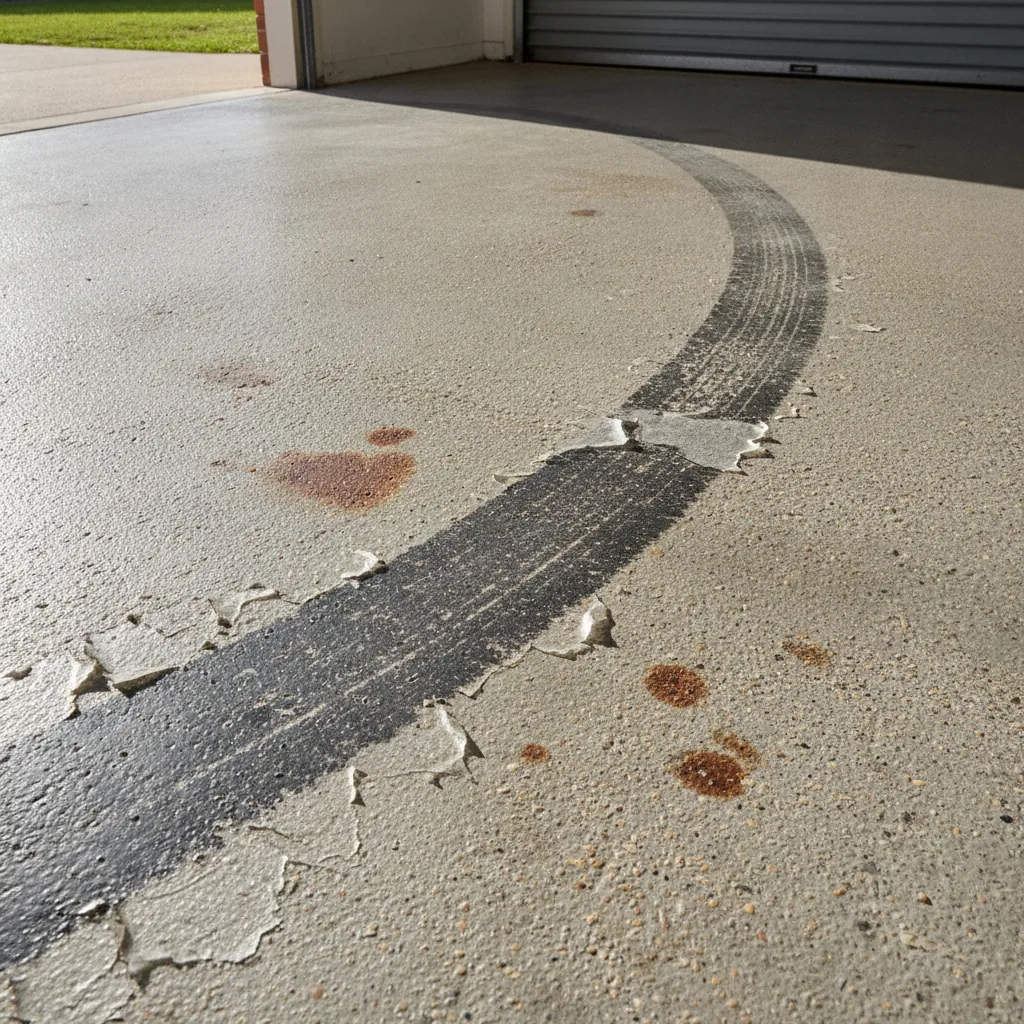
Concrete floor sealers fall short in garage settings because they cannot bond to a heavily contaminated slab, they offer minimal chemical resistance and they do not bridge existing cracks or surface defects. Hot tyre pick-up is also a common problem: when a car sits on a sealed floor after a drive, the heat from the tyres can literally pull the acrylic coating off the concrete in sheets.
Craigieburn’s climate adds another layer of difficulty. The area experiences significant temperature swings between summer and winter, and that expansion and contraction cycles the slab constantly. A thin sealer layer, which is not flexible, tends to crack and lift at the edges over time. Once moisture gets beneath a peeling sealer, you end up with a floor that looks worse than an unsealed one, because the coating traps the damp underneath and the concrete starts to spall.
Chemical resistance is another genuine gap. A 500ml spill of engine oil, brake fluid or radiator coolant will sit on a sealed floor briefly, but if you do not wipe it up within minutes, it will seep through any micro-crack in the coating and stain the concrete permanently. Epoxy and polyurethane systems, by contrast, cure into a solid, chemically resistant layer that is typically 2 to 4 millimetres thick, far more capable of taking that kind of abuse without damage.
Is a concrete floor sealer in Craigieburn worth applying at all?
A concrete floor sealer in Craigieburn is worth applying in situations where budget is the primary constraint, the floor is a low-traffic area like a garden shed or storage room, or you are treating a freshly poured slab that is not yet ready for a full coating system. In those cases, a quality penetrating sealer will reduce dusting and slow moisture absorption, giving you a cleaner, harder surface without a large upfront investment.
For a workshop, a double garage or any floor that sees vehicle traffic, tools and regular spills, a sealer alone is a short-term fix that will cost you more time and money in the long run. You will be reapplying product every year or two, and if you ever want to step up to an epoxy or polyaspartic system later, the old sealer has to be fully ground back first. Diamond grinding to remove a failed sealer before a coating job is an added cost that many homeowners do not factor in when they choose the cheap option upfront.
How does epoxy flooring compare to a basic sealer?
Epoxy flooring compares to a basic sealer the way a weatherboard cladding compares to a coat of paint: one is a structural system, the other is a surface treatment. A properly installed epoxy floor starts with diamond grinding the concrete to open up the surface profile, which is measured in CSP (Concrete Surface Profile) ratings. A CSP of 3 to 4, roughly the texture of 60-grit sandpaper, gives the epoxy something to grip mechanically, not just chemically. That mechanical bond is what stops the coating peeling under hot tyres or heavy point loads.
A standard two-coat epoxy system applied over prepared concrete in a suburban Craigieburn garage will typically handle foot traffic and vehicle traffic daily for 10 years or more before showing any real signs of wear. Polyaspartic topcoats extend that lifespan further and cure hard enough to return to service within 24 hours of application. Decorative flake broadcast into the wet basecoat adds both grip and a finish that hides dirt and minor surface marks far better than plain concrete or a shiny acrylic sealer.
The key difference in real, everyday terms is maintenance. A sealed floor still shows every tyre mark, oil drip and boot scuff. A properly coated epoxy floor wipes clean with a mop and some neutral detergent. For anyone spending time in their garage working on cars, storing gear or running a small home business, that practical difference is significant.
What should you check before choosing a floor treatment for your Craigieburn slab?
Before choosing a floor treatment for your Craigieburn slab, you need to check three things: moisture vapour transmission, surface contamination and existing crack depth. Moisture rising through a slab from below is the single most common reason epoxy floors fail prematurely. A basic plastic sheet test left taped to the floor for 16 hours will show you whether you have a moisture issue. If condensation collects under the sheet, the slab needs either a moisture mitigation primer or a moisture-tolerant system before any coating goes down.
Surface contamination from old oil stains needs to be degreased and ground out, not painted over. Any sealer or coating applied over oil will not bond properly and will peel within months. Cracks wider than a hairline should be filled with a flexible polyurea crack filler before the floor is coated, otherwise the crack will telegraph through the finish coat as the slab moves.
Getting a professional to assess your slab before you commit to any product, whether a sealer or a full epoxy system, is genuinely worth doing. The cost of a site visit is small compared to the cost of stripping back a failed job and starting again from scratch.
Book a floor assessment in Craigieburn with Metal and Flake