Concrete Floor Sealer vs Epoxy Coating: Which Protects Better?
A concrete floor sealer sits on the surface and repels moisture and light stains, but it offers only basic, short-lived protection. An epoxy coating bonds chemically into the concrete and creates a hard, abrasion-resistant layer that handles vehicle traffic, chemical spills and heavy workshop use far better. For most Melbourne garages and workshops, epoxy wins by a wide margin.
What exactly is a concrete floor sealer and how does it work?
A concrete floor sealer is a thin liquid product, either acrylic, polyurethane or penetrating silicate based, that you apply over bare concrete to reduce moisture absorption and surface dusting. Penetrating sealers soak into the pores and harden the top few millimetres of the slab. Topical sealers form a thin film over the surface. Either way, the protection layer is measured in microns, not millimetres, and it wears away with regular foot or tyre traffic within one to three years depending on the product and conditions.
Sealers are popular because they are cheap to buy and easy to roll on yourself. A basic acrylic sealer from a hardware store might cost under $100 for a single-car garage. That low entry price is appealing, but the trade-off is regular reapplication and limited durability. They will not hide existing cracking or surface imperfections, and they offer almost no resistance to oil, petrol or brake fluid soaking through and staining the slab beneath.
How does an epoxy coating compare to a concrete floor sealer for durability?
An epoxy coating outperforms a concrete floor sealer on every durability measure that matters in a working garage. Epoxy is a two-part system: a resin and a hardener that chemically react and cure to a rigid, dense surface typically 2 to 3 millimetres thick. That cured layer resists abrasion from steel-capped boots and tyre scuffing, shrugs off spilled engine oil, and can handle the compressive load of a car hoist or loaded shelving unit without cracking or delaminating when installed correctly.
Independent testing by flooring material bodies has consistently shown that a properly applied epoxy system can last 10 to 20 years in a residential garage environment before needing significant attention, compared to the 1 to 3 year recoat cycle typical of acrylic or polyurethane sealers. That longer service life changes the economics completely. When you spread the cost of a quality epoxy install over 15 years, the per-year figure often comes out lower than repeatedly buying and applying sealer products yourself.
Adhesion is the other big difference. Epoxy requires surface preparation, usually diamond grinding or shot blasting, so that the coating keys into the concrete profile at a microscopic level. A sealer skips that step, which means it sits on top of any contamination, laitance or weak surface material and can peel when that layer breaks down. Proper prep followed by epoxy means the coating and the slab essentially become one structure.
Which option handles Melbourne’s climate and garage conditions better?
Melbourne’s climate throws a lot at concrete floors. Cold winters, hot summers, and the kind of humidity swings that cause concrete to expand and contract regularly. A thin sealer film has very little flexibility and tends to flake or craze as the slab moves. A quality epoxy system, particularly one finished with a polyaspartic or polyurethane topcoat, has enough elongation built in to tolerate normal slab movement without cracking.
Moisture coming up through the slab (rising damp) is a real issue in many Melbourne homes, especially older slabs without an effective membrane. Both sealers and standard epoxy can fail if moisture vapour pressure is too high. The difference is that a professional installer will test the moisture vapour emission rate (MVER) before choosing the right primer and system. A DIY sealer job rarely involves that test, which is one reason you see bubbling and peeling on garage floors that were sealed in good faith but on a damp slab.
Thermal cycling on a dark coloured surface also matters. Flake or metallic epoxy finishes, the kind Metal and Flake specialise in, distribute heat more evenly across the surface and do not trap UV damage the way a clear sealer film does. An aliphatic topcoat keeps the colour stable for years without yellowing, something a basic acrylic sealer simply cannot promise.
Is a concrete floor sealer ever the right choice?
A concrete floor sealer can be the right choice in specific, lower-demand situations. If you have an internal laundry or utility room that just needs dust suppression and a quick clean-up surface, a penetrating silicate sealer does that job at low cost. If your slab is freshly poured and you are waiting for moisture levels to drop before committing to a full epoxy system, a breathable curing compound sealer protects the concrete during the curing period without trapping vapour.
Outdoor concrete paths and driveways are another case where a penetrating sealer makes sense. Epoxy is not designed for direct UV exposure without a UV-stable topcoat, and on a long outdoor driveway the cost of a full epoxy system can outweigh the benefit. A quality penetrating sealer will still outperform nothing and is far easier to reapply every couple of years than stripping and recoating an outdoor epoxy.
But for a residential garage, workshop, gym, or commercial floor that sees real daily use, the sealer is the cheaper short-term option that ends up costing more in labour, reapplication and frustration over the long run. Most homeowners who have tried the sealer route once come back asking for epoxy after the first year.
What does the installation process look like for each option?
Sealing concrete yourself is genuinely straightforward. Clean the surface, let it dry, roll the sealer on with a lambswool roller, let it cure. Most products are back in service in 24 hours. The simplicity is real, and for low-traffic areas it is a reasonable weekend job.
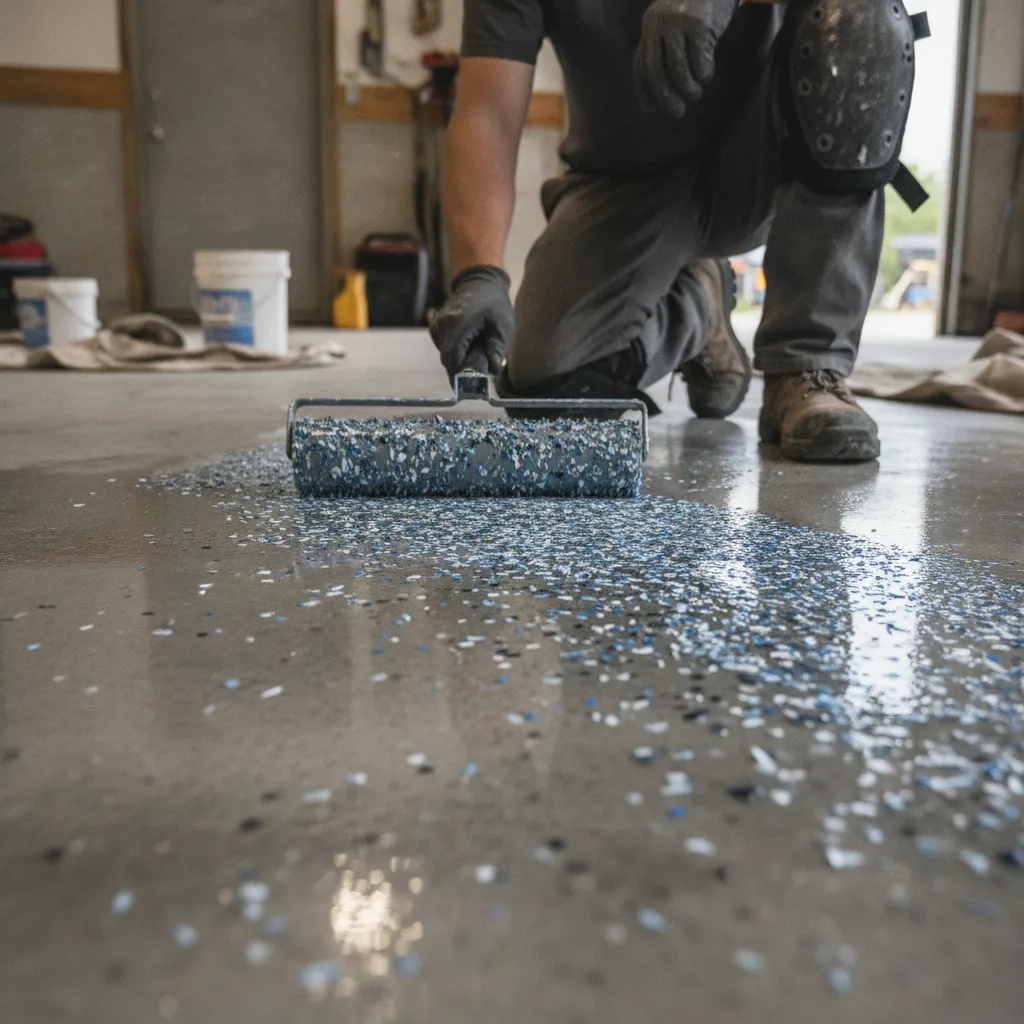
Epoxy installation is a different scope of work. The concrete surface needs to be mechanically prepared, which means hiring or operating a diamond grinder and dealing with the silica dust that comes with it (silica dust is a serious respiratory hazard under Australian Work Health and Safety guidelines, requiring proper PPE and often wet grinding or vacuum-assisted equipment). After grinding, any cracks and spalls are filled, the primer coat goes down, the base coat is applied within a strict recoat window, decorative flake or metallic pigment is broadcast, excess flake is scraped back, and a clear topcoat seals everything in. Each layer needs to cure within a specific temperature and humidity range.
Get any of those steps wrong and you are looking at delamination, fisheyes, hot tyre pickup or colour blotching. That is not a scare tactic. It is just the reality of a chemical system that demands precision. A professional crew with calibrated tools, the right products and experience reading a slab gets it right the first time. That is the core reason a professional epoxy install delivers a result that outlasts years of DIY sealer attempts.
Get an epoxy floor assessment from Metal and Flake