Rust-Oleum Garage Floor Coating vs Professional Epoxy: An Honest Comparison
A Rust-Oleum garage floor coating kit costs roughly $150 to $300 from a hardware store and can be rolled on over a weekend. Professional epoxy flooring costs more upfront but uses higher-solids products, proper concrete preparation and specialist application that produces a finish lasting 10 to 20 years with far greater chemical and abrasion resistance than any DIY kit.
What exactly is in a Rust-Oleum garage floor coating kit?
Rust-Oleum EpoxyShield and similar retail kits contain a water-based epoxy with a solids content typically between 40 and 50 percent. That means roughly half of what you brush or roll onto the slab evaporates as water. What remains is a relatively thin film, around 2 to 3 mils dry film thickness, which gives the floor a painted look rather than a proper epoxy build. The kits include a two-part mix, a decorative colour chip broadcast and sometimes a topcoat sachet. The prep instructions ask you to etch the concrete with an included acid solution, which opens the pores enough for a DIY product but falls well short of the mechanical grinding that professionals use. The end result can look great on day one. The question is how it performs at the six-month mark, and beyond.
How does a professional epoxy coating actually differ from a DIY kit?
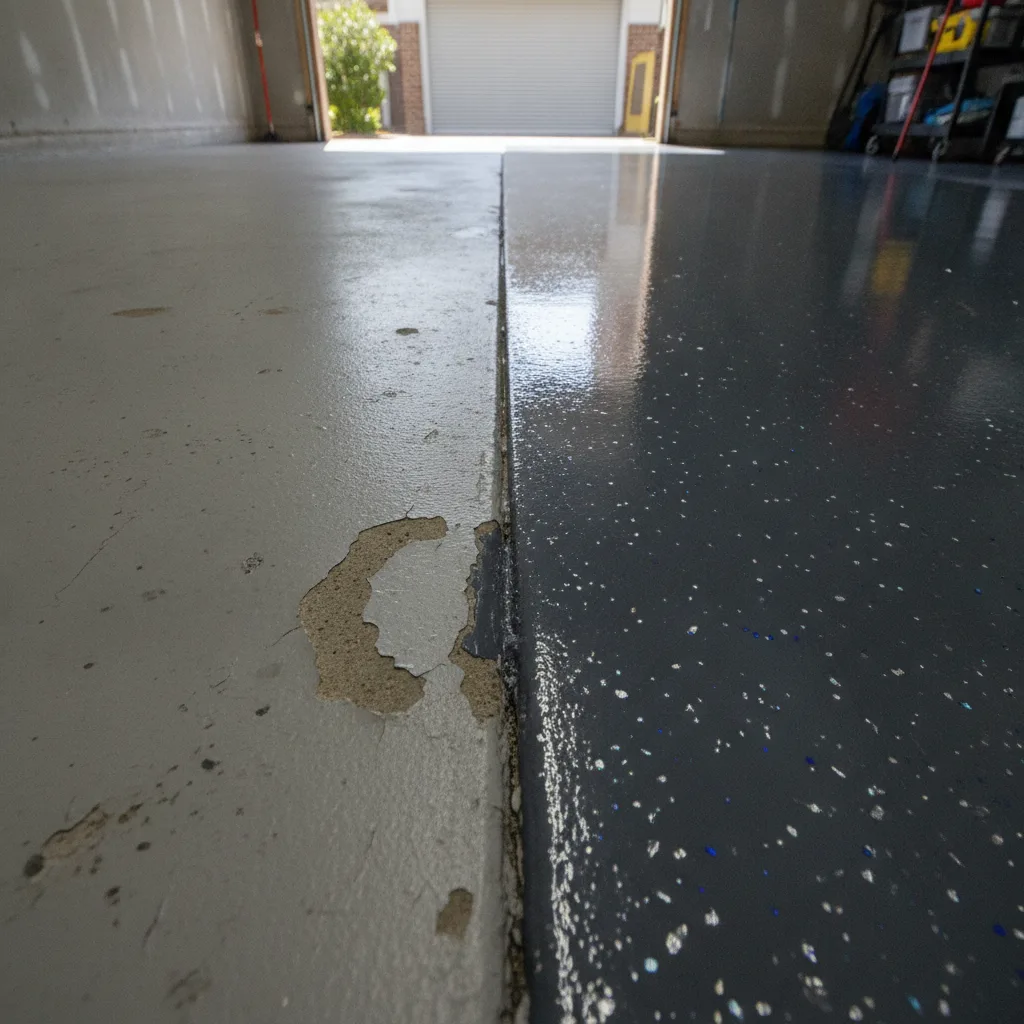
Professional epoxy flooring uses 100-percent-solids or high-solids (typically 80-plus percent) two-part epoxy systems. Because there is no water carrier, virtually all of the material stays on the floor, building to 10 mils or more of hardened coating. Professionals prepare the concrete with a diamond grinder or shot blaster, which creates a surface profile (measured on the CSP scale) that allows the epoxy to mechanically bond rather than just sit on top. A properly ground and primed slab means the coating bonds at a tensile strength that peeling simply cannot happen under normal use. The system is then finished with a polyurethane or polyaspartic topcoat that resists UV yellowing, hot tyre pick-up and petrol spills in a way that a thin water-based film cannot.
What are the most common problems with the Rust-Oleum garage floor coating?
The three most reported failures with retail epoxy kits are peeling, bubbling and hot-tyre transfer. Peeling happens when the acid etch does not open the concrete enough, or when residual moisture in the slab pushes the coating off from below. Bubbling occurs when the product is applied in direct sun or on a warm slab, trapping air or solvent under the film. Hot-tyre transfer is exactly what it sounds like: the softened rubber of a car tyre that has just been driven sticks to the coating when parked, then pulls chunks of it away when the car moves. These are not Rust-Oleum-specific faults. They are the predictable result of using a thin, water-based film on a substrate that demands mechanical prep and a thicker build. Many Melbourne homeowners come to professional applicators having already tried a kit, which means the slab now needs additional grinding to remove the failed coating before anything new can go down. That adds cost and time to what was meant to be a budget solution.
When does a Rust-Oleum garage floor coating actually make sense?
A retail kit can be a reasonable short-term choice in a low-traffic scenario: a garden shed floor, a single-car garage used only for storage, or a rental property where you just want something presentable for a year or two. If you follow the prep instructions carefully, apply in mild temperatures (between 10 and 25 degrees Celsius as most manufacturers specify), and keep expectations in line with what a thin coating can deliver, you will get a tidy result. The key is understanding you are buying a decorative film, not a durable flooring system. If your garage sees daily vehicle traffic, oil drips, chemical spills or heavy foot traffic from a home workshop, a kit will underperform and you will be back at the hardware store sooner than you think.
How do the long-term costs of each option compare?
This is where the comparison shifts firmly toward professional work. A Rust-Oleum kit might need reapplying every two to four years. Each reapplication requires prep, a new kit (cost: $150 to $300 per application) and a full weekend of your time. Over a ten-year period, you could spend more on repeated DIY attempts, plus the labour cost of grinding off failed coatings, than a single professional installation would have cost at the start. A professionally applied epoxy system in Melbourne typically carries a five-year workmanship warranty and can last 15 to 20 years with basic maintenance: sweeping and an occasional mop with a pH-neutral cleaner. The floor also adds genuine visual appeal and can be a selling point if you come to sell the property. Thin painted finishes rarely photograph well or impress a buyer walking through an open for inspection.
What should you check before choosing between the two?
Start by assessing your concrete. If it has existing coatings, significant cracking, moisture issues or a power-float finish (the very smooth, almost glassy surface common in newer slabs), a retail kit will struggle regardless of how carefully you follow the instructions. Power-floated concrete is particularly problematic because acid etching cannot create enough profile on a very dense surface. A professional applicator will grind the slab to a CSP 3 or CSP 4 profile, opening the concrete properly. Also think about use: daily car parking, a home gym, a workshop with heavy equipment or a space that doubles as an entertainment area all justify professional-grade product. If you are in any doubt, get a professional quote before buying a kit. The quote is free. Grinding off a failed DIY coating is not.
Compare results by booking a professional epoxy quote with Metal and Flake