Epoxy Flake Flooring Kits: What They Don’t Tell You
An epoxy flake flooring kit seems like a straightforward weekend project, but most homeowners underestimate the preparation work, the sensitivity of epoxy to temperature and moisture, and the gap between a kit finish and a professional result. Before you spend money on a kit, it pays to understand exactly where DIY ends and where real problems begin.
What actually comes inside an epoxy flake flooring kit?
Most epoxy flake flooring kits include a two-part epoxy base coat, a broadcast bag of decorative vinyl flakes, and a clear topcoat sealer. Some mid-range kits add an acid-etch solution and basic application rollers. What they rarely include is enough material for proper coverage, a moisture-barrier primer, or the diamond-grind prep that a concrete slab almost always needs.
That last point matters more than the price on the box. The kit manufacturers measure coverage on a perfectly smooth, perfectly dry, perfectly clean slab. Real garage floors in Melbourne have oil stains from decades of parked cars, surface laitance (that chalky weak layer on top of cured concrete), and moisture wicking up from below. None of those conditions are “kit ready” without serious prep work first.
A standard retail kit covers roughly 25 to 30 square metres at the stated film thickness. Push it any thinner trying to stretch the kit across a double garage and the topcoat will wear through inside a year. That is a concrete experiential reality, not a sales pitch.
Why does surface preparation make or break an epoxy flake flooring kit result?
Surface preparation is the single biggest reason DIY epoxy flake floors fail. Epoxy bonds chemically to open concrete pores, so if those pores are sealed by oil, paint, curing compound or laitance, the coating sits on top rather than bonding into the slab. Within weeks or months it peels, bubbles or lifts in sheets, taking the flakes with it.
Professional installers use diamond grinding or shot blasting to achieve a concrete surface profile (CSP) of around CSP 2 to CSP 3, the equivalent of 60-grit sandpaper on concrete. The acid-etch sachets bundled in retail kits produce nowhere near that profile on a dense slab. Acid etching works adequately on fresh, porous concrete but is largely ineffective on older garage floors that have been driven on and compressed for years.
Moisture is the other hidden enemy. Concrete is not waterproof, and moisture vapour moving upward through the slab creates hydrostatic pressure that pushes a bonded coating off from underneath. A simple plastic sheet taped to the floor overnight will tell you if you have a moisture problem. If condensation forms under the sheet, no retail kit will give you a lasting result without a moisture-mitigation primer, which is rarely included in the box.
What do epoxy flake flooring kits actually cost once you add everything up?
The advertised kit price is the starting point, not the finish line. Here is a realistic picture of what a single-car garage project typically adds up to when you go the DIY route properly.
- Retail epoxy flake kit for 25 to 40 sqm: $150 to $400 depending on brand and quality.
- Diamond grinder hire for a day (the minimum viable prep tool): $80 to $120 from a tool hire shop.
- Diamond grinding pads, vacuuming and disposal bags: $40 to $80.
- Extra flakes if you want denser broadcast coverage than the kit allows: $20 to $60.
- Concrete degreaser for oil spots: $20 to $40.
- Spike roller shoes, mixing paddle, lint-free roller sleeves: another $30 to $60.
That puts a properly executed single-car garage job at $340 to $760 in materials and hire before you count your own time. A double garage pushes those numbers up significantly, and you will likely need two full weekends to do it right: one for prep, one for coating.
Compare that to a professional epoxy flake installation where the prep, primer, base coat, broadcast and topcoat are all handled as a system, warranties are included, and the result is consistent and durable. The cost gap narrows considerably once you price the DIY route honestly.
What are the most common epoxy flake flooring kit mistakes Melbourne homeowners make?
Skipping the grind and using acid etch alone is the most common mistake, followed closely by applying the epoxy when the concrete or air temperature is outside the ideal range. Epoxy is sensitive. Below about 10 degrees Celsius it cures too slowly and can remain tacky or blush. Above 30 degrees it kicks off so fast you end up with drag marks and uneven coverage before you have finished rolling. Melbourne’s weather swings between those extremes regularly, so timing matters.
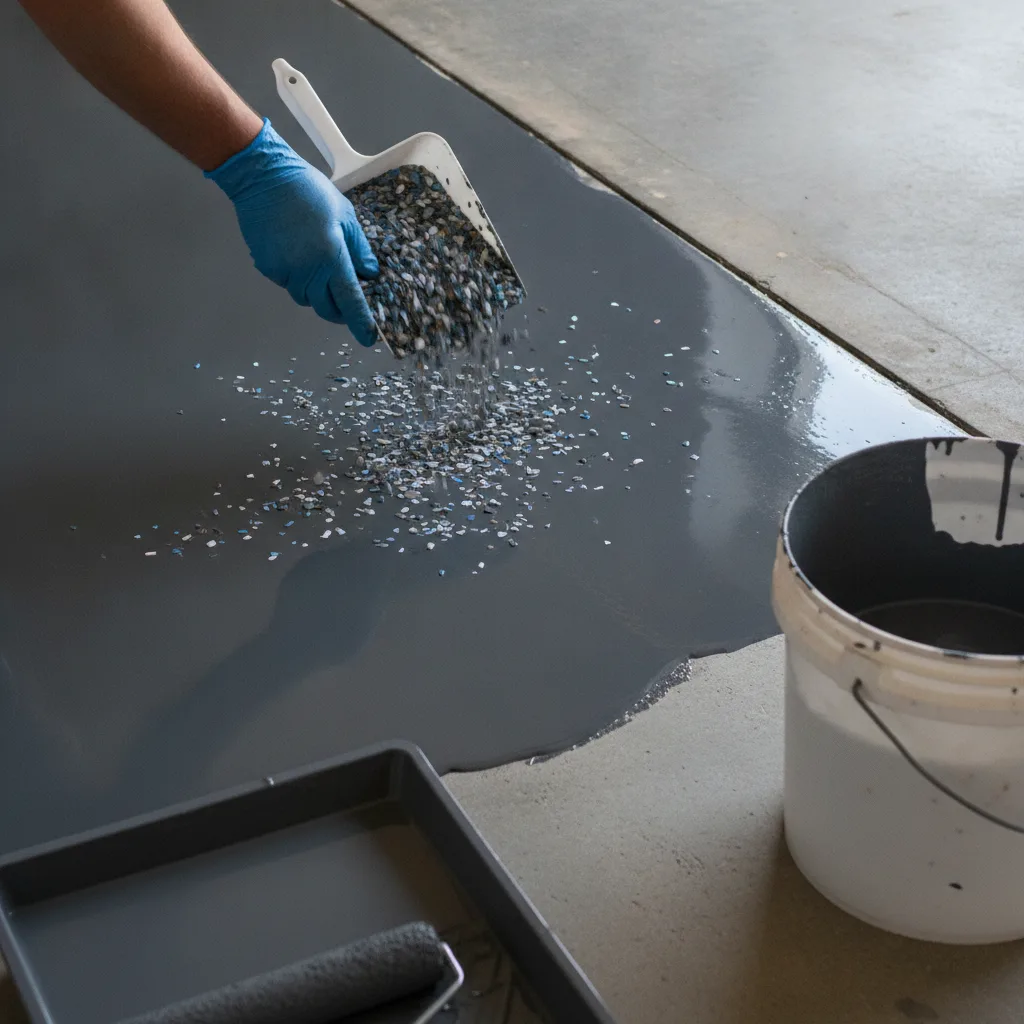
The second big mistake is broadcasting the vinyl flakes unevenly. Pros walk the wet base coat and throw flakes from hip height in a smooth arc, overlapping each throw for consistent density. First-timers tend to clump the flakes near where they are standing, leaving thin patches elsewhere. Once the base coat sets, you cannot go back and fix it.
The third mistake is applying the clear topcoat too soon. Most kit instructions say “recoat after 8 to 24 hours” but that window is highly temperature dependent. Apply the topcoat over a base coat that has not fully cured and you trap solvents, which causes clouding, soft spots and early delamination.
When does a professional installation make more sense than a kit?
If your slab has significant oil contamination, visible cracks, a history of moisture problems, or if you are coating more than a single-car garage, professional installation is the practical choice. The same logic applies if you want the floor to last more than three to five years without maintenance coats, or if the space is used commercially or for a workshop with rolling loads, chemical spills or heavy foot traffic.
Professional installers apply multiple coats at controlled film thicknesses, use broadcast densities that give the floor real texture and slip resistance, and seal everything under a commercial-grade polyaspartic or urethane topcoat that is significantly harder than the clear coat in any retail kit. The finish looks genuinely different too, not just aesthetically but under the foot: denser, harder, more uniform.
There is also the question of warranty. A retail kit gives you no comeback if it fails due to conditions on your particular slab. A professional installation comes with workmanship backing and the installer is accountable if something goes wrong.
For Melbourne homeowners who want the epoxy flake look without the risk of a failed DIY attempt, the maths often work out in favour of getting it done properly the first time. A peeled-up DIY floor still needs to be ground back before anything else can be applied, so a failed kit job adds cost rather than saving it.
Book a professional epoxy flake installation with Metal and Flake