Sealing a Concrete Floor: Which Method Works Best for Your Garage?
Sealing a concrete floor protects it from oil, moisture, tyre marks and surface breakdown. For a garage, the best method depends on how much traffic it gets, whether you want a decorative finish, and how long you need it to last. Penetrating sealers suit bare slabs; epoxy coatings suit heavy-use garages where durability and looks both matter.
Why does sealing a concrete floor actually matter in a garage?
Unsealed concrete is porous. Moisture soaks in from below, oil drips soak in from above, and the freeze-thaw cycle (even in Melbourne winters) causes micro-cracking over time. Sealing a concrete floor closes those pores, which means easier cleaning, no more oil stains that grind into the surface, and a slab that stays structurally sound for decades rather than years. Left bare, a garage floor can start pitting and dusting within five to ten years of regular vehicle use.
There is also the safety angle. Bare concrete, especially when wet, can be surprisingly slippery. A good sealer or coating includes a slip-resistant aggregate or texture that gives tyres and boots something to grip. That is a practical benefit you notice the first time you roll a trolley jack across it without it sliding away.
What are the main methods for sealing a concrete floor?
There are four broad categories worth knowing: penetrating sealers, acrylic sealers, polyurethane coatings, and epoxy coatings. Each sits at a different point on the scale of cost, durability and finish quality.
Penetrating sealers (silane or siloxane-based) soak into the concrete and create a water-repellent barrier below the surface. You cannot see them once applied. They are good for outdoor slabs and driveways but offer almost no protection against oil or tyre marks inside a garage. Expect to reapply every three to five years.
Acrylic sealers sit on top of the surface and give a wet-look or matte sheen. They are inexpensive, easy to roll on, and dry fast. The catch is durability. A single-part acrylic will typically last one to three years in a working garage before it starts peeling and yellowing, particularly under hot tyres. Hot-tyre pickup is a genuine problem with acrylic products.
Polyurethane coatings are tougher than acrylics and resist UV yellowing better. They are often used as a topcoat over epoxy rather than as a standalone system. As a standalone, they offer reasonable protection but lack the mechanical bond strength that heavy garages demand.
Epoxy coatings are the go-to choice for residential and commercial garages that see real use. A two-part epoxy bonds chemically to properly prepared concrete, creating a surface that resists impact, oil penetration, abrasion and tyre marks. Thickness matters: a quality garage epoxy system runs at 250 to 500 microns dry film thickness, compared to 50 to 100 microns for a rolled acrylic. That extra build is what makes the difference when a loaded toolbox gets dropped or a vehicle sits in the same spot for weeks.
How does concrete preparation affect the result?
Preparation is where most DIY sealing jobs fall apart. Concrete looks flat and clean, but the surface is covered in laitance (a weak, dusty top layer), old contamination, and often a curing compound applied at the time of the pour. Any sealer applied over these will bond poorly and peel within months.
Professional preparation involves either diamond grinding or shot blasting the surface. Diamond grinding uses a multi-head machine fitted with diamond-tipped segments to mechanically abrade the surface down to sound concrete. Shot blasting fires steel pellets at high speed to open the surface profile. Both methods remove laitance, old coatings and contamination, and leave a concrete surface profile (CSP) of around CSP 3 to 4, which is the rough texture that gives a coating something real to grab onto.
Cracks and control joints also need attention before any coating goes down. Low-viscosity epoxy crack fillers or polyurea joint fillers are injected or poured into voids and allowed to cure before the main coating system is applied. Skipping this step means cracks telegraph through the new coating within a season.
Moisture is another non-negotiable. Concrete slabs in Melbourne often sit on ground with a high water table or poor drainage. A calcium chloride moisture emission test measures how much vapour is moving through the slab. Most epoxy manufacturers specify a maximum of around 3 kg per 24 hours per 100 square metres. Coat over a wet slab and the epoxy will blister and delaminate, sometimes within weeks.
What finish options are available with epoxy garage coatings?
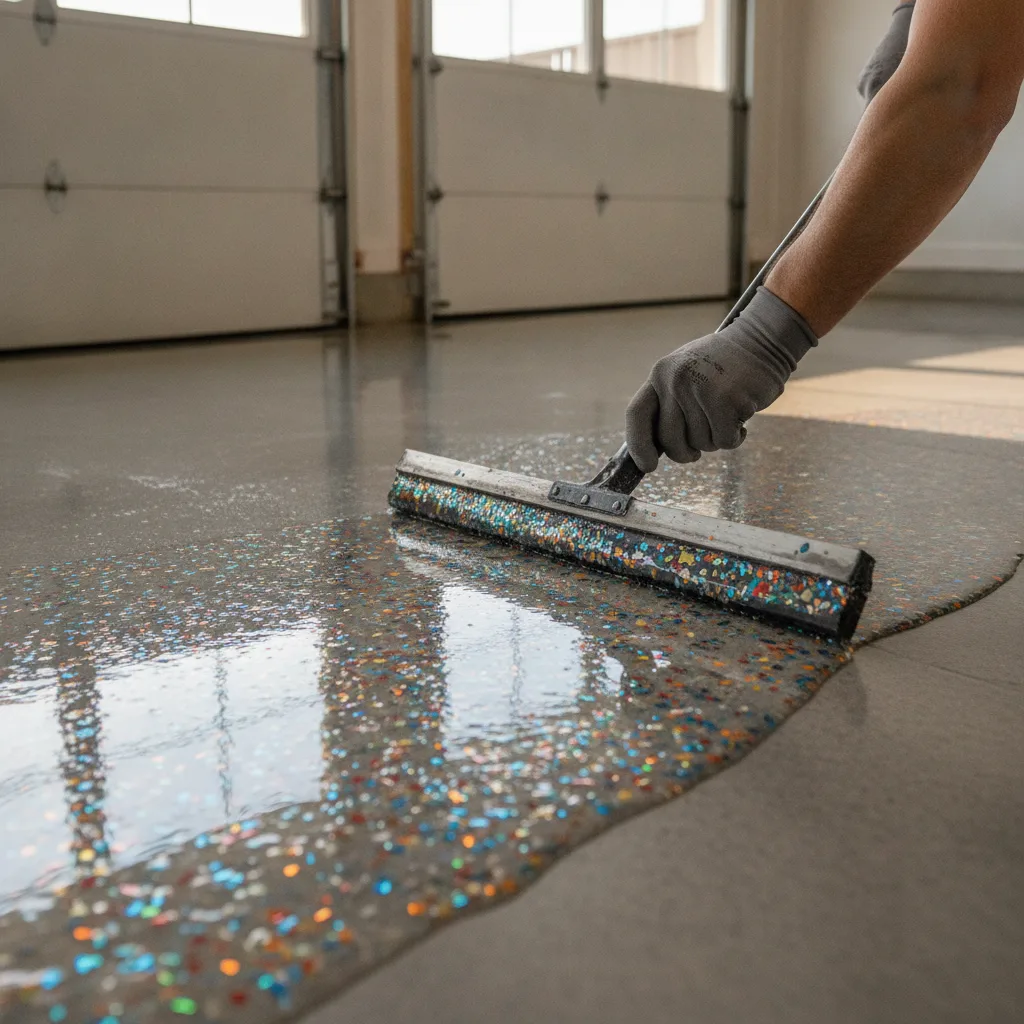
Once the system is chosen, there is a lot of room to customise how the floor looks. Solid colours are the simplest option and give a clean, workshop feel. The classic choice for residential garages is a coloured base coat with decorative flake broadcast across the wet epoxy, then sealed with a clear polyurethane topcoat. The flake adds texture (which improves slip resistance), hides minor surface imperfections, and gives the floor a professional finish that holds up well under scrutiny.
Metallic epoxy systems use pigmented powders mixed into a clear epoxy base to create a flowing, three-dimensional look. The finished surface resembles polished stone or molten metal depending on the colour combination. This is a more involved application that requires an experienced hand to control how the pigment moves during the pour and roll-out stage.
For homeowners who want a high-gloss, seamless floor without heavy customisation, a clear epoxy over a solid base coat is a practical middle ground. It reflects light well, making a garage feel larger and brighter, and is straightforward to clean.
Can you seal a concrete floor yourself, or is professional application worth it?
A determined DIYer can apply a single-part acrylic sealer on a weekend. The results will be acceptable for a low-traffic space and the cost is low. For a working garage, though, the preparation equipment alone puts a professional-grade result out of reach for most homeowners. Diamond grinders capable of proper surface profiling are large, expensive machines that require training to operate without gouging the slab or leaving grinding marks.
Beyond equipment, mixing ratios and pot life are critical with two-part epoxy systems. The wrong ratio or working past the pot life produces a coating that never fully cures, stays tacky and picks up every footprint and piece of grit. Professional applicators have done this enough times to read the conditions: air temperature, slab temperature and humidity all affect open time and cure rate.
The concrete surface is also a one-shot deal. Over-grind it and you expose aggregate that changes the aesthetics. Under-prepare it and the coating fails. Getting the preparation right the first time is the main reason professional application pays for itself over the life of a quality epoxy system, which should realistically last ten or more years with basic maintenance.
If you are weighing up the options for your Melbourne garage and want a floor that genuinely handles daily vehicle use, oil spills and the odd dropped tool without looking tired after two seasons, the method matters less than the quality of preparation and the system behind it.
Book concrete floor sealing and preparation with Metal and Flake