Concrete Garage Floor Coating: Choosing the Right System
A concrete garage floor coating is a protective layer applied directly over bare or prepared concrete to resist oil stains, abrasion, moisture and daily vehicle traffic. The most common systems are epoxy, polyurea and polyaspartic, often finished with decorative flake or metallic pigment. Choosing the right one comes down to how you use the space, your budget and the condition of the slab underneath.
Why does your concrete garage floor coating choice actually matter?
The coating system you choose determines how long your floor lasts, how it handles real-world punishment and how much prep work is required before application. Get it wrong and you end up with a floor that peels, yellows or cracks within a couple of years. Get it right and a well-installed system can last a decade or more with minimal maintenance.
Bare concrete is porous. Every time you park a hot vehicle on it, or a battery leaks, or you spill brake fluid, that liquid soaks straight in. Staining sets fast and moisture from below can cause concrete to flake. A proper coating seals the surface, gives you something easy to clean and, depending on the system, adds genuine slip resistance.
Beyond function, the floor is the first thing people see when the garage door rolls up. A neat, finished surface lifts the whole look of the space and adds perceived value to the home. That matters whether you are a car enthusiast who spends weekends in the garage or a homeowner who just wants a tidy storage area.
What are the main types of concrete garage floor coating systems?
There are three coating families worth understanding: standard epoxy, polyurea or polyaspartic, and hybrid broadcast flake systems. Each has a different chemistry, cure time and performance profile, so comparing them before committing saves you from an expensive redo down the track.
Standard epoxy is a two-part product: a resin and a hardener mixed together before application. It forms a hard, glassy film that bonds well to properly prepared concrete. The main limitations are cure time (typically 24 to 72 hours before foot traffic, longer before vehicles), sensitivity to moisture in the slab and a tendency to amber or yellow under UV if used in areas with direct sunlight. For an indoor, low-light garage that gets moderate use, standard epoxy remains a cost-effective choice.
Polyurea and polyaspartic coatings are newer chemistries that cure much faster, often in two to four hours, and hold up better under UV exposure and thermal shock. Thermal shock matters in a garage because concrete expands and contracts with temperature swings. A polyaspartic topcoat over an epoxy base is a popular combination because you get the build and adhesion of epoxy with the UV stability and scratch resistance of polyaspartic on top.
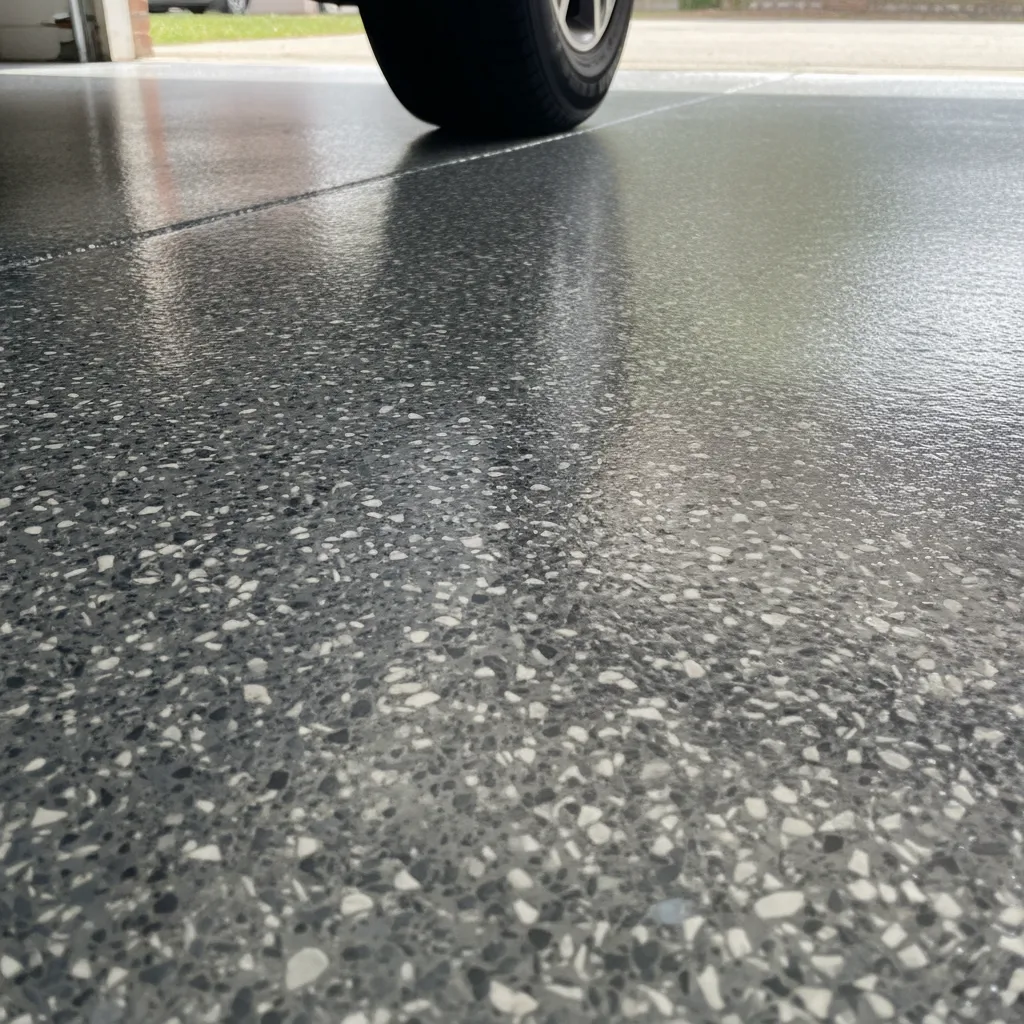
Broadcast flake systems (sometimes called chip or flake floors) scatter vinyl colour flake into a wet base coat, then lock it in with a clear topcoat. This is the system Metal and Flake specialises in. The flake serves two purposes: it adds visual depth and texture that hides minor marks, and the embedded texture provides a non-slip surface underfoot and under tyre. The result looks sharp without looking sterile.
Metallic epoxy is a decorative option where metallic pigment is manipulated in the wet coat to create a flowing, three-dimensional effect. It works brilliantly in showrooms or display garages but requires a skilled applicator to get consistent results across a full garage floor.
How important is surface preparation for a garage floor coating?
Surface preparation is the single most important factor in whether a concrete garage floor coating bonds properly and lasts. Even the best coating product will fail on a poorly prepared slab. At minimum, the concrete needs to be mechanically ground or shot-blasted to open the surface profile so the coating can grip. Acid etching alone is generally not sufficient for a garage that takes vehicle traffic.
Before any grinding starts, the slab needs to be checked for moisture. Concrete naturally retains some moisture, and if the vapour transmission rate is too high, it will push the coating off from below, causing bubbles and delamination. A basic moisture test involves taping a square of plastic film to the floor for 24 hours and checking for condensation underneath. Professionals use a calcium chloride test or a relative humidity probe for a more accurate reading.
Cracks, spalls and holes need to be addressed before coating goes down. Hairline shrinkage cracks are common in garage slabs and can usually be filled with a flexible polyurea crack filler. Larger structural cracks need assessment because a coating will not bridge an active crack that continues to move.
Oil contamination is another common problem in garages that have been used for years. Oil penetrates deep into concrete and, if not properly degreased and ground out, it acts as a release agent that prevents adhesion. In severe cases, multiple grinding passes are needed to get below the contamination layer.
Which concrete garage floor coating system suits different situations?
The right system depends on how the space is used, whether the garage is exposed to direct sunlight and what the homeowner values most: durability, speed of installation, aesthetics or cost. Matching the system to the situation is what separates a floor that lasts from one that needs redoing in three years.
For a typical suburban double garage used daily for family vehicles, a full-broadcast flake system over an epoxy base with a polyaspartic topcoat is a strong choice. The flake hides tyre marks and everyday grime between cleans, the epoxy base gives excellent chemical resistance and the polyaspartic topcoat handles UV if the garage door stays open for long periods.
For a home workshop or man cave where aesthetics matter as much as function, a metallic epoxy or a partial flake system with a solid colour base creates a showroom feel. These finishes photograph well and make the space feel deliberate rather than functional.
For a commercial or semi-commercial application, such as a large shed used for trade work or storage, a thicker epoxy build coat with a high-solids formulation gives better impact resistance. Some applications also benefit from an anti-fatigue or anti-static additive mixed into the topcoat.
One thing worth noting: Melbourne’s climate brings some specific challenges. Summer days can push garage slab temperatures above 30 degrees Celsius, which shortens the working time of some epoxy formulations. A professional applicator accounts for this by scheduling work during cooler parts of the day or selecting products formulated for higher ambient temperatures.
How do you maintain a coated concrete garage floor?
A good concrete garage floor coating is genuinely low maintenance, but a few habits keep it looking sharp for longer. Regular sweeping or blowing out dust and grit prevents fine particles from acting like sandpaper under tyres. For spills, a mop with a neutral pH cleaner is all that is needed. Avoid harsh solvents, bleach or citrus-based degreasers on a finished coating because these can dull or soften the topcoat over time.
Placing a rubber mat under the vehicle’s parking position is a practical move, especially if the car is parked hot. Hot tyre pickup (sometimes called tyre tracking) can occur on softer epoxy formulations when a vehicle sits stationary on a warm surface. A polyaspartic topcoat significantly reduces this risk, but a mat adds an extra layer of protection on very hot days.
Most quality systems will benefit from a light topcoat refresh after seven to ten years of heavy use, which is far cheaper than stripping and recoating from scratch. Keeping the surface clean and free of standing water extends the life of the coating significantly.
If you are ready to stop looking at a stained, dusty slab every time you open the garage door, the next step is straightforward. Request a concrete garage floor coating quote from Metal and Flake.