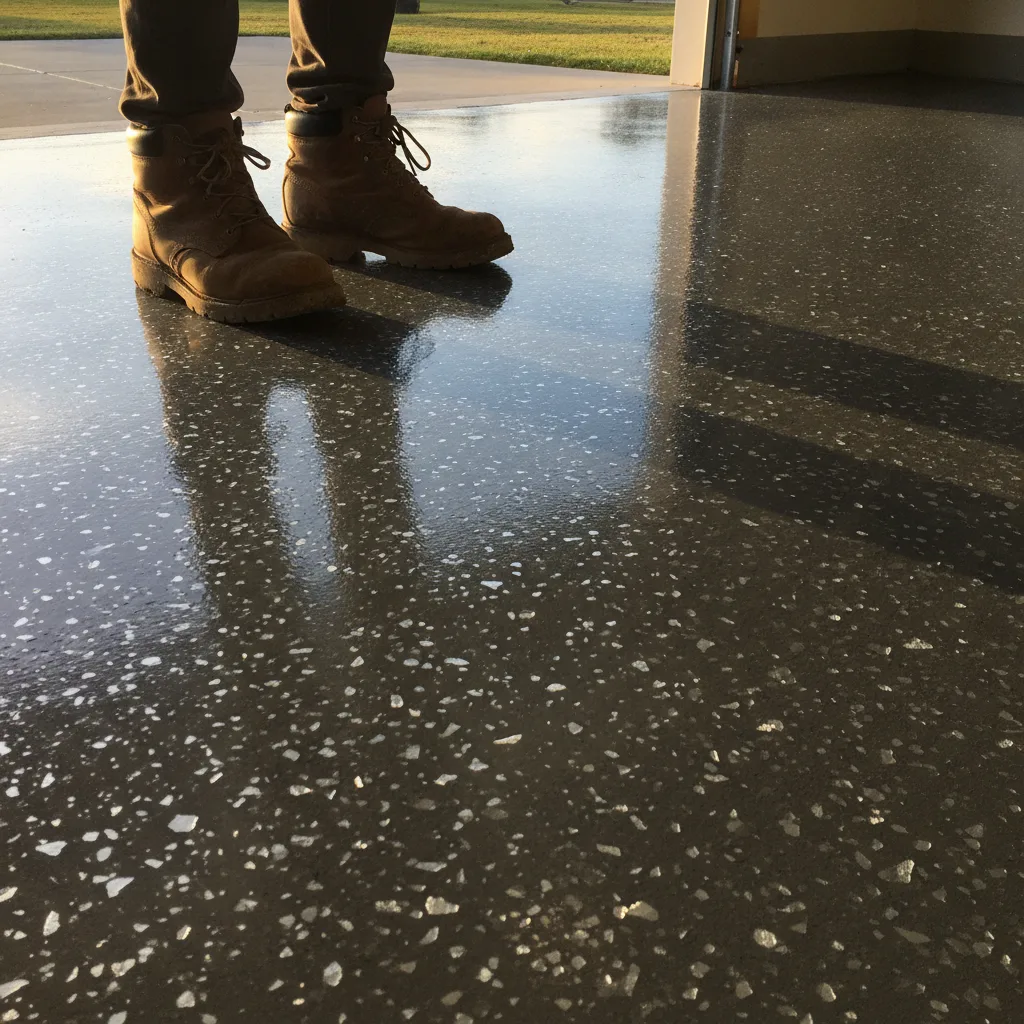
Polyaspartic Garage Floor Coating: Is It Better Than Epoxy?
A polyaspartic garage floor coating cures faster than epoxy, resists UV yellowing, and handles Australia’s temperature swings without going brittle. Epoxy costs less upfront and delivers a thick, hard-wearing base coat. For most garages, the best result combines both: epoxy as the foundation, polyaspartic as the tough topcoat that ties it all together.
What exactly is a polyaspartic garage floor coating?
Polyaspartic is a type of polyurea coating. It uses an aliphatic chemistry that makes it flexible, UV-stable and extremely fast-curing. A single coat can go from wet to foot-traffic-ready in as little as one to two hours, compared to the 24-plus hours a standard water-based epoxy needs before you can walk on it. That speed is the headline feature, but it comes with other genuine advantages that are worth understanding before you commit.
The coating bonds to prepared concrete through a chemical reaction that creates a dense, slightly flexible film. That flexibility matters in a Melbourne garage where concrete can expand and contract with the seasons. A rigid coating that can’t move with the slab can crack or peel at the edges over time.
Polyaspartic was originally developed for industrial applications like bridge coatings and mining equipment. It filtered down to residential garage floors over the last decade or so, and it’s now a common topcoat choice for professional installers who want durability without long cure times holding up a job.
How does polyaspartic compare to epoxy on durability and cure time?
Polyaspartic outperforms standard epoxy on cure speed and UV resistance; epoxy generally wins on raw thickness and upfront cost. Polyaspartic is typically applied at 2 to 4 mils dry film thickness per coat, curing fully in two to four hours. Solvent-based epoxy builds thicker at 6 to 10 mils but needs a full 24 hours between coats and up to 72 hours before driving on it.
Here’s where it gets practical. Epoxy is a workhorse base coat. It fills minor surface imperfections, builds a solid foundation, and holds the decorative flakes or metallic pigments that give your floor its look. Polyaspartic, applied over the top, seals everything in and adds the UV-stable, scratch-resistant surface that people actually see and scuff every day.
The two materials genuinely complement each other. Running epoxy alone as your final surface means risking yellowing in a garage that gets direct sunlight through the door. A clear epoxy topcoat will go amber within a year or two in those conditions. Polyaspartic won’t. That’s not a small thing when you’ve spent money on a decorative flake floor and don’t want it looking tired by the second summer.
On hardness, a fully cured solvent-based epoxy sits around 80 to 85 Shore D. A quality polyaspartic sits in the same range, so there’s no meaningful gap in scratch or impact resistance. What changes is how quickly you get there. A polyaspartic-only system can have a car parked on it the same day. An epoxy-only system needs the weekend.
What are the real drawbacks of polyaspartic garage floor coatings?
Polyaspartic’s fast cure time, which is its biggest advantage, is also its trickiest limitation. Because it sets so quickly, application has to be fast, consistent and deliberate. An inexperienced applicator can end up with lap marks, fish eyes or uneven sheen if they lose pace on a large floor. This is why most professional installers with proper training treat polyaspartic as a topcoat material rather than a DIY product.
Cost is the other honest drawback. Polyaspartic raw materials cost more than standard epoxy, so a polyaspartic-only system carries a higher price tag. A hybrid system using epoxy as the base and polyaspartic as the topcoat is often the better value proposition because you get the build and affordability of epoxy with the UV and wear performance of polyaspartic on the surface that matters.
Temperature sensitivity during application is also worth flagging for Melbourne conditions. Polyaspartic cures faster in heat, which can be a problem on a 38-degree day in Dandenong if you’re working on a large floor. On cold winter mornings, it behaves more predictably and gives you a bit more working time. A professional applicator plans their schedule and product ratios around the ambient temperature on the day.
Is a polyaspartic garage floor coating worth it for a residential garage in Melbourne?
Yes, for most Melbourne homeowners who want a long-lasting, good-looking garage floor, a system that includes a polyaspartic topcoat is worth the investment. It handles UV from the afternoon sun, resists hot tyre pickup, cleans up easily and keeps its colour and gloss for years longer than an epoxy-only surface would in the same conditions.
Hot tyre pickup is a specific issue worth naming. When you park a hot car on an uncured or low-quality floor coating, the rubber can bond to the surface and pull it up when the car moves. A properly cured polyaspartic topcoat has the thermal resistance to handle this where a budget epoxy often won’t.
For a standard double garage of around 36 to 40 square metres, a professionally installed epoxy base with broadcast decorative flake and a clear polyaspartic topcoat gives you a floor that genuinely looks sharp and holds up to daily use. The colour flakes sit under the polyaspartic seal, protected from scuffing and staining, and the surface wipes clean with a mop. That’s a practical, sensible outcome for a working garage.
The question of whether polyaspartic alone beats epoxy alone misses the point a bit. The best garage floor systems use each product for what it does well. Epoxy builds, bonds and holds decoration. Polyaspartic protects and finishes. Together, they produce results that neither can match on its own.
Ask Metal and Flake about polyaspartic and epoxy garage floor options.