What Is the Best Epoxy Coating for a Garage Floor in Australia?
The best epoxy coating for a garage floor in Australia is a 100% solids, two-part epoxy system professionally applied over a properly prepared concrete slab. It outperforms water-based or single-part products because it bonds harder, resists hot tyre pick-up, and holds up to oil, chemicals and daily traffic for well over a decade when done right.
Why does epoxy type matter so much for Australian garages?
Australian garages cop a lot more punishment than people expect. Summer concrete temperatures in Melbourne can push past 35°C on a hot slab, and that heat is exactly what peels a cheap coating off in sheets. The type of epoxy you choose determines whether the floor lasts two years or twenty. A 100% solids two-part epoxy contains no water or solvents to evaporate, so almost everything you apply stays on the floor as a thick, hard film. Water-based epoxy paints, by contrast, can contain as little as 40 to 50% solids, meaning you are essentially paying for water to evaporate and leaving a much thinner layer behind. That thinner layer cracks, yellows and lifts under the kind of load and heat a garage throws at it every day.
Single-part epoxy products sold in hardware stores are convenient but they are not true epoxies in the structural sense. They do not cross-link the same way a proper two-part system does, so they sit on top of the concrete rather than bonding into it. When a tyre sits on that surface on a hot day, the rubber grips the coating and pulls it right off. That is the infamous hot tyre pick-up problem, and it is the number one complaint people have after a DIY garage floor job.
What makes the best epoxy coating for a garage floor hold up long-term?
The best epoxy coating for a garage floor holds up long-term because of three things working together: the right product chemistry, proper concrete preparation, and a quality topcoat. Getting even one of these wrong shortens the life of the floor dramatically. A high-build, two-part epoxy basecoat applied at the right thickness (typically 300 to 500 microns dry film thickness) gives the floor its strength and chemical resistance. The topcoat, usually a polyurethane or polyaspartic clear, protects the colour, adds UV stability and makes the surface easy to clean.
Concrete prep is the step that kills most DIY jobs before they even start. The slab needs to be mechanically prepared, either by diamond grinding or shot blasting, to open up the concrete profile and give the epoxy something to grip. Simply acid etching, which is what most hardware store instructions suggest, rarely creates a profile deep enough for a 100% solids system to bond correctly. When a professional uses a diamond grinder they are aiming for a concrete surface profile (CSP) of around 2 to 3 on the ICRI scale, which is a standardised way of measuring how rough and open the surface is before coating.
Moisture is the other silent killer. Concrete that has a high moisture vapour emission rate will push water vapour up through the slab and cause the coating to blister and delaminate, sometimes within weeks of application. A good installer tests for moisture before they start and, where needed, uses a moisture-tolerant primer to manage it.
What are the different epoxy garage floor systems available in Australia?
There are several systems you will come across when researching garage floor coatings, and it helps to know what each one actually is before you commit. Here is a plain-English breakdown of the main options.
Water-based epoxy paint. Readily available in hardware chains, easy to apply, cheap upfront. Solids content is low, film build is thin, and durability under heavy traffic or chemical exposure is poor. Fine for light foot traffic in a laundry or workshop but not well suited to a busy garage with vehicles on it.
Solvent-based two-part epoxy. A step up from water-based products and used by many trade applicators. Higher solids content than water-based options and a stronger bond, but still not as hard or as thick as a 100% solids system. Solvent odour during application is significant and ventilation is critical.
100% solids two-part epoxy. The professional standard for garage floors. No solvents, maximum film build, very high chemical and abrasion resistance. Requires proper mixing ratios and temperature management during application, which is why professional installation gives far better results than a DIY attempt.
Polyaspartic coatings. A newer technology that cures faster than epoxy and has excellent UV resistance. Some applicators use polyaspartic as both the base and topcoat for a fast-turnaround job. The quick cure time can be a double-edged sword: it means you can park on the floor sooner, but it also leaves less working time for the installer to apply it correctly.
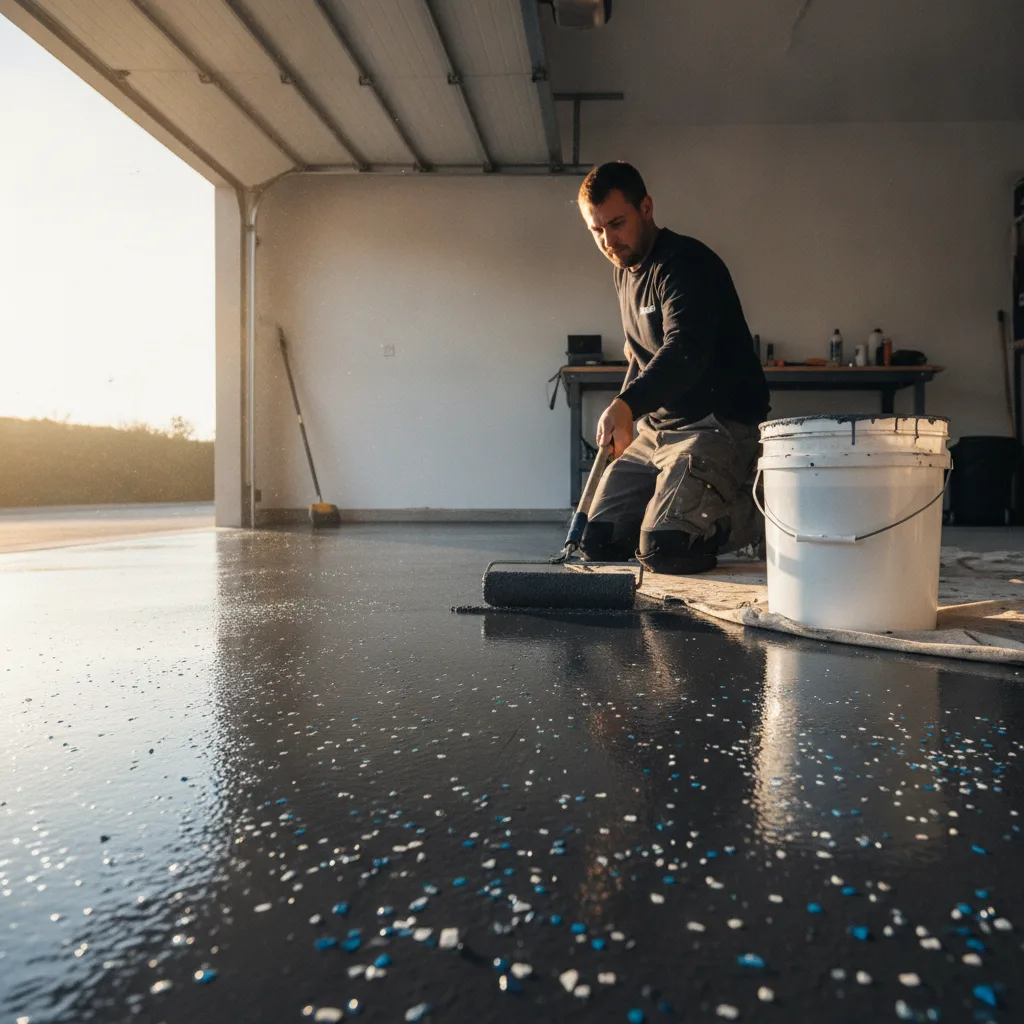
Flake or chip systems. These are decorative broadcast systems where vinyl flakes or colour chips are scattered into a wet epoxy base. The flakes hide minor surface imperfections, add texture for grip, and give the floor a clean, finished look. A clear topcoat is then applied over the flakes to lock them in and seal the surface. This is one of the most popular finishes for residential garages in Melbourne because it looks sharp and hides dirt well between cleans.
How does climate in Melbourne affect which system is best?
Melbourne’s climate adds a few specific considerations that do not apply in every Australian city. The city’s famously variable weather, cold winters dropping close to freezing overnight and hot dry summers, means the concrete slab goes through more thermal expansion and contraction cycles than in a consistently warm climate like Brisbane or Darwin. A flexible, well-bonded system handles that movement better than a brittle, thin coating.
Humidity during application also matters. Most epoxy systems have application windows specifying that the substrate temperature must be at least 3°C above the dew point. On a cold Melbourne morning that window can be tighter than you think. Professional installers know to check dew point and slab temperature before they start mixing, whereas most DIYers do not know the dew point figure even matters.
UV exposure is another factor. Standard epoxy without a UV-stable topcoat will amber and chalk over time when exposed to sunlight through an open garage door. A polyurethane or polyaspartic clear topcoat over the epoxy base prevents that yellowing and keeps the floor looking fresh for years longer.
Is it worth paying for professional epoxy floor coating versus doing it yourself?
Professional installation is worth the cost for most homeowners because the failure rate on DIY epoxy garage floors is genuinely high, not because homeowners are incompetent, but because the margin for error in preparation and application is tighter than product marketing suggests. Hiring a pro who uses a diamond grinder, moisture tests the slab, applies a proper two-part 100% solids system and finishes with a quality topcoat delivers a floor that realistically lasts 10 to 15 years with normal maintenance. A DIY job using hardware store products might last two to five years before it needs stripping and redoing, and removing a failed epoxy coating from a slab is a time-consuming, dusty job.
The other thing professionals bring is experience with mixing ratios and pot life. A two-part epoxy has a working time once mixed, often as short as 20 to 30 minutes at warm temperatures. If you mix too much at once or work too slowly, the material kicks off in the bucket before you have finished rolling it out, leaving an uneven finish or a wasted batch. Experienced installers have systems for managing this efficiently across a full garage floor.
Beyond that, a professional can source commercial-grade products that are not available to the general public through hardware stores. The product range accessible to trade applicators is simply broader, and the formulations designed for heavy commercial or industrial use translate directly to a more durable residential garage floor.
Get a professional epoxy garage floor coating from Metal and Flake.