Concrete Floor Finishes: How Do They Compare to Epoxy Coating?
Concrete floor finishes range from basic sealers and floor paint through to polished concrete and epoxy coating. Each option differs in durability, cost, preparation required and final appearance. Epoxy coating consistently sits at the top for residential garages because it bonds directly to the slab, resists oil and chemical stains, and lasts well over a decade with minimal upkeep.
What are the most common concrete floor finishes available to homeowners?
The most common concrete floor finishes for residential use are penetrating sealers, acrylic floor paint, polished concrete, polyurethane topcoats and epoxy coating systems. Each one sits at a different point on the scale of cost, labour and longevity, so the right choice depends on what the floor needs to do and how much traffic and abuse it will cop over the years.
It helps to understand what each option actually involves before you spend a dollar. Here is a plain-language breakdown of how they all stack up.
Penetrating sealers soak into the concrete and harden it slightly. They are cheap and quick to apply, but they do very little for appearance and offer almost no protection against oil, petrol or tyre marks. They are best suited to paths and driveways where you just want to reduce dusting and moisture absorption.
Acrylic floor paint is what a lot of people try first. You can roll it on in an afternoon and it looks decent for a few months. The problem is adhesion. Concrete is alkaline and slightly porous, and acrylic paint sits on top rather than bonding into the surface. Tyre hot-spots, workshop chemicals and even pressure-washing will peel it off faster than most people expect. Industry experience shows that most painted garage floors start flaking within one to two years, especially in a Melbourne climate where summer temperatures swing dramatically.
Polished concrete is a mechanical process where the slab is ground through progressively finer diamond tooling until it reaches a reflective finish. It looks stunning in the right space, particularly open-plan interiors and showrooms. The trade-off is that it requires specialist equipment, takes multiple days and leaves you with a floor that still needs a topcoat or densifier to resist staining. Raw polished concrete will absorb oil quickly if left unprotected.
Polyurethane topcoats are often applied over polished concrete or as a standalone finish. They are UV stable and flexible, which matters for outdoor areas. On their own they can be slippery when wet, and they do not have the same build thickness or impact resistance as a full epoxy system.
How does epoxy coating compare to other concrete floor finishes for a garage?
Epoxy coating outperforms most other concrete floor finishes for a residential garage because it forms a chemical bond with the concrete slab rather than just sitting on top. This makes it far more resistant to peeling, tyre scuffing and chemical spills. A properly prepared and applied epoxy system typically carries a serviceable life of ten to fifteen years, far beyond what paint or a basic sealer can offer.
The key difference comes down to chemistry and preparation. A quality epoxy coating system involves two components, a resin and a hardener, that react together and cure into a rigid, seamless surface. That cured surface is significantly harder and more adhesive than anything you can achieve with a single-component acrylic paint.
Preparation is where most DIY attempts fall apart. The concrete must be mechanically ground or diamond-scarified to open the pores and give the epoxy something to grip. Skipping this step is the number one reason garage floor coatings fail prematurely. Professional installers use industrial grinders that produce a surface profile measured in microns, ensuring the coating keys in properly rather than delaminating under heat and load.
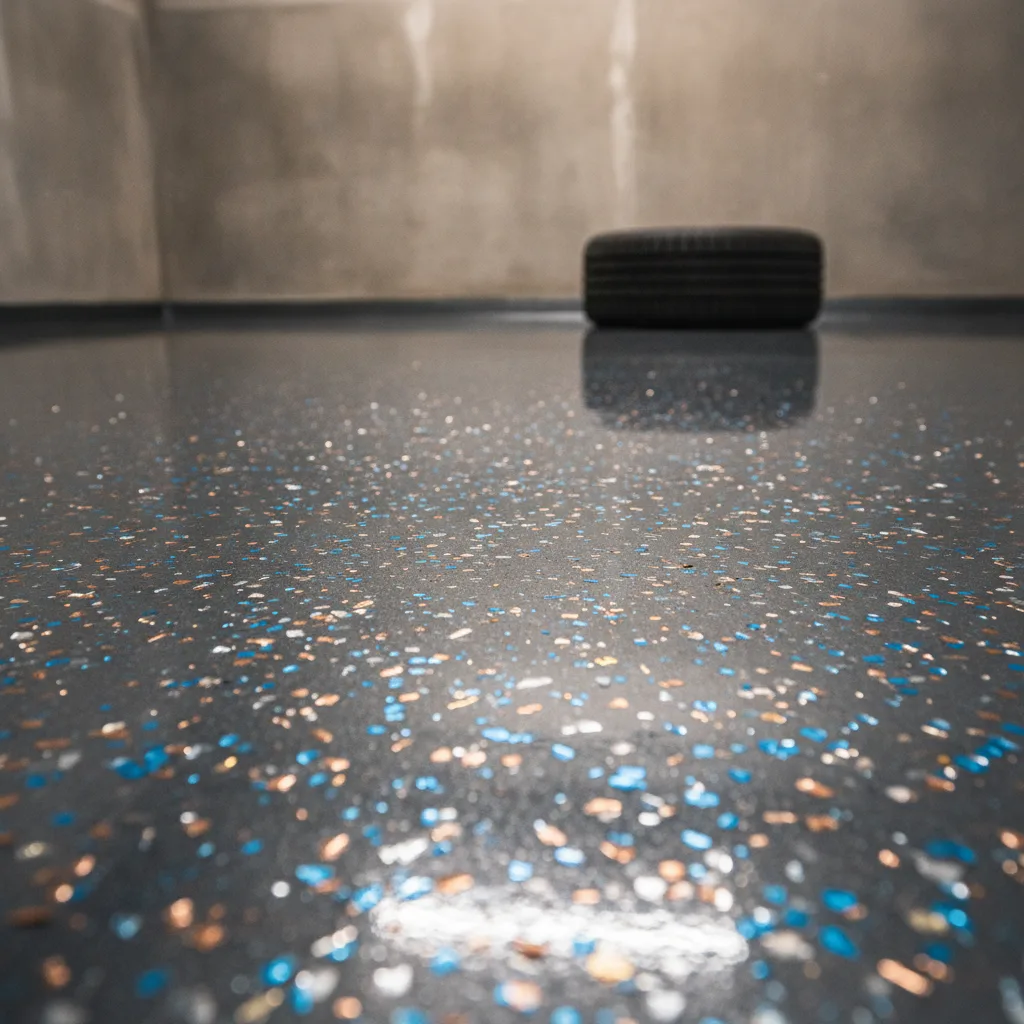
Decorative options are also worth noting. A metallic epoxy or flake broadcast system adds texture and visual depth that polished concrete and paint simply cannot replicate. Coloured vinyl flakes broadcast into the wet epoxy give the floor a slip-resistant, speckled finish that hides minor imperfections in the slab and stays looking good through years of vehicle traffic.
What are the practical trade-offs worth knowing before choosing a concrete floor finish?
The main practical trade-offs between concrete floor finishes are upfront cost, cure time, ongoing maintenance and suitability for the specific environment. Cheaper options cost less on day one but tend to cost more in repeat applications over the life of the floor, while a premium epoxy system involves a higher initial outlay that pays for itself through longevity.
Here is how those trade-offs play out in practice across the most popular options:
Cure time. Acrylic paint can be walked on within a few hours, but you should not drive on it for at least 72 hours and even then it is marginal. A two-part epoxy coating needs 24 hours before foot traffic and typically 72 hours before vehicle access, depending on ambient temperature. Polished concrete requires multiple grinding sessions across several days and still needs a topcoat to cure before use.
Maintenance. Polished concrete requires periodic reapplication of densifier or guard to maintain its stain resistance. Paint needs touch-ups and eventual full recoating every couple of years. Epoxy flooring, by contrast, needs nothing more than a damp mop and an occasional clean with a pH-neutral cleaner. That low-maintenance reality matters a lot for a busy household garage.
Slab condition. No coating makes a bad slab look great for long. Cracks, moisture vapour transmission from below and previous failed coatings all affect how well the new finish will perform. A professional assessment of the slab before any work begins is the single most valuable step you can take, regardless of which finish you end up choosing.
Environment. Melbourne garages face wide temperature swings, sometimes exceeding 40 degrees Celsius in summer. Flexible coatings like polyurethane handle thermal movement better than rigid systems, which is why the best epoxy installers use a topcoat designed to accommodate minor movement without cracking.
Slip resistance. Raw polished concrete and some sealers can be dangerously slippery when wet. Epoxy systems with a flake broadcast or anti-slip additive maintain traction even when the floor is damp, which is particularly important in a garage where oil drips and wet tyres are a fact of life.
Which concrete floor finish gives you the best long-term value?
For a residential garage in Melbourne, epoxy coating gives the best long-term value when you account for the full cost over ten years. A professional epoxy coating applied once to a properly prepared slab will outlast three or four rounds of floor paint and require far less ongoing maintenance than polished concrete. The total cost of ownership is lower even though the day-one price is higher.
That does not mean epoxy is the right call for every space. A high-traffic commercial kitchen might benefit from a specialist anti-bacterial polyurethane system. A heritage home with a decorative exposed aggregate path needs a penetrating sealer rather than a coloured coating. Context matters. But for the typical Melbourne homeowner who wants a garage floor that looks sharp, handles the car, the bikes and the weekend DIY projects, and does not need repainting every two summers, epoxy coating is the clear front-runner among all the concrete floor finishes on the market.
The other thing worth saying plainly: the quality of the installation matters as much as the product. The same epoxy system applied over a poorly prepared slab will fail just as fast as cheap paint. Choosing an experienced local installer who diamond-grinds the slab, checks for moisture and uses commercial-grade materials is what separates a coating that lasts a decade from one that peels in eighteen months.
Book a residential garage floor coating consultation with Metal and Flake.