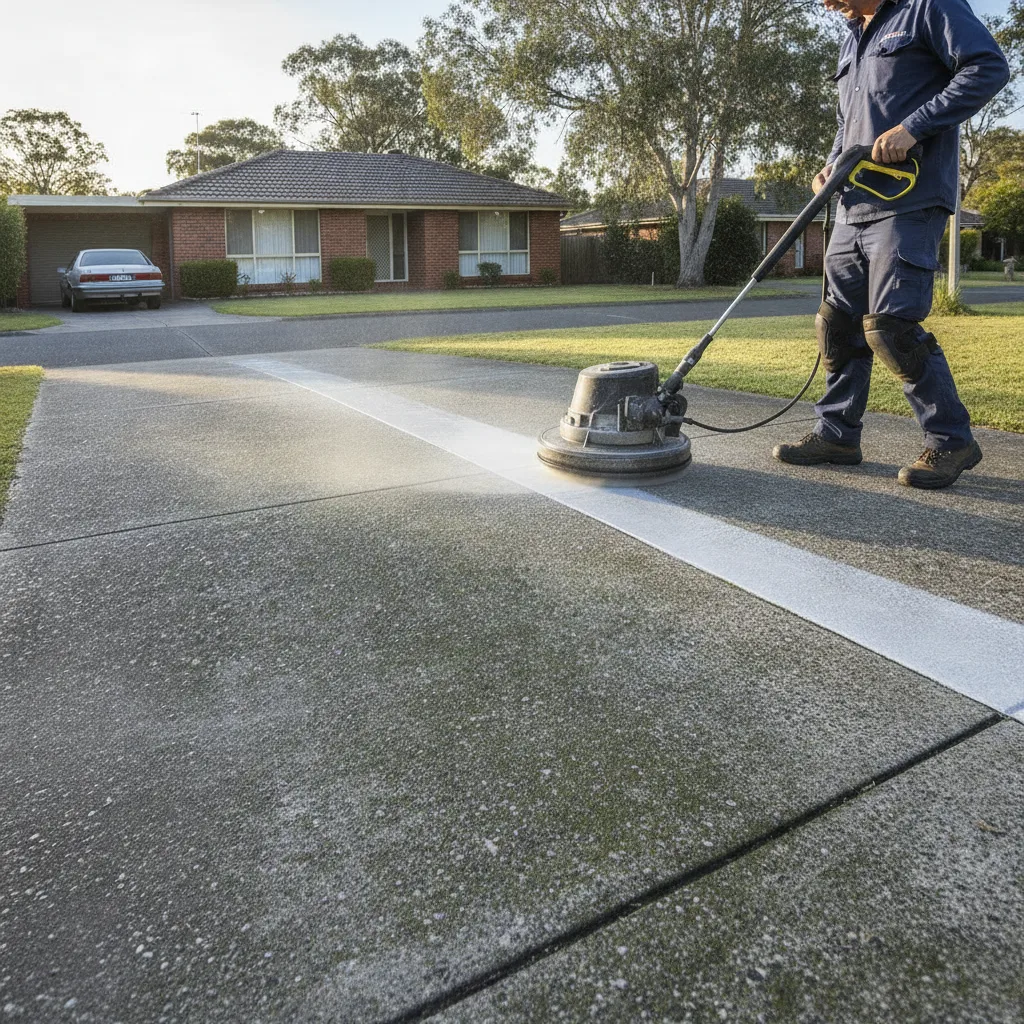
Pressure Cleaning Concrete in Melbourne: Before Coating or Sealing
To pressure clean concrete before coating or sealing, you need to blast away surface contaminants, old residues and biological growth so the coating can bond directly to the slab. Skipping this step is the single biggest reason coatings peel prematurely. A properly pressure-washed surface, followed by a dry and grind, gives any sealer or epoxy the clean slate it needs to last.
Why does pressure cleaning concrete matter so much before you coat it?
Pressure cleaning concrete before applying any coating or sealer removes the layer of dirt, oil, mould, efflorescence and old product that sits between your slab and whatever you put on top. If that layer stays, the coating bonds to the contamination rather than the concrete itself, and it will lift, bubble or peel within months. A high-pressure wash is the fastest way to strip that layer back to something the coating can actually grip.
Think of it like painting over a greasy wall. The paint might look fine on day one, but it has nothing solid to hold onto. The same physics apply to garage floors, driveways, warehouse slabs and pool surrounds. Melbourne’s climate adds its own twist: our combination of hot summers and wet winters encourages mould and algae to build up fast, especially on south-facing or shaded slabs. Pressure cleaning gets all of that off in one pass.
It also gives the installer a chance to spot problems early. Cracks, surface delamination, contamination from old oil spills or previous coatings become obvious once the slab is clean. Trying to assess a dirty floor is like trying to read a page through mud.
What pressure and technique do you actually need to pressure clean concrete properly?
To pressure clean concrete effectively, you typically need a machine running between 3,000 and 4,000 PSI with a flow rate of at least 15 litres per minute and a turbo or rotary nozzle. A domestic pressure washer running at 1,500 PSI will shift loose dirt but it will not cut through hardened grease, biofilm or embedded residues the way a trade-grade machine does.
The nozzle angle matters as much as the pressure. A zero-degree pencil jet concentrates force in one spot and can actually etch or pit soft concrete if you hold it too close. A 15-degree or 25-degree fan nozzle, or a purpose-built surface cleaner attachment, covers ground faster and gives a more even result. For larger areas like driveways or warehouse floors, a rotary surface cleaner head keeps the pressure consistent across the full pass and avoids the striping pattern you often see from a hand-held lance.
For stubborn oil stains, a degreaser applied before the wash and left to dwell for 10 to 15 minutes makes a real difference. The pressure wash then rinses the broken-down grease away rather than just pushing it around. On biological growth like lichen or mould, a sodium hypochlorite pre-treatment works the same way.
One thing that often catches homeowners out: the slab needs to be completely dry before any coating goes down. In Melbourne’s cooler months that can mean waiting 48 to 72 hours after a wash before grinding and applying product. Rushing that drying window is another common reason coatings fail early.
Is pressure cleaning concrete on its own enough surface prep before epoxy or sealing?
Pressure cleaning concrete is an essential first step but it is rarely sufficient on its own before applying epoxy, polyurea or a penetrating sealer. For coatings that need a mechanical bond, the slab also needs to be ground or diamond-scarified after the wash to open up the concrete’s pores and create a surface profile. Pressure washing alone leaves the surface too smooth for most coating systems to grip reliably.
The Concrete Institute of Australia’s guidelines note that surface preparation is the most critical factor in coating durability, and they recommend a minimum surface profile of CSP 2 to CSP 3 (a light sandpaper texture visible to the eye) for most thin-film coatings. Pressure washing typically achieves CSP 1 at best. That gap is closed by grinding after the wash.
For penetrating sealers on outdoor concrete, driveways and paths, the equation is a little different. A penetrating sealer soaks into the slab rather than sitting on top of it, so it is less dependent on mechanical profile. A thorough pressure wash, a degrease and a full dry is often enough prep for that category of product. But even then, a clean surface means the sealer penetrates evenly rather than being blocked by surface residue in patches.
The takeaway is simple: pressure cleaning is step one, not the whole job. It sets up every step that follows, and doing it properly saves time and money compared to dealing with a failed coating six months down the track.
What should Melbourne homeowners watch out for when organising concrete pressure cleaning?
There are a few things worth knowing before you book or attempt a concrete pressure clean in Melbourne. First, check what’s around the slab. High-pressure water carries contaminants with it, and if you are washing a driveway next to garden beds or near stormwater drains, degreasers and biological residues need to be contained or neutralised before they run off. Many Melbourne councils have requirements around trade waste and what can enter the stormwater system.
Second, older Melbourne homes (particularly anything built before 1990) may have concrete that was laid thinner or with a weaker mix than modern slabs. Aggressive pressure washing on soft or porous concrete can open up surface cracks or push water into existing ones. A professional eye before you start can save a lot of grief.
Third, be realistic about what pressure cleaning will and will not fix. Heavy oil saturation, for example from a car that leaked for years in the same spot, may need chemical treatment, grinding and sometimes partial repair before a coating will hold over that area. Pressure cleaning reduces the contamination but does not always eliminate it entirely at depth.
Finally, timing matters in Melbourne. Avoid scheduling a wash followed immediately by coating application if a cool or rainy stretch is forecast. Moisture in the slab is the enemy of adhesion, and Melbourne’s shoulder seasons can be unpredictable. A good installer will test slab moisture with a meter before they apply anything.
Getting your concrete prep right from the start is the difference between a coating that looks great for a decade and one that starts lifting within a year. The team at Metal and Flake handles the full process, from pressure cleaning through to grinding and applying high-quality epoxy and coating systems across Melbourne and surrounds. Get a quote for concrete cleaning and coating.