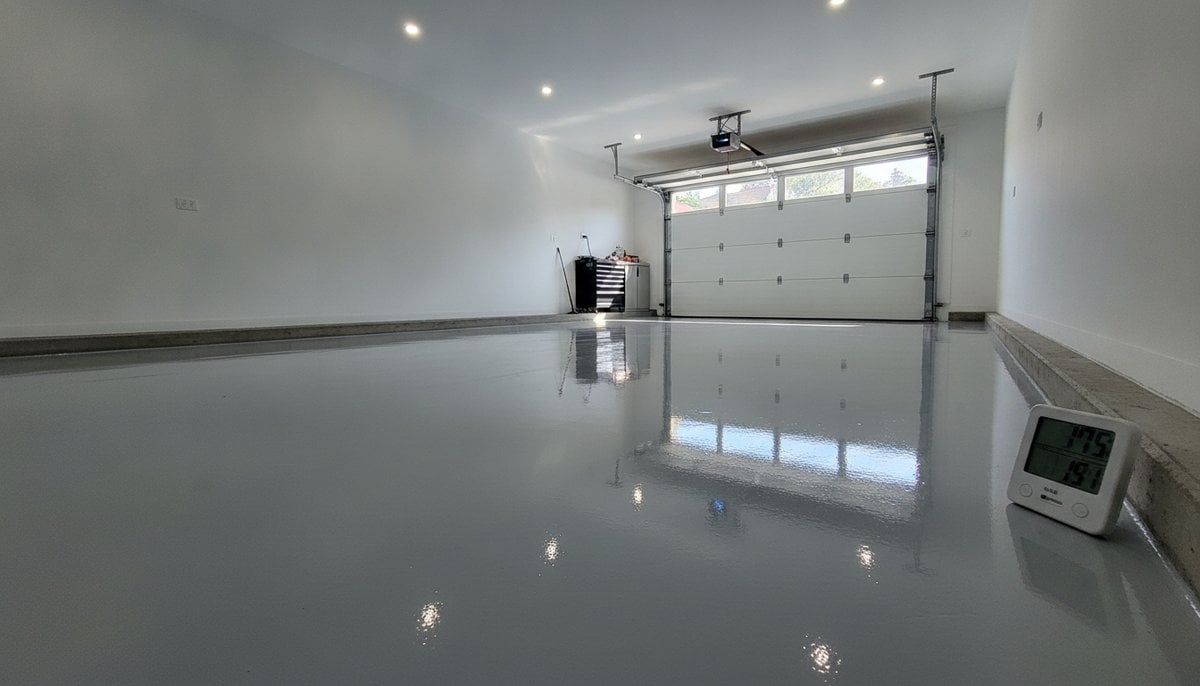
If you’re planning an epoxy garage floor in Melbourne, the question most people ask second (right after price) is: how long before I can use it again? Epoxy floor cure time is not a single number. It moves depending on the temperature in your garage, the humidity in the air, the moisture sitting in your concrete slab, and the specific product your installer uses. Get the timing wrong and you risk a floor that peels, clouds, or leaves tyre marks on its first day of use. This guide gives you a straight, climate-aware answer, including what Melbourne’s notoriously variable weather actually means for your install schedule.
Whether you’re a tradie fitting out a workshop, a small-business owner resurfacing a commercial floor, or a homeowner who just wants their car back inside, you’ll find a clear timeline here, city-by-city comparisons for Australian conditions, and an honest look at fast-cure alternatives that can cut your downtime significantly.
Key takeaways
- Standard epoxy is dry to walk on in 24 hours, ready for light use in 72 hours, and fully cured in 5 to 7 days.
- In Melbourne winters (garage temps below 15°C), allow 4 to 5 days before light vehicle traffic and up to 10 days for heavy loads.
- Concrete moisture is the number-one cause of epoxy failures in southern Australia. Slabs must read below 75% relative humidity before coating begins.
- Polyurea and fast-cure systems can return a floor to vehicle use in as little as 24 hours, at a higher material cost.
- Ventilate the space for the full cure window. Re-entry within the first 24 hours requires appropriate respiratory protection.
- For a business floor, calculate your cost of downtime before choosing between standard epoxy and a fast-cure system.
The standard epoxy floor cure time: stage by stage
Epoxy cures through a chemical reaction between the resin and hardener, not by drying out like paint. That reaction generates heat and continues long after the surface feels solid. Here are the four stages you need to plan around.
Stage 1: dry to touch (12 to 24 hours)
The surface feels firm and is no longer tacky. You can walk on it carefully in clean, soft-soled shoes. Do not drag anything across it. At this stage the coating has very little abrasion resistance and is still off-gassing. Keep the garage door slightly open for ventilation.
Stage 2: light foot traffic (24 to 48 hours)
Normal foot traffic is safe. Avoid dragging furniture or equipment. Do not park a vehicle. In Melbourne summer conditions (25°C to 35°C in the garage), some systems reach this point closer to 18 to 24 hours. In winter (10°C to 15°C), budget 36 to 48 hours.
Stage 3: light vehicle and equipment use (72 hours)
The floor can handle a standard passenger car at 72 hours under warm, dry conditions. This is the milestone most residential customers care about. Note that turning the steering wheel while stationary (power-steering scrubbing) can still damage the surface at this stage. Roll in, park straight, leave it.
Stage 4: full cure and maximum hardness (5 to 7 days)
Full chemical cure is complete. The floor can handle heavy vehicles, jack stands, trolleys, and concentrated point loads. This is also when the coating reaches its rated chemical resistance, so avoid spilling solvents or battery acid before this point.
| Stage | Warm conditions (20°C+) | Cool conditions (below 15°C) |
|---|---|---|
| Dry to touch | 12 to 18 hours | 18 to 24 hours |
| Light foot traffic | 24 hours | 36 to 48 hours |
| Light vehicle use | 72 hours | 4 to 5 days |
| Full cure | 5 to 7 days | 7 to 10 days |
How Melbourne’s climate affects epoxy garage floor drying time
Melbourne is the hardest Australian city to predict when it comes to epoxy garage floor drying time. A 28°C north wind on a Friday afternoon can drop to 12°C and 80% humidity by Sunday morning. That 16-degree swing inside an uninsulated garage directly changes the cure rate and the risk profile of your install.
Temperature: the main dial
Epoxy resin needs a minimum ambient temperature of around 10°C to cure at all. Below that threshold, the chemical reaction essentially stalls. The sweet spot for most systems is 18°C to 25°C. Above 30°C, the pot life (the time you have to apply the mixed product before it starts to gel) shortens dramatically, and applying epoxy in a hot garage can cause surface bubbling as trapped air tries to escape through the coating before it sets.
For Melbourne installs, this means:
- November to March (summer): schedule the install early in the week so the floor hits 72 hours before the weekend. Start application in the morning before the garage heats up.
- June to August (winter): add 30% to 50% to every stage in the timeline above. A 72-hour milestone becomes a 4 to 5 day milestone. Plan your downtime accordingly.
- Autumn and spring: most reliable window. Stable 16°C to 22°C temperatures give predictable results closest to the manufacturer’s stated times.
Australian city-by-city comparison
If you’re looking at this from elsewhere in Australia, here’s how conditions differ:
| City | Main risk factor | Typical full-cure window |
|---|---|---|
| Melbourne | Temperature swings, winter cool, damp slabs | 5 to 10 days (seasonal) |
| Sydney | Humidity in summer, coastal moisture | 5 to 7 days |
| Brisbane | High humidity year-round, summer heat | 5 to 7 days (moisture prep critical) |
| Adelaide | Extreme summer heat shortens pot life | 5 to 7 days (timing of application critical) |
| Darwin | Wet season humidity can prevent adhesion | Dry season installs only; 5 to 7 days |
| Hobart / alpine VIC | Cold temperatures year-round | 7 to 14 days; specialist products needed |
Concrete moisture: the hidden problem in southern Australia
Concrete slabs in Melbourne’s cooler, wetter months hold moisture longer than their northern counterparts. Applying epoxy over a slab that reads above 75% internal relative humidity is one of the most common causes of delamination and blistering in this city.
A professional installer will test the slab with a calibrated hygrometer before applying any primer. Standards Australia sets substrate moisture limits for resin floor coatings, and a good installer follows these regardless of how dry the surface looks. Visual dryness is not reliable. A slab poured in winter can look bone dry on top while holding excess moisture beneath the surface for weeks.
Practical implications for Melbourne homeowners and business owners:
- If your garage slab was recently wet (flooding, hose-down, or heavy rain ingress), allow at least 5 to 7 days of dry weather before testing, and potentially longer before coating.
- New slabs need a minimum of 28 days to cure before any epoxy coating, and ideally 60 days in winter.
- A damp-proof membrane under the slab significantly reduces moisture-related delays. If yours doesn’t have one and the garage sits below grade, discuss this with your installer before booking.
How long before you can park on epoxy? A practical answer
The answer to “how long before you can park on epoxy” depends on which epoxy system was used and what your garage temperature has been since installation.
- Standard solvent-based or water-based epoxy, Melbourne summer: 72 hours minimum. 5 days preferred.
- Standard epoxy, Melbourne winter (garage under 15°C): 5 days minimum. 7 days strongly preferred. 10 days for a heavy ute or van.
- 100% solids epoxy (thicker build, slower cure): 5 to 7 days regardless of season before vehicle use.
- Polyurea topcoat over epoxy base: vehicle use often possible at 24 to 48 hours, depending on the specific system.
One practical tip: when you do park for the first time, leave the vehicle in the same spot for no more than 24 hours. Tyre plasticisers can temporarily stain a floor that hasn’t reached full cure. After 7 days, this is no longer a concern with a quality topcoat.
Fast-cure alternatives: polyurea and what it costs you
If your floor being out of action for 5 to 7 days costs you real money, a tradie who parks a work vehicle in the workshop, a mechanic, a small-business owner with a client-facing space, then a polyurea or fast-cure hybrid system is worth a serious look.
Polyurea coatings cure significantly faster than standard epoxy:
- Dry to touch: 1 to 4 hours.
- Light foot traffic: 4 to 6 hours.
- Vehicle use: 24 hours in most conditions.
- Full cure: 24 to 72 hours.
The trade-offs are real. Polyurea costs more per square metre in materials. It has a very short pot life (sometimes under 30 seconds for 100% polyurea), which means it almost always requires professional spray application rather than roller application. The aesthetic range is also narrower: if you want a metallic epoxy finish with deep visual movement, a standard multi-coat epoxy system delivers a result that polyurea alone cannot match.
A practical middle ground used by many Melbourne installers is an epoxy base coat with a polyurea or polyaspartic topcoat. You get the build, colour, and finish options of epoxy with a topcoat that dramatically cuts the return-to-service time. Ask your installer specifically whether this combination is available and what the cost difference is. For a Melbourne epoxy garage floor, the price premium for a faster-cure system typically runs 15% to 25% above a standard epoxy quote.
Ventilation and re-entry safety during the cure window
Epoxy resins are classified as hazardous chemicals during application and the early cure period. Safe Work Australia identifies uncured epoxy resins as skin sensitisers and notes that vapour inhalation during application requires appropriate controls, including ventilation and, in enclosed spaces, respiratory protection.
For a residential garage, the practical steps are:
- Keep the garage door open or partially open for at least 24 hours after application.
- Do not use the space as a shortcut or storage area during the first 24 hours.
- If you need to re-enter in the first 12 hours (to check on the floor), wear a half-face respirator with organic vapour cartridges.
- After 48 hours, off-gassing from a water-based epoxy system is typically minimal in a ventilated space.
- Solvent-based systems off-gas longer. Follow your installer’s specific guidance.
For commercial premises with staff, ventilation requirements under the National Construction Code are worth confirming with your installer before work begins. The Australian Building Codes Board sets performance requirements for indoor air quality in occupied commercial spaces that are relevant during any resin floor installation or cure period.
What business owners should calculate before booking
If this floor is in a working space, do the maths before you choose a system. A standard epoxy floor might cost $2,000 less than a fast-cure alternative on a 60m² workshop, but if your business runs through that space and loses $500 a day in productivity, 5 days of downtime costs $2,500. The fast-cure system just paid for itself.
Questions to put to your installer before signing:
- What is the guaranteed return-to-vehicle-use time for your specific system, at current seasonal conditions in Melbourne?
- Is a polyurea or polyaspartic topcoat available, and what does it add to the quote?
- Will you test the slab moisture before application, and what happens if it’s too wet to coat on the booked day?
- What temperature range does your product specification cover, and how does that apply to my garage’s actual conditions?
You can also review the Metal and Flake epoxy flooring FAQ for answers to common questions about Melbourne installs, or look through the floor gallery to see finished systems and help choose the right product for your space.
FAQ
Can I speed up epoxy curing time by using a heater?
A space heater can raise garage temperature and modestly speed the cure, but it must be used carefully. Heating the air while the slab remains cold creates a temperature differential that can cause condensation on the surface, which will ruin the coating. If you use heat, warm the space for at least 4 hours before application and keep it consistent throughout the cure window. Do not direct heat at the floor surface directly.
What happens if it rains during the cure period?
Rain doesn’t directly damage curing epoxy inside a closed garage, but a rise in ambient humidity can slow the reaction and, in extreme cases, cause surface blush (a chalky, waxy residue) on two-pack systems. Keep the garage door closed during rain events in the first 48 hours. If moisture gets onto the surface before it has fully cured, contact your installer immediately rather than attempting to fix it yourself.
How long does epoxy floor cure time take on a new concrete slab?
New concrete needs a minimum of 28 days before any coating is applied, and 60 days is strongly preferred in Melbourne winter conditions. The concrete must also pass a moisture test before application begins. Coating a slab too early is one of the most common causes of epoxy failure and will likely void any installer warranty.
How long before you can park on epoxy if it was a DIY kit?
Consumer epoxy kits are almost always lower-solids formulations than professional systems, and they typically have longer cure times, not shorter. Most kit instructions recommend 72 hours before vehicle use under ideal conditions. In Melbourne’s cooler months, add 2 to 3 days. Professional-grade systems applied correctly often return to vehicle use faster than DIY kits because the product formulation, surface preparation, and application conditions are all optimised.
Does the colour or finish affect how long epoxy takes to cure?
The colour has no meaningful effect on cure time. The system type does. A single-coat epoxy sealer cures faster than a full broadcast flake system with multiple coats and a topcoat. A metallic epoxy with a clear polyurethane topcoat will have a different cure schedule to a plain pigmented epoxy with no topcoat. Always ask your installer for the specific cure schedule for the exact system being applied, not a generic estimate.
Ready to plan your install?
Epoxy floor cure time in Melbourne is manageable when you know what to expect before the job starts. Pick the right season, confirm your slab is dry, choose the system that matches your downtime budget, and follow the ventilation rules. If you’re weighing up a standard epoxy finish against a fast-cure option for a garage or workshop, the team at Metal and Flake can give you a straight answer based on your specific space and Melbourne’s current conditions. Get in touch for a free epoxy floor quote and we’ll walk you through the timeline before any work begins.