Garage Floor Tiles vs Epoxy: Which Lasts Longer in Melbourne?
When comparing garage floor tiles ideas against epoxy coating, epoxy generally outlasts loose-lay or interlocking tiles in a working garage. A professionally applied epoxy system bonds directly to the concrete slab, creating a seamless surface that resists tyre scuffs, oil and moisture. Quality interlocking tiles can lift, crack or discolour under the same conditions within a few years.
What are the most popular garage floor tiles ideas for Melbourne homes?
The most popular garage floor tile options in Melbourne are rigid PVC interlocking tiles, rubber mat tiles and polypropylene drain tiles. PVC interlocking tiles are the bestseller because they are easy to install yourself, come in various colours and cost roughly $3 to $8 per square metre at most hardware chains. Rubber tiles absorb impact well and suit workshops. Polypropylene open-grid tiles allow water to drain through, which is handy for Melbourne’s wetter months when wet boots and dripping cars bring water inside.
All three options share the same appeal: no grinding, no primer, no waiting for coats to cure. You lay them on a Saturday afternoon and park the car back in on Sunday. That convenience is real, and for a rented garage or a temporary workshop setup it makes complete sense.
The trade-off is that none of them bond to the slab. Every tile sits on top of the concrete, which means the concrete underneath keeps doing whatever it was doing before. Oil stains soak into the concrete and stay there. Moisture still moves through. And once a tile cracks or a corner chips, you either replace individual tiles or live with the gap.
How does epoxy compare to garage floor tiles ideas on durability?
Epoxy outperforms interlocking tiles on long-term durability because it becomes part of the slab surface rather than sitting on top of it. A properly prepared and applied epoxy floor can last 10 to 20 years in a domestic garage with normal use. Interlocking PVC tiles typically show significant wear, fading or deformation within 3 to 7 years, especially in Melbourne’s summer heat where slab temperatures can reach 50 degrees Celsius and cause cheaper tiles to warp and pull apart at the joints.
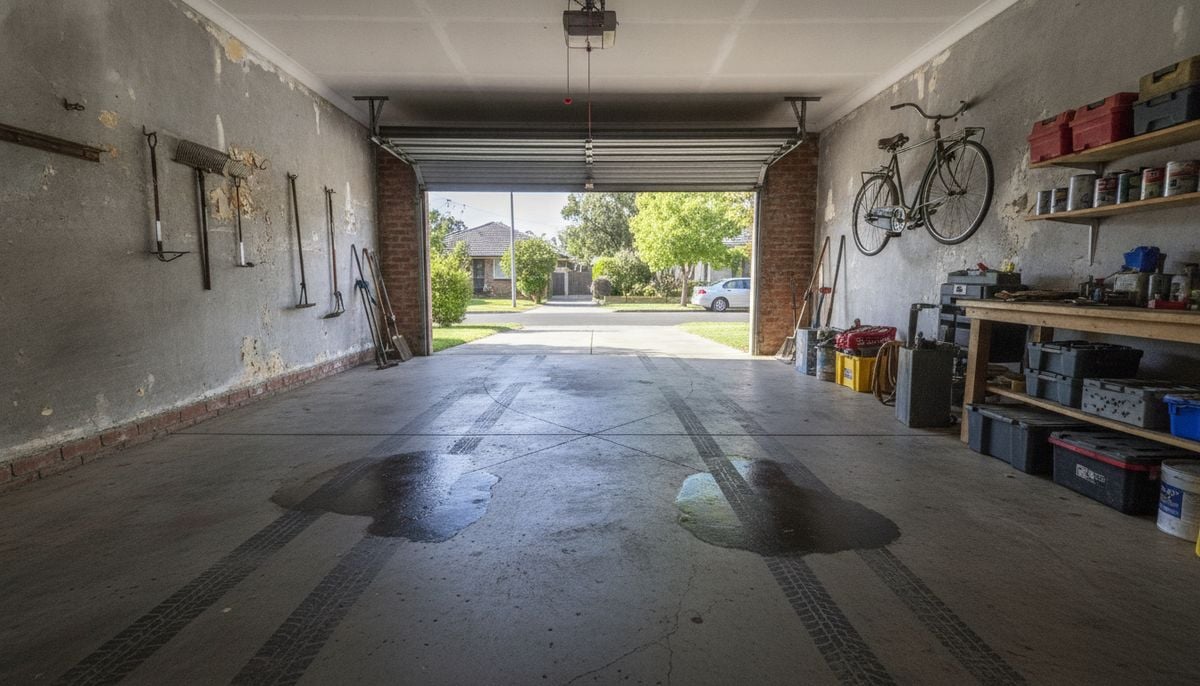
Tyre marks are a well-known issue with soft PVC tiles. Plasticisers in car tyres react with the PVC and leave permanent yellow or brown stains. Once that happens, the tiles look tatty and there is no cleaning it out. Epoxy with a topcoat sealer resists tyre staining because the surface is non-reactive and far denser.
Epoxy also handles point loads better. A car jack, a dropped engine block or a heavy tool cabinet sitting in one spot will indent or crack a tile over time. Epoxy doesn’t dent. The bond to the concrete means the load transfers straight into the slab, which is exactly what the slab is designed for.
Which option costs more upfront and over time in a Melbourne garage?
Tiles cost less upfront but more over time, while epoxy costs more to install but pays for itself through longevity and lower maintenance. A full PVC tile kit for a standard two-car garage of around 36 square metres might set you back $300 to $500 at a hardware store. Professional epoxy for the same area typically runs $1,500 to $3,500 depending on the system, surface prep required and finish chosen.
Run the numbers over ten years, though. If you replace or patch your tile floor twice in that period, you are spending money, time and effort. You also still have the original concrete doing nothing for you underneath. Epoxy, done once properly, sits there and performs for the decade with nothing more than occasional mopping.
Surface preparation is where the real cost difference lives. Epoxy requires diamond grinding or acid etching to open the concrete’s pores so the resin can penetrate and bond. That preparation step is what makes the difference between a floor that peels in 18 months and one that goes the distance. Tiles skip that step entirely, which is partly why they feel cheaper and simpler but also why they have no grip on the slab beneath them.
What does a good garage floor look like from a design perspective?
Good garage floor design balances looks with practicality. Tiles offer a grid pattern that some homeowners like for a motorsport or workshop aesthetic, and swapping individual tiles lets you mix colours easily. Epoxy systems, particularly flake and metallic finishes, give a seamless, high-end look that reads more like a showroom than a utility space. For Melbourne homes where the garage opens to the street or connects to a living area, that seamless finish tends to lift the whole property’s presentation.
Flake epoxy systems, which broadcast vinyl colour flakes into a wet epoxy base before sealing, are particularly popular because the texture adds slip resistance underfoot and the speckled pattern hides minor dirt and scuffs between cleans. Metallic epoxy creates a swirling, almost three-dimensional look that photographs well and impresses guests, though it is best kept for spaces that won’t see heavy mechanical work. The main point is that epoxy gives you far more variety in finish than a grid of interlocking squares.
What should Melbourne homeowners consider before choosing?
Before committing, Melbourne homeowners should weigh three practical factors: how long they plan to stay in the property, how the garage is used day to day, and the current condition of the slab. If you are renting or planning to sell within two years, tiles are a sensible, removable investment. If you own the home and the garage sees regular car parking, storage or workshop use, epoxy makes far more sense for the long haul.
Slab condition matters a lot. A heavily cracked or contaminated concrete floor needs repair and preparation before either option performs well. Tiles will bridge small cracks but flex over them and eventually crack themselves at the same spot. Epoxy, applied over a properly repaired and ground slab, locks the surface solid and prevents further surface deterioration.
Melbourne’s climate is worth factoring in too. The city gets hot, dry summers and cold, damp winters. Concrete slabs here expand and contract more than in more temperate climates. A bonded epoxy system moves with the slab. Tiles sitting on top of it move independently, which is why you see lifted corners and gapping joints in older tile floors across Melbourne’s western and northern suburbs, where temperature swings are most pronounced.
If you are genuinely sold on the tile aesthetic, some epoxy systems can replicate that grid look using saw-cut or inlaid designs in the epoxy itself. You get the visual of tiles with the durability of a bonded coating. It is a niche request but worth knowing it exists.
At the end of the day, most homeowners who have tried both eventually land on epoxy as the answer. Tiles are fine for a quick fix. For a garage floor that looks sharp, cleans easily and holds up through decades of Melbourne weather and daily use, epoxy is the practical choice.
Compare epoxy flooring options with Metal and Flake