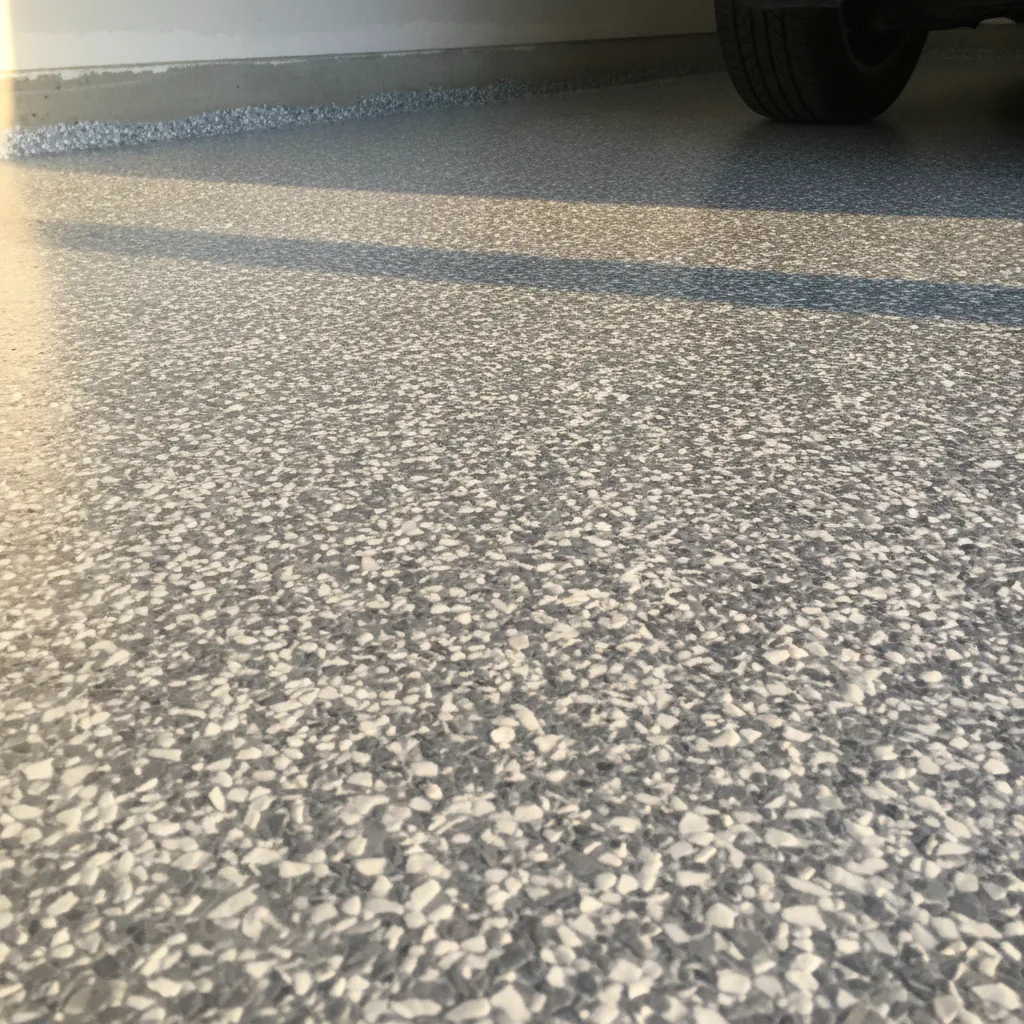
Garage Floor Ideas for Williamstown Homes: Epoxy Coating Guide
The best garage floor ideas for Williamstown homes come down to one proven option: epoxy coating. A quality epoxy system bonds directly to the concrete slab, resists oil and water, handles the daily grind of a working garage, and looks sharp doing it. Most residential jobs use a broadcast flake finish for grip and colour, applied in two to three layers over a diamond-ground base.
Why do Williamstown homeowners choose epoxy over other garage floor options?
Williamstown homeowners choose epoxy because it outperforms paint, tiles and bare concrete on every practical measure. Garage paint peels within a year or two under tyre heat and moisture. Tiles crack and lift when heavy loads are dragged across them. Bare concrete stains permanently and turns to dust under traffic. Epoxy bonds chemically to the slab and cures to a hard, seamless surface that handles all of it.
The suburb itself plays a role too. Williamstown sits on Port Phillip Bay, which means higher humidity and the occasional salt air off the water. Moisture is the enemy of a bare concrete slab: it seeps up from below, carries salts to the surface and causes the concrete to spall over time. A properly applied epoxy coating with a moisture-tolerant primer layer stops that cycle before it starts.
There is also the lifestyle angle. Williamstown is a heritage-rich suburb with a strong owner-occupier culture. People here invest in their homes for the long term. A garage floor coating is one of those upgrades that costs a fraction of a bathroom reno but adds genuine usability and visual appeal to a space that gets used every single day.
What are the most popular garage floor ideas and finishes available?
The most popular garage floor finishes are full broadcast vinyl flake systems, solid-colour epoxy, and metallic epoxy. Vinyl flake is the go-to for residential garages because the chips hide minor imperfections, add texture for grip, and come in a huge range of colour blends. Solid colour suits a cleaner, more commercial look. Metallic epoxy creates a swirling, high-gloss effect that suits showrooms and feature spaces.
Here is a closer look at each option so you can match the finish to your garage:
Full broadcast vinyl flake: This is the most common system on residential jobs. Coloured vinyl chips are broadcast into the wet base coat until it is fully saturated, then sealed with a clear polyaspartic or polyurethane topcoat. The result is a textured, non-slip surface with good depth and colour. Blends range from earthy greys and charcoals (popular in Williamstown’s classic weatherboard homes) through to bold whites, blacks and multicolour mixes.
Solid colour epoxy: A clean two-tone or single-colour finish that suits garages used as workshops or home gyms. The surface is smooth and easy to sweep, which is a practical win in a working space. Greys and mid-tones wear the best because they disguise light tyre marks between cleans.
Metallic epoxy: A premium finish that uses metallic pigment suspended in the base coat, manipulated with air to create flowing, three-dimensional patterns. No two floors look alike. It is a showpiece finish that suits a display garage or a man cave rather than a daily-driver workshop, because the surface tends to show scuff marks more readily than a flake system.
Anti-slip additives: Regardless of the finish you choose, a fine aluminium oxide or shark grip additive can be blended into the topcoat. This is worth considering in Williamstown where bay breezes carry moisture and garages can stay damp longer than inland suburbs.
How does surface preparation affect your garage floor coating result?
Surface preparation is the single biggest factor in whether a garage floor coating lasts five years or twenty. The concrete must be mechanically ground with a diamond-head grinder to open the surface profile, remove any old paint or sealer, and expose clean aggregate for the epoxy to grip. Without that step, even a high-quality product will peel.
On older Williamstown properties, the concrete slab often has hairline cracks, surface contamination from years of oil drips, or areas where moisture has wicked up from below. Each of these needs to be addressed before a single drop of epoxy goes down. Cracks are filled with a flexible polyurea filler. Oil contamination is ground back and, in severe cases, treated with a degreaser before grinding. Moisture is managed with a breathable, moisture-tolerant primer that allows vapour transmission without blowing the coating off the surface.
Skipping or rushing prep is the number one reason DIY garage floor kits fail. The kits sold at hardware chains rely on acid etching rather than mechanical grinding, and acid etching simply does not create a consistent enough surface profile for epoxy to bond reliably. A professional installer using a planetary grinder will achieve a CSP (concrete surface profile) of 3 to 4, which is the standard recommended by most epoxy manufacturers for floor coatings.
How long does a garage floor coating last in a Williamstown climate?
A professionally applied epoxy garage floor coating in Williamstown typically lasts between 10 and 20 years with normal residential use. The lifespan depends on the thickness of the system, the quality of the topcoat, and how the floor is maintained. A polyaspartic topcoat outperforms standard epoxy as a sealer because it resists UV yellowing, handles thermal shock better, and reaches full cure faster than traditional epoxy topcoats.
Williamstown’s climate is mild compared to inland Victoria, but the coastal humidity does mean the floor sees more moisture cycling than a garage in, say, the outer eastern suburbs. That makes topcoat selection important. A hard, UV-stable polyaspartic clear coat will hold its gloss and resist moisture penetration far longer than a basic epoxy seal.
Day-to-day maintenance is straightforward. Sweep or blow out the floor weekly. Mop with a pH-neutral cleaner monthly. Avoid dragging sharp metal objects across the surface and clean up any chemical spills quickly. Battery acid and brake fluid will etch the coating if left to sit. Beyond that, the floor largely looks after itself.
What should you ask a garage floor coating contractor before booking?
Before booking any contractor for your Williamstown garage floor, ask these five things: What surface preparation method do you use (acid etch or mechanical grinding)? What is the total dry film thickness of the system? What brand and product line are you using for the base coat and topcoat? Do you carry public liability insurance? Can you provide photos of completed residential jobs?
A contractor who grinds the floor mechanically, uses a named commercial-grade product, builds the system to at least 400 to 500 microns dry film thickness, and can show you finished work in similar homes is a contractor worth booking. A quote that skips the prep details or refuses to name the product being used is a red flag worth taking seriously.
Also ask about the turnaround time. A polyaspartic topcoat reaches light foot traffic in as little as four to six hours and full vehicle traffic within 24 hours. That means the car can go back in the garage the next day, which matters for households that rely on their garage for daily access.
Williamstown homes are worth looking after, and the garage floor is part of the picture. Whether you are renovating a Federation cottage, updating a 90s brick veneer or finishing out a new build, a well-chosen epoxy system turns a drab concrete slab into a surface you are actually proud of.
Book a garage floor coating in Williamstown with Metal and Flake.