Garage Floor Ideas for Preston Homes: Epoxy Coating Options Explained
The best garage floor ideas for Preston homes balance durability with looks. Epoxy coatings are the standout choice because they bond directly to concrete, resist oil, tyre rubber and moisture, and last well over a decade with minimal upkeep. Options range from solid-colour systems through to metallic flake finishes, so there is something to suit every budget and style.
Why are epoxy coatings the most popular garage floor idea in Preston?
Epoxy coatings dominate the Preston garage floor market because they solve the two problems bare concrete cannot: staining and surface fatigue. A properly prepared and coated concrete slab creates a seamless, non-porous surface that shrugs off petrol drips, brake fluid and the grit that Melbourne’s weather tracks inside. Maintenance drops to a quick sweep and occasional mop.
Preston sits in Melbourne’s inner north, a suburb full of weatherboard homes on standard suburban blocks. Most garages here were built with a basic broom-finished concrete slab that was never sealed. After a decade or two, those slabs show oil stains near the bay door, salt-pepper pitting from road grit, and the odd hairline crack from seasonal movement. Epoxy does not just hide those flaws. A competent installer grinds or diamond-preps the surface first, removing the weak top layer and opening up the concrete’s pores so the coating actually bonds rather than peeling off within a year.
The thermal cycling Melbourne dishes out, hot dry summers and cold wet winters, matters here too. A quality two-part epoxy system applied at the right temperature window (generally between 10 and 28 degrees Celsius) cures to a film that flexes slightly with the slab rather than cracking away from it. That is why product choice and installation timing are not details to rush.
What garage floor finish options should Preston homeowners know about?
The main finish categories are solid-colour epoxy, full-flake broadcast systems, metallic epoxy and polyaspartic topcoats. Each suits a different combination of budget, traffic level and personal taste. Solid colour is the most affordable entry point; full-flake broadcast is the most popular for family garages because the chip pattern hides dirt between cleans and adds texture underfoot.
Here is a practical breakdown of the main options available to Preston homeowners.
Solid-colour epoxy. A single-tone basecoat, often grey or charcoal, finished with a clear topcoat. Clean lines, easy to hose down, and the most budget-friendly of the coated options. The downside is that every piece of grit on the floor is visible, so it suits people who keep a tidy workshop or use the garage mainly for parking.
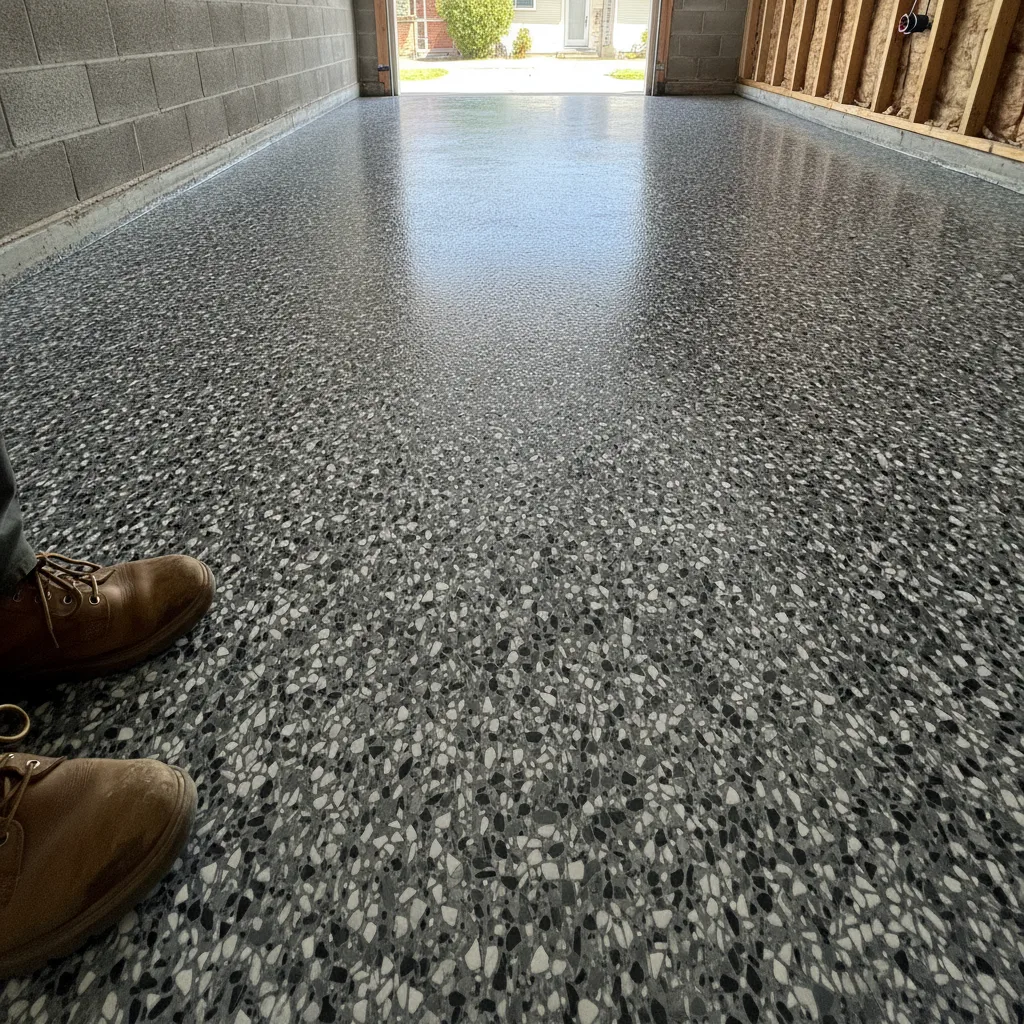
Full-flake broadcast (the Metal and Flake signature look). Coloured vinyl flakes are broadcast into the wet basecoat until the surface is fully covered, then sealed under a clear polyurethane or polyaspartic topcoat. The result is a speckled finish that closely resembles terrazzo. It hides dirt well, adds a non-slip texture and comes in dozens of flake blends. This is the system Metal and Flake specialises in, and it is the most requested finish across Melbourne’s inner-north suburbs including Preston, Northcote and Thornbury.
Metallic epoxy. Pigment powders are suspended in the epoxy base to create swirling, liquid-metal effects. Every floor looks slightly different because the installer manipulates the pigment before it sets. Stunning in a showroom-style garage or a home gym conversion, though the reflective surface shows dust more than a flake finish does.
Polyaspartic topcoat only. Some installers apply a fast-curing polyaspartic directly over prepped concrete as a standalone coating. Cure times can be as short as a few hours, which suits clients who cannot leave the garage out of action for a full day. The trade-off is that without a pigmented basecoat the floor has less depth of colour. Polyaspartic is more commonly used as the final topcoat over an epoxy base, combining the build and colour of epoxy with the UV stability of polyaspartic.
How does surface preparation affect garage floor coating results in Preston?
Surface preparation is the single biggest predictor of whether a garage floor coating lasts five years or fifteen. Proper prep means mechanical grinding or shot-blasting to open the concrete profile, not acid etching alone. Without that mechanical key, even premium epoxy can delaminate within months, especially on older Preston slabs that have absorbed years of oil.
This is worth spelling out because a lot of homeowners get caught out by DIY kits or low-cost quotes that skip the grinder. A rental-grade paint roller and a tin of hardware-store epoxy will bond to the surface, but it bonds to the weak top layer of the concrete, not to the structural slab beneath. When that weak layer moves or dusts, the coating comes with it. You end up with peeling patches that cost more to strip and redo than a proper installation would have cost in the first place.
Professional installers use diamond-cup grinders or planetary machines that remove roughly half a millimetre of surface concrete and leave a consistent profile, usually a concrete surface profile (CSP) of 3 to 4 on the standard ICRI scale. That roughness gives the epoxy something to grip. On a Preston slab that has an oil-soaked bay area, a degreaser treatment followed by grinding is typically needed before any primer or basecoat touches the floor.
Moisture is the other factor. Melbourne’s inner-north suburbs have older housing stock, and some garages sit on slabs poured without a membrane. A simple plastic sheet tape test left overnight will tell you whether vapour is rising through the slab. If it is, a moisture-tolerant epoxy primer is essential, or the coating will blister within months of installation.
What does a garage floor coating cost for a typical Preston garage?
A standard single-car garage in Preston runs to roughly 25 to 35 square metres. A full flake system professionally installed, including surface prep, a pigmented basecoat, full broadcast of vinyl flake and a clear polyaspartic topcoat, typically falls in the range of $1,500 to $2,500 for that footprint depending on the condition of the concrete and the flake blend chosen. Double garages (50 to 60 square metres) scale accordingly but often attract a better per-square-metre rate.
Those numbers are a general guide only. Heavily contaminated slabs, crack repairs, or complex layouts with drains and pillars all add to the prep time and therefore the price. The best way to get an accurate figure is a site visit, because no photo or description captures what a concrete slab actually needs until someone walks on it.
One concrete thing worth knowing: polyaspartic topcoats carry a higher upfront cost than standard polyurethane, but they are UV-stable. Melbourne’s summer sun, which hits north-facing garage openings hard, will yellow a standard urethane topcoat over time. Polyaspartic holds its colour. That difference is worth factoring into a long-term cost comparison.
Which garage floor idea suits your Preston home best?
The right choice depends on three things: how you use the space, how much natural light the garage gets, and how hands-on you want to be with maintenance. For a working garage that sees tools, bikes and the family car, a full-flake broadcast system is the most forgiving and durable option. For a clean, minimal aesthetic where the floor is a feature, metallic epoxy or a solid-colour system with a gloss topcoat will turn heads. For a fast turnaround before a renovation or sale, a polyaspartic single-coat system gets the job done in a day.
Preston homeowners specifically benefit from choosing a Melbourne-based installer who understands local conditions, older inner-north slab construction, the soil movement patterns of the area, and the seasonal temperature windows that affect cure times. A good installer will walk you through the options honestly rather than up-selling a finish that does not suit the space.
Book a garage floor consultation in Preston with Metal and Flake