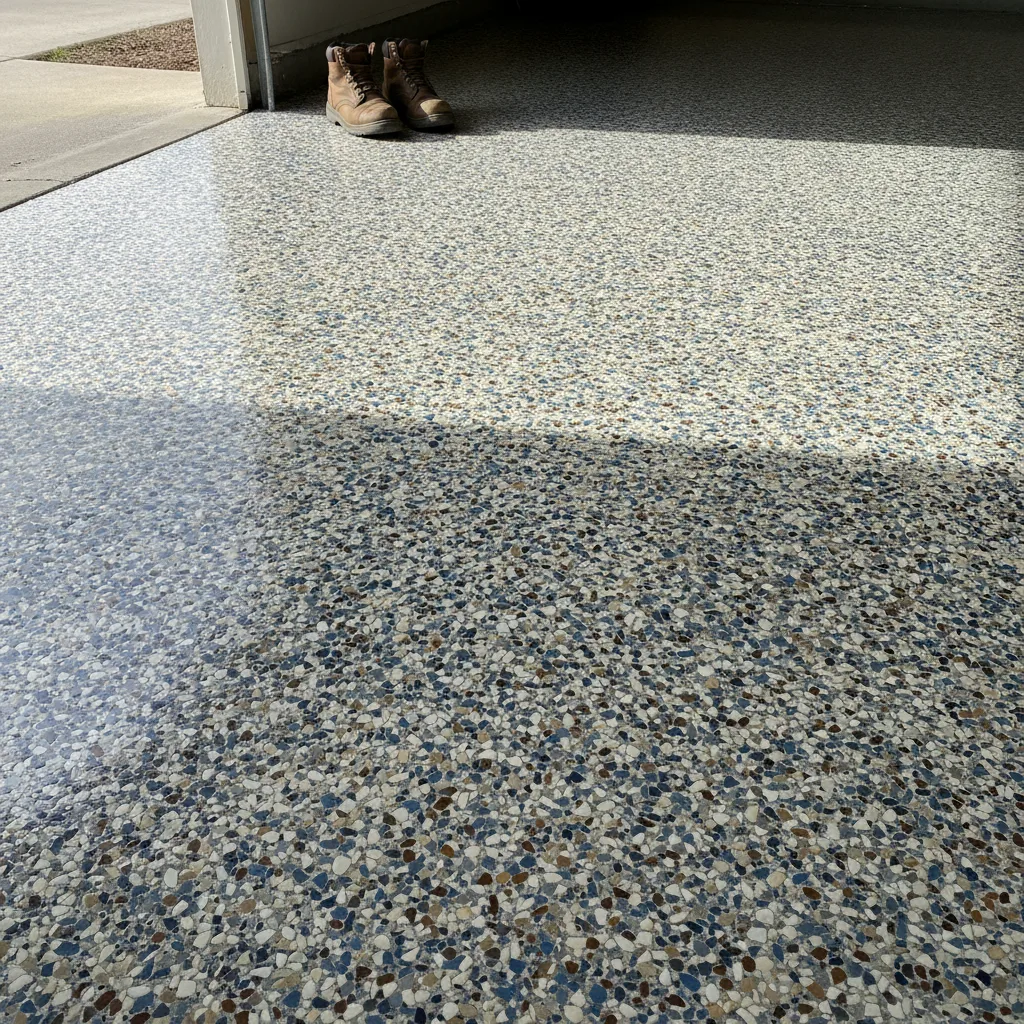
Epoxy Garage Floors in Coburg: A Local Homeowner’s Checklist
An epoxy garage floor in Coburg is a two-part resin coating bonded directly to your concrete slab, giving you a hard-wearing, chemical-resistant surface that handles Melbourne’s clay-heavy ground movement better than paint. A properly installed system lasts 10 to 15 years with minimal upkeep, and the whole job is typically completed in two to three days.
Why are epoxy garage floors such a popular choice for Coburg homes?
Coburg homes range from early Federation-era weatherboards to 1960s brick veneer and newer infill builds, and nearly all of them sit on expansive clay soils that shift with the seasons. An epoxy garage floor coating is flexible enough to handle minor slab movement, bonds tightly to aged concrete, and handles the oil drips, tyre marks and gritty residue that come with everyday Melbourne garage use. It also lifts the look of a space dramatically without the cost of tiling or replacement.
Beyond the practical side, Coburg’s inner-north demographic skews toward homeowners who are renovating older properties and want finishes that look sharp without being fussy. A metallic or flake epoxy floor sits comfortably alongside polished concrete bench tops, timber joinery and exposed brick. It reads as considered rather than over-the-top.
One more practical point: concrete floors in garages built before the 1990s are often thinner, poorly cured or contaminated with old oil. A professional coating system accounts for all of that, whereas a DIY roller kit rarely does.
What should you check before an epoxy garage floor is installed in Coburg?
Before any coating goes down, you need to assess the condition of your slab, confirm there is no active moisture rising through it, and make sure the surface has been properly ground or shot-blasted to open the concrete’s pores. Skipping any of these steps is the single biggest reason epoxy coatings peel within twelve months of installation.
Work through this checklist before your installer arrives:
- Check for moisture. Tape a 600mm square of plastic film to the bare concrete floor, seal the edges and leave it for 24 hours. If condensation collects underneath, you have a moisture vapour transmission issue that needs addressing before coating.
- Look for cracks and spalling. Hairline cracks are common in Coburg’s older slabs and can be filled as part of the prep process. Larger structural cracks (wider than 3mm or with vertical displacement) need an assessment from a builder or structural engineer first.
- Clear the garage completely. That includes wall-mounted shelving sitting on legs that contact the floor. Installers need full access to perimeter edges, and anything left in the space can delay the job and add cost.
- Check the age of any previous coating. If there is already a sealer, paint or old coating on the slab, your installer needs to know. Those layers must be fully removed before new epoxy is applied or adhesion will fail.
- Measure your garage carefully. Standard single garages in Coburg’s older streets are often narrower than modern double garages. Knowing your exact square meterage helps you get an accurate quote and choose the right product volume.
- Consider drainage and fall. Some older Coburg garages have no floor drain and a flat slab. This matters if you wash the car inside or live in a flood-prone street. Discuss it with your installer before the coating goes down.
- Plan for cure time. Most epoxy systems need 24 hours before foot traffic and 72 hours before you drive a car back in. Do not schedule the job the week before school holidays if the car will be stuck outside.
What finish options work best for an epoxy garage floor in Coburg?
The three most practical finish options for a Coburg garage are a full-flake broadcast system, a solid colour epoxy with a clear topcoat, and a metallic epoxy. Each suits different budgets and aesthetics, and the right choice depends on how the garage is actually used day to day.
A full-flake broadcast (also called a decorative flake or chip system) is the workhorse of the three. Coloured vinyl flakes are broadcast into a base coat and sealed with a clear polyurethane or polyaspartic topcoat. The result is slip-resistant, hides dirt well, and does not show tyre marks easily. It is the most practical option for a working garage that sees regular traffic. Flake sizes range from 1mm micro flakes for a refined look to 6mm large chips for a bold, high-contrast finish.
A solid colour epoxy is cleaner and more minimal. It suits garages being converted into home gyms or workshop spaces where the floor needs to look neat without drawing attention to itself. The downside is that scuffs and tyre marks are more visible, so a higher-sheen or matte topcoat choice matters here.
A metallic epoxy uses pigment and a pearlescent additive to create a swirling, marbled effect that looks genuinely striking. It suits Coburg homeowners who are using the garage as a showroom-style space, a home studio or a room that opens to the house. It costs more and requires a skilled installer to achieve a consistent result, but the finish is unlike anything else on the market.
How do you maintain an epoxy garage floor once it is installed?
Epoxy garage floors are low-maintenance by design, but a few straightforward habits will keep the surface looking sharp for years without any recoating. Sweep or blow out grit regularly, because fine particles act like sandpaper underfoot and dull the topcoat over time. Mop with warm water and a pH-neutral cleaner when needed. Avoid using bleach or solvent-based cleaners, as these can soften or cloud certain topcoat formulations.
For Coburg homeowners with older homes and unlined garages, leaf litter and grit tracking in from the garden is the main culprit for surface wear. A simple rubber mat inside the entry point catches most of it. If you park on the floor immediately after driving in wet conditions, give the tyres a moment to cool before parking on the coating, as hot tyre transfer (where rubber compounds bond faintly to the surface) is more common with budget topcoats than with quality polyaspartic systems.
Touch-ups are possible if a section chips or scratches, but matching colour and sheen exactly is tricky once the original coating has aged. It is worth keeping a small amount of your topcoat product stored in a cool, dark place for the first couple of years just in case.
How do you choose the right epoxy flooring installer in Coburg?
Choosing an installer is straightforward if you know what to ask. Get at least two on-site quotes rather than phone or online estimates, because the slab condition in every Coburg garage is different and a quote based on a photo will rarely be accurate. Ask specifically whether surface preparation (grinding or shot-blasting) is included in the price, as some operators quote low and charge prep as an add-on. Ask what brand and grade of resin they use, how many coats are included, and what the warranty covers.
Photos of completed local jobs are a reliable indicator. A good installer will have a portfolio of finished Coburg or inner-north Melbourne garages you can look at, and ideally a reference you can call. Check that they carry public liability insurance and are comfortable putting the scope of work in writing before you pay a deposit.
The difference between a coating that lasts a decade and one that peels by the second winter almost always comes down to prep and product quality, not the day rate on the quote.
Book an on-site quote in Coburg with Metal and Flake