Epoxy Floor Coating for Your Garage: A Melbourne Buyer’s Guide
An epoxy floor coating for your garage is a two-part resin system that bonds directly to concrete, creating a hard, chemical-resistant surface that is far tougher than bare slab. A quality installation lasts 10 to 20 years, handles oil spills and tyre scuff without fuss, and costs Melbourne homeowners roughly $50 to $100 per square metre depending on the finish and prep required.
Why do Melbourne garages need a proper floor coating in the first place?
Melbourne’s climate swings between cold, damp winters and scorching summers, and that cycle does real damage to untreated concrete. Bare slabs absorb oil, salt and moisture, which causes pitting, dusting and staining over time. A quality epoxy floor coating for your garage seals those pores completely, so spills sit on the surface and wipe away cleanly, and the slab underneath stays structurally sound for decades.
Beyond protection, there is the practical side of using the space. A reflective epoxy surface bounces light around a garage that often has limited natural light, making it easier to spot a dropped bolt or read a tyre sidewall. Many Melbourne homeowners also use the garage as a workshop, home gym or extra living zone, and a coated floor simply makes the room feel finished rather than industrial.
Uncoated concrete also dusts constantly. That fine grey powder settles on tool shelves, cars and everything else stored in the space. Epoxy eliminates it entirely once the coating is cured.
What types of epoxy floor coating are available for a garage?
There are three main systems you will encounter when shopping for an epoxy floor coating for your garage: solid colour epoxy, metallic epoxy, and flake or chip epoxy. Each suits a different budget, aesthetic and slip-resistance requirement.
Solid colour epoxy is the most straightforward option. A pigmented epoxy base coat is applied over the prepared concrete and sealed with a polyurethane or epoxy topcoat. It is durable and clean-looking, but the surface can show every scuff and scratch more obviously than a patterned finish.
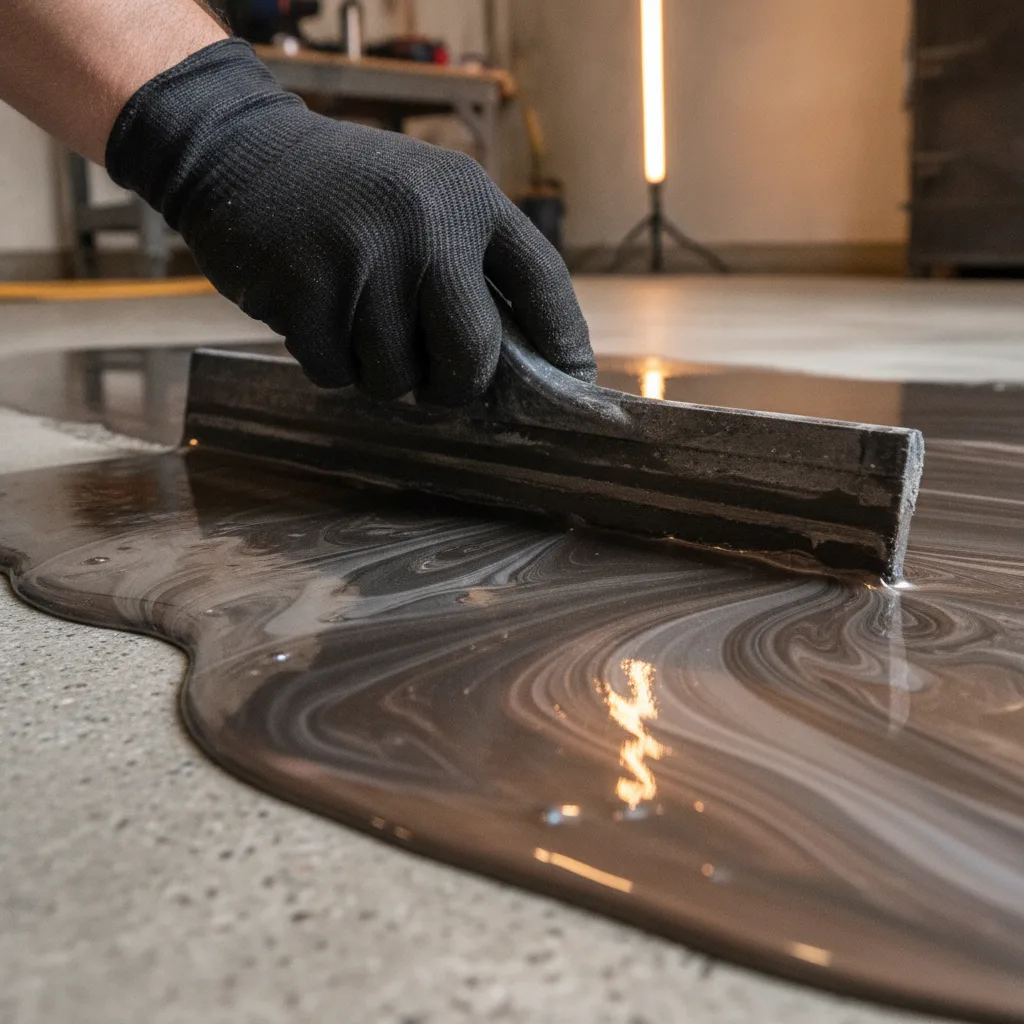
Metallic epoxy uses metallic pigment powders suspended in a clear or tinted epoxy base to create flowing, three-dimensional effects that look like polished stone or liquid metal. The result is genuinely striking and each floor is unique because the installer manipulates the pigment by hand as it cures.
Flake or vinyl chip systems broadcast coloured polymer flakes into a wet epoxy base coat, then seal everything under a hard topcoat. The flakes hide surface imperfections, add grip underfoot, and come in dozens of colour blends. This is one of the most popular finishes for residential garages because it balances looks, practicality and cost very well.
A full-broadcast flake system, where flakes are applied until the base coat is completely hidden, gives the most uniform, durable result. A partial broadcast creates a speckled granite-style look on a coloured background.
How does concrete preparation affect the quality of an epoxy floor coating?
Concrete preparation is the single biggest factor in whether an epoxy floor coating sticks properly or peels within a year. The epoxy needs a mechanically open surface to bond to, and there is only one reliable way to achieve that: diamond grinding or shot blasting the slab before any coating goes down.
Many cheaper operators skip proper prep and use acid etching instead. Acid etching can work on fresh, clean concrete, but Melbourne’s older residential slabs are often contaminated with oil, previous sealers, or simply have a hard laitance layer on top. Acid alone does not reliably open those surfaces. A diamond grinder removes the laitance, opens the concrete profile and exposes a fresh, porous face for the epoxy to grip.
Any cracks or spalling in the slab should be repaired with an epoxy mortar or filler before coating begins. Skipping this step means cracks telegraph through the finished surface within months. A good installer will also check moisture readings with a concrete moisture meter before proceeding, because high moisture vapour transmission causes delamination regardless of how well the surface is ground.
If a quote you receive does not mention grinding, moisture testing or crack repair, that is a clear signal to ask more questions before signing anything.
What should a Melbourne homeowner budget for an epoxy floor coating for their garage?
For a standard single garage of around 18 to 20 square metres, a professionally installed flake epoxy system in Melbourne typically runs between $900 and $1,800 all up. A double garage at 36 to 40 square metres moves the budget to roughly $1,800 to $3,500. Metallic and custom finishes sit at the higher end or above those ranges.
The main cost variables are:
- Slab condition. Heavily cracked or contaminated concrete needs more prep time and materials, which adds cost.
- Finish type. Metallic epoxy requires more skilled labour and pricier materials than a standard flake system.
- Number of coats. A proper system includes a primer or base coat, a broadcast layer and at least one clear topcoat. Cutting any of these layers reduces longevity.
- Access and clearance. Garages with limited access or cars and shelving that need moving take longer to prep.
Be cautious of quotes that come in well below $40 per square metre. At that price something is usually being skipped, whether it is proper grinding, a quality topcoat or genuine two-part epoxy rather than a water-based paint marketed as epoxy.
How long does an epoxy floor coating take to install and cure?
Most residential garage epoxy jobs take one to two days to install, depending on size and finish. The slab is ground and prepped on day one, then coats are applied with cure time between each layer. Some systems require a return visit 24 hours later for the topcoat.
Light foot traffic is usually safe at 24 hours. However, parking a car on the surface requires a full seven-day cure at typical Melbourne ambient temperatures. Rushing this and parking too early is one of the most common reasons tyre marks become permanent, as the softening heat from tyres can indent a coating that has not fully cross-linked.
Temperature matters during installation too. Epoxy does not cure reliably below about 10 degrees Celsius, and Melbourne winters can push garage temperatures down to that threshold early in the morning. A professional installer will monitor conditions and, if needed, schedule the job for warmer parts of the day or season.
How do you maintain a garage epoxy floor once it is installed?
Maintenance is genuinely simple, which is one of the reasons epoxy is such a practical choice for busy households. A weekly sweep or blower to remove grit, combined with an occasional mop using warm water and a pH-neutral cleaner, is all the floor needs under normal use.
Avoid harsh solvents and bleach-based cleaners. They will not destroy the coating quickly, but repeated use dulls the gloss over time. For oil spills, a simple degreaser and warm water is enough. The sealed surface means oil never penetrates; it stays on top until you wipe it away.
For heavy workshop use, placing rubber anti-fatigue mats under a stationary workbench protects the surface from dropped heavy tools. Furniture pads under shelf feet prevent point-load scuffing over many years. A good-quality topcoat is UV-stable, so the colour and gloss hold up well even in garages with a north-facing door that lets in direct afternoon sun.
With basic care, a professionally installed epoxy floor coating for a garage realistically lasts 15 or more years before any recoat is needed. When it is time to recoat, a light grind and fresh topcoat refreshes the surface without needing a full reinstall from scratch.
Ready to get your garage sorted? Request a free quote for garage floor coating from Metal and Flake.