Concrete Floor Sealing in Preston: What Local Homeowners Should Know
Concrete floor sealing in Preston protects bare or decorative concrete from moisture, stains and surface wear by applying a penetrating or topical coating that locks the slab. A properly sealed floor resists oil, water and everyday grit, lasts five to ten years depending on traffic, and dramatically improves how the surface looks without needing a full replacement or overlay.
Why does concrete floor sealing matter so much in Preston specifically?
Preston sits in Melbourne’s inner north, where a large share of the housing stock dates from the 1950s through the 1980s. That means a lot of original concrete garage slabs, exposed back-yard paths and bare internal floors that have had decades of exposure to foot traffic, vehicle oil and Melbourne’s variable seasons. Sealing that concrete stops the slow deterioration that comes with moisture cycling through an unsealed slab every winter and summer, and it prevents staining that grinds in so deep no surface scrub will shift it.
The other local factor is the sheer number of Preston homeowners renovating right now. A freshly polished or ground slab left unsealed after a reno is wide open to construction dust, paint splatter and trade boot marks. Getting a sealer on quickly is not an afterthought. It is the final step that actually finishes the job.
What types of concrete sealer are worth considering?
There are four main categories, and the right one depends on what the surface is used for and how you want it to look. Penetrating sealers (silane or siloxane-based) soak into the concrete and create an invisible moisture barrier without changing the surface sheen. They are the go-to for external paths, driveways and any slab that sits partially outdoors. They do not build up a film, so there is nothing to peel or scratch.
Acrylic topical sealers sit on the surface and add a visible gloss or satin finish. They are budget-friendly, easy to reapply and popular on garage floors and shed slabs. The trade-off is durability: a busy garage floor might need a fresh coat every two to three years.
Polyurethane sealers are tougher than acrylics and more resistant to abrasion and chemicals. They are a solid middle-ground option for internal garage or workshop floors where a harder wearing film is useful but a full epoxy system is more than the budget allows.
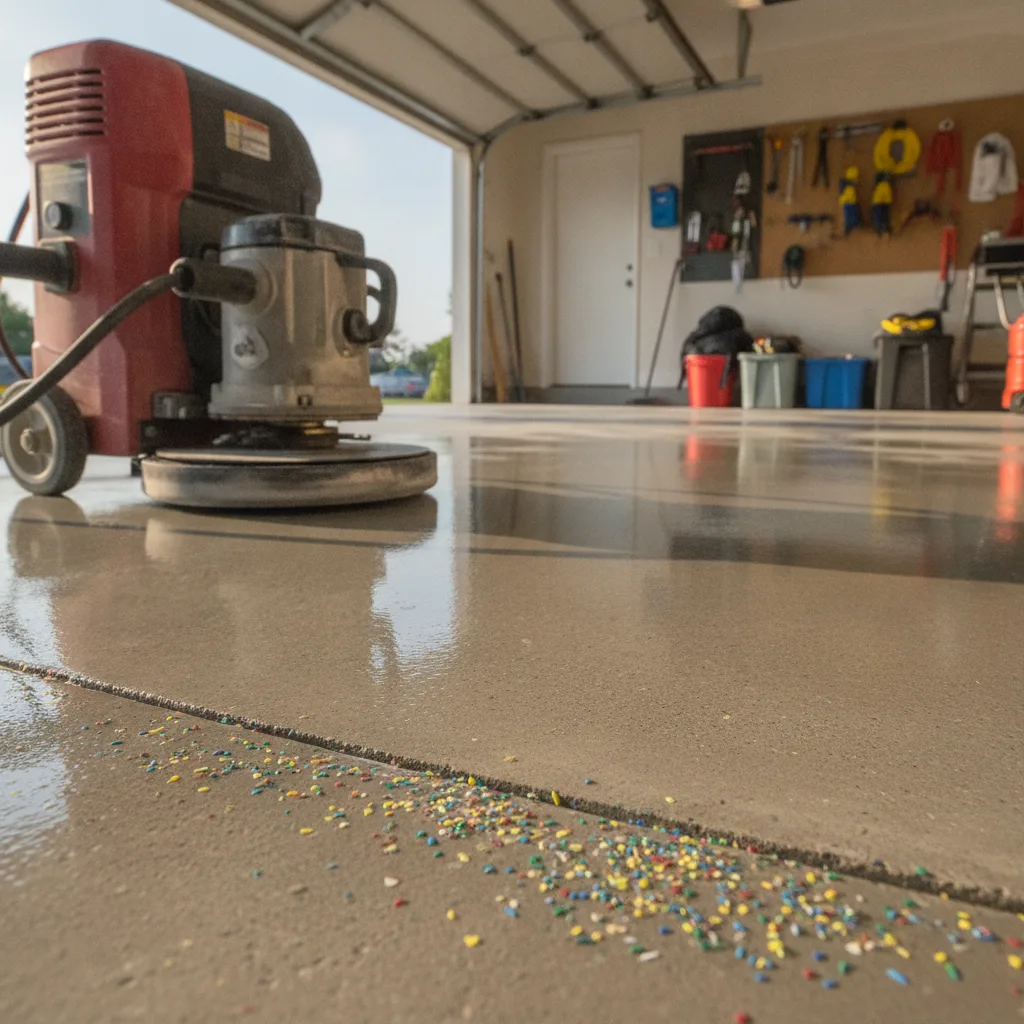
Epoxy coatings are the most durable option for heavy-use internal floors. Rather than just sealing the surface, a proper epoxy system bonds to the concrete and builds a hard, cleanable shell that handles vehicle tyres, dropped tools and regular hosing down. A full broadcast system with colour flakes (the kind Metal and Flake specialises in) takes that one step further, adding slip resistance and a finished appearance that completely transforms a plain grey slab.
How do you prepare a concrete slab before sealing?
Surface preparation is where most DIY sealing jobs go wrong. A sealer can only bond to clean, open-pore concrete. If the slab has a curing compound from the original pour, old paint, oil contamination or even a light dust layer, the sealer will bubble, peel or fail to penetrate at all.
Professional preparation typically involves mechanical grinding or shot blasting. Grinding opens the surface profile so the coating has something to grip. The Concrete Institute of Australia’s guidelines recommend a surface profile of CSP 2 to CSP 4 for most topical coatings. That is not something you can achieve with a mop and a bucket of degreaser. For penetrating sealers on outdoor concrete, a thorough acid etch followed by a full rinse and a 24-hour dry period can be adequate, but any significant contamination still needs mechanical removal first.
Cracks and spalling should be filled before sealing. Applying a sealer over a crack does not stabilise it. The crack will continue to move and the sealer will simply split along the same line within months.
How long does concrete floor sealing take and how long before you can use the floor?
For a standard single-car garage slab of around 20 to 25 square metres, a professional sealing job typically takes one day: a few hours of prep in the morning and the coating applied by early afternoon. Recoat times vary by product. Most acrylic sealers are dry to foot traffic within two to four hours. Polyurethane and epoxy systems generally need a full 24 hours before light foot traffic and 72 hours before vehicles drive on them.
Temperature matters more than most people realise. Applying a sealer when it is below 10 degrees Celsius or above 35 degrees risks poor adhesion and uneven curing. Melbourne’s Preston suburb can hit both extremes. Early autumn and late spring are genuinely the best times to book the work, and a good contractor will plan the job around the forecast.
What should Preston homeowners watch out for when getting quotes?
A few things separate a quality sealing job from a cheap one that fails inside 12 months. Ask any contractor what surface preparation method they use. If the answer is “we’ll give it a clean and apply the product,” walk away. Ask what specific product they are applying and request the technical data sheet. Reputable products have published coverage rates, cure times and adhesion specs. A contractor who cannot name the brand or describe the product is applying whatever they can buy cheap that week.
Also ask whether the quote includes crack repair. On older Preston slabs, there are almost always a few hairline cracks that need filling. A quote that excludes this can balloon once the job starts.
Finally, check that the contractor carries public liability insurance. Sealing a floor involves grinding equipment, chemical products and work inside someone’s home. Tradespeople who skip insurance are usually cutting other corners too.
Is concrete sealing different from a full epoxy floor coating?
Yes, and the distinction is worth understanding before you commit to either. A sealer, whether penetrating or topical, protects the existing surface. An epoxy coating system builds a new functional layer on top of the concrete that is far thicker, harder and more chemical-resistant than any sealer. A quality epoxy floor coating applied at the standard 300 to 400 microns of combined build is roughly three to four times the thickness of a standard acrylic sealer film.
For a garage, workshop or internal living area where the floor gets genuine use, an epoxy system with decorative colour flakes is often the smarter spend. The upfront cost is higher, but the lifespan is longer, maintenance is simpler (a regular sweep and occasional mop), and the result looks far better. Metal and Flake focuses specifically on this kind of high-performance decorative epoxy work for garages and interior spaces across Melbourne’s inner north.
If your Preston slab is in reasonable shape and you just want to protect an external path or a lightly used indoor space, a good penetrating or polyurethane sealer is the practical choice. If the floor takes real punishment or you want it to look sharp, a full epoxy system is worth the conversation.
Book concrete floor sealing in Preston with Metal and Flake