Concrete Floor Sealing in Hoppers Crossing: Local Options Explained
Concrete floor sealing in Hoppers Crossing involves applying a protective coating over bare or existing concrete to stop moisture, oil, dust and staining from getting in. The right sealer depends on where the floor is, how much traffic it takes, and what finish you want. Most residential garage and shed floors in the area can be sealed in a single day.
What types of concrete sealer are available for Hoppers Crossing homes?
The main types of concrete sealer available are penetrating sealers, acrylic sealers, polyurethane sealers and epoxy coatings. Penetrating sealers soak into the slab and are invisible. Acrylics sit on top and add a low-sheen finish. Polyurethanes are tougher and more chemical-resistant. Epoxy coatings are the most durable option, bonding directly to the concrete for a hard, decorative surface that lasts many years.
Here in Hoppers Crossing, most of the residential work falls into two camps. You’ve got people who just want to protect a driveway or back shed slab without changing the look, and you’ve got homeowners who are doing up their garage and want something that looks sharp and holds up to car traffic, oil drips and general hard use.
For the first group, a penetrating silane or siloxane sealer is a solid, low-cost choice. It repels water and salts without leaving a film. You won’t see it, but it does the job of stopping the concrete from absorbing stains and moisture. These are popular on driveways because they don’t go slippery when wet and they need re-application only every few years.
For the second group, an acrylic or polyurethane sealer adds a visible sheen and a bit more surface protection. These sit on top of the concrete rather than penetrating it, so they can peel or wear through in high-traffic zones over time. They’re fine for light use areas but need more maintenance than a thicker coating system.
Epoxy floor coatings are in a different league altogether. A proper two-part epoxy bonds chemically to the prepared concrete and creates a surface that is genuinely tough: resistant to petrol, brake fluid, hot tyres and heavy foot traffic. When you add metallic pigments or decorative flake, you also get a floor that looks like it belongs in a showroom rather than a suburban garage. That’s the kind of work Metal and Flake specialises in across Melbourne’s west.
How does concrete floor sealing differ from an epoxy coating?
Concrete floor sealing uses a thin product, either absorbed into the slab or applied as a surface film, mainly to protect the concrete from staining and moisture. Epoxy coating is a multi-layer system bonded to mechanically prepared concrete, far thicker and more durable, with a finish that transforms the appearance of the floor. Sealing is maintenance; epoxy is an upgrade.
It’s worth understanding this difference before you spend money, because the two are often confused in online searches and even in hardware store conversations. A cheap acrylic sealer from a big box store might seem like the same thing as an epoxy floor coating. It isn’t. The thickness, the bond strength, the surface preparation required and the end result are all very different.
A penetrating sealer might be 50 to 100 microns deep in the slab. A quality two-coat epoxy floor system sits at around 3 to 5 millimetres once you account for the base coat, broadcast flake and clear topcoat. The epoxy won’t lift under hot tyres. The acrylic sealer likely will, especially in a West Melbourne summer.
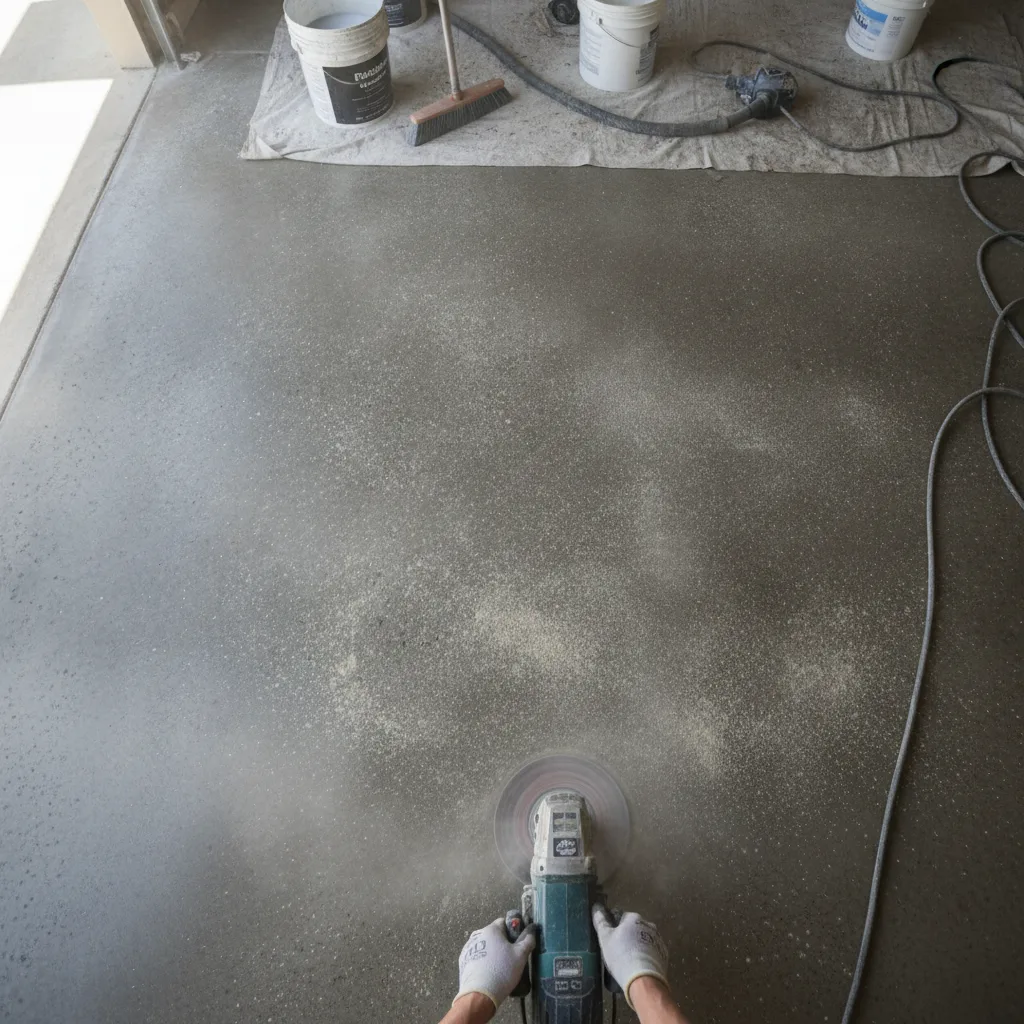
The prep work is also a big differentiator. A basic sealer can go over a clean, dry slab. A proper epoxy floor requires the concrete to be ground or diamond-abraded to open the surface profile, any cracks to be filled, and the slab moisture content to be tested and within tolerance before you pour a drop of coating. Skip those steps and you’ll be peeling the whole thing up within a year.
What should you check before sealing a concrete floor in Hoppers Crossing?
Before sealing any concrete floor in Hoppers Crossing, check for moisture rising through the slab, existing coatings that may cause adhesion problems, surface cracks that need filling, and whether the concrete has cured long enough. New slabs should cure for at least 28 days before any sealer is applied, and the slab should pass a simple plastic sheet moisture test.
Hoppers Crossing sits in Melbourne’s western suburbs, an area with a mix of clay soils that can hold moisture and shift seasonally. That matters for concrete floors because rising damp from below is one of the main reasons sealers and coatings fail prematurely. A quick test: tape a 600mm square of plastic sheeting to the bare concrete, seal the edges with tape, and leave it for 24 hours. If you find condensation or the concrete darkens under the sheet, there is moisture movement you need to account for before sealing.
Cracks also need attention. Hairline cracks in a garage slab are common and usually cosmetic, but they should still be filled with a flexible polyurethane or epoxy crack filler before any topcoat goes down. Wider or moving cracks can indicate a structural or soil movement issue and may need a builder’s eye before you seal over them.
Finally, if the slab has been previously sealed or painted, that old coating needs to either be ground back or tested for adhesion. Applying a new sealer over a failing old one is a guaranteed way to end up with a peeling mess inside six months.
Is concrete floor sealing worth it for a Hoppers Crossing garage?
Yes, sealing a garage floor in Hoppers Crossing is worth it because bare concrete is porous and absorbs oil, fuel and water within seconds, making stains near-permanent. Even a basic sealer cuts cleaning time significantly. An epoxy or polyurethane coating goes further, protecting the slab for a decade or more while making the space brighter, cleaner and easier to maintain.
Think about what a garage floor puts up with on a daily basis: oil drips, tyre rubber, grit tracked in from the driveway, the occasional fuel spill, and in summer, concrete that heats up enough to cause hot-tyre lifting with cheap coatings. A properly sealed or coated floor handles all of that without staining, without dusting and without becoming a slip hazard when the slab gets damp.
The cost side of the equation also stacks up. A professional epoxy floor on a standard two-car garage in the western suburbs typically runs into the low thousands, and when you’re talking about a space people are increasingly using as a workshop, a gym or even an extended living area, that’s a reasonable outlay for a surface that will outlast a replacement carpet or vinyl job in almost any other room of the house.
Decorative options like metallic epoxy or broadcast flake finishes add to the cost but also add genuine visual impact. Metallic epoxy in particular creates a one-off, fluid appearance in the concrete that you simply cannot replicate with a sealer. If you’ve spent money on your driveway, your home’s interior or your landscaping, it makes sense to bring the garage floor up to the same standard rather than leaving it as a dusty afterthought.
Metal and Flake works across Melbourne’s west and inner suburbs, bringing the same prep-first, no-shortcuts approach to every floor. The finish you see in the photos is the finish you get on site, because the ground preparation is done properly before any product touches the concrete.
Book concrete floor sealing in Hoppers Crossing with Metal and Flake