Concrete Floor for Shed: What Melbourne Homeowners Need to Know Before They Pour
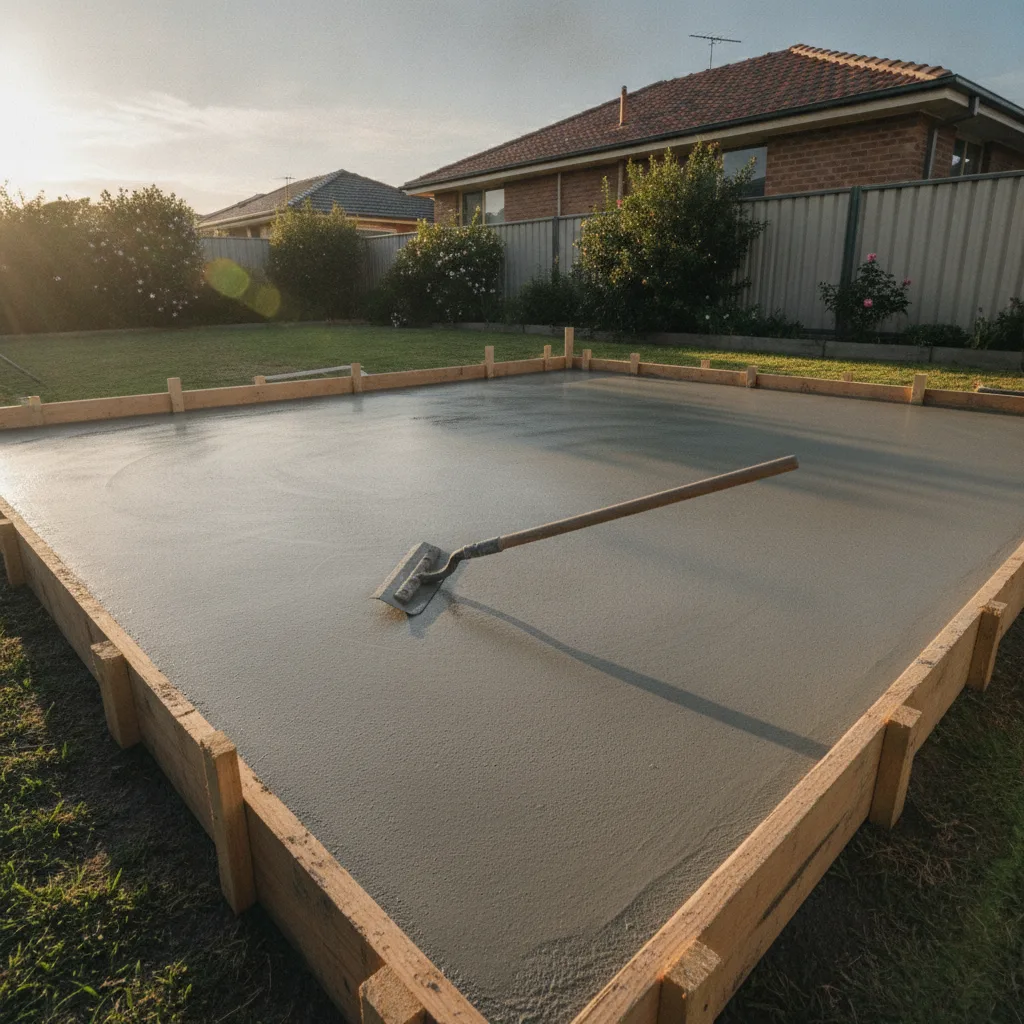
A concrete floor for a shed gives you a hard-wearing, vermin-resistant base that outlasts timber by decades. In Melbourne, you generally need a 75 to 100 mm slab reinforced with SL72 mesh, poured on a compacted base, with a curing time of at least 28 days before you load it up. Getting those basics right from the start saves you a heap of grief later.
Why does a concrete floor for a shed make sense compared to other options?
A concrete floor for a shed beats compacted gravel or timber bearers because it stays level, keeps moisture and pests out, and gives you a surface you can actually coat or seal. It handles heavy rolling loads like car jacks and ride-on mowers without shifting underfoot, and it does not rot, warp or attract termites the way timber sub-floors can over Melbourne’s wet winters.
That said, not every shed needs the full treatment. A small garden tool shed sitting on dry, stable soil might get away with pavers or a gravel base. But the moment you plan to park a car, run power tools, or store chemicals, concrete is the right call. It gives you a surface that can be cleaned properly and, importantly, one that can be coated later if you want to step things up.
Concrete also adds real value. A well-finished slab turns a basic shed into a usable workshop or storage space that prospective buyers notice. That matters in Melbourne, where a decent garage or workshop is a genuine selling point.
How thick does a shed concrete slab need to be in Melbourne?
For a standard residential shed in Melbourne, a 75 mm slab is the accepted minimum, but 100 mm is the smarter choice if you plan to drive a vehicle onto it or store heavy equipment. A 100 mm slab reinforced with SL72 mesh sitting on 100 mm of compacted roadbase handles most domestic loads without cracking, provided the sub-base is prepared correctly before the pour.
Sub-base preparation is where a lot of DIY jobs go wrong. Melbourne’s clay-heavy soils expand and contract with moisture changes. If you pour onto soft or uneven ground, the slab will crack along those weak points within a season or two. The ground needs to be excavated to a consistent depth, compacted in layers, and brought to the right level before the formwork even goes in.
Reinforcement matters too. SL72 trench mesh or a full sheet of SL72 mesh, supported on bar chairs so it sits at roughly mid-depth in the slab, is standard for residential work. In areas with reactive soil (and there is plenty of that across Melbourne’s eastern and south-eastern suburbs), a structural engineer may specify thicker slabs or edge beams. It is worth getting that advice before you pour rather than after.
Control joints are another thing people skip and regret. Concrete shrinks as it cures. Cutting or forming control joints every 3 to 4 metres gives the slab a place to crack predictably along a straight line rather than randomly across the middle of your floor.
What concrete mix is right for a shed slab?
For a shed floor in Melbourne, a 25 MPa (N25) concrete mix is the standard starting point. It gives you enough compressive strength for domestic foot and vehicle traffic without overcomplicating the pour. If the shed is close to soil that may shift, or you are in a bushfire-affected zone where the slab might need to meet specific construction requirements, a 32 MPa mix is worth discussing with your concretor.
Water content is critical. Too much water in the mix weakens the finished slab and increases shrinkage cracking. Ready-mix concrete from a truck is generally more consistent than mixing on site, and for anything bigger than about 10 square metres it is the practical choice. Most Melbourne ready-mix suppliers will deliver a minimum of around half a cubic metre, so for a small shed you may need to batch your own or find a supplier who does smaller drops.
Curing is the step that gets rushed on DIY jobs. Concrete reaches roughly 70 percent of its design strength at seven days but does not hit the full 28-day strength for a month. Keeping the surface damp with wet hessian or a curing compound during that first week makes a real difference to the final hardness and durability of the surface.
What does a shed concrete slab cost in Melbourne?
Rough ballpark figures for Melbourne: a basic shed slab of around 6 x 6 metres (36 m²) poured at 100 mm with SL72 mesh and a broom finish typically runs somewhere between $3,500 and $6,000 installed, depending on site access, ground conditions and the finish level. That works out to roughly $100 to $165 per square metre for a straightforward pour.
Those numbers shift quickly if you add extras. A steel-trowel finish costs more than a broom finish but gives a smoother base for coatings. Difficult site access, rock breaking or extra excavation add labour. Edge beams or thickened edges for a vehicle slab add material and time.
Getting two or three quotes from local concretors is the sensible move. Make sure each quote specifies the same slab depth, mix strength, reinforcement type and finish so you are comparing apples with apples.
Should you coat or seal a shed concrete floor?
Once the slab has cured fully (that 28-day mark again), sealing or coating it is well worth considering. A bare concrete floor in a shed absorbs oil, grease and chemical spills, stains permanently and is hard to sweep clean because the surface stays slightly porous. A coating closes that porosity and gives you a surface that wipes down easily.
Penetrating concrete sealers are a straightforward entry-level option. They soak into the surface, repel water and oil, and do not change the look of the floor much. They are easy to apply and reasonably affordable.
Epoxy and polyaspartic floor coatings sit at the other end of the scale. Applied over a properly prepared concrete slab, an epoxy coating bonds to the surface and creates a hard, chemical-resistant, glossy finish that transforms a shed into a proper workshop or garage space. Many Melbourne homeowners add decorative flake to the coating for a non-slip texture and a cleaner look. These coatings are a specialist job: the concrete needs to be diamond-ground before application so the coating bonds properly rather than peeling down the track.
That preparation step is non-negotiable. Coatings applied over dusty, oil-contaminated or poorly cured concrete will fail. Done right, though, an epoxy-coated shed floor is one of the most satisfying upgrades you can make to a working space. It holds up to foot traffic, vehicle tyres, dropped tools and chemical spills for years.
At Metal and Flake, we specialise in epoxy and polyaspartic floor coatings across Melbourne and surrounds. If your shed slab is poured, cured and ready to go, we can assess it, grind it back properly and apply a coating that actually lasts.
Get a quote for your shed concrete floor or coating