Best Concrete Floor Coating: How to Choose the Right System
The best concrete floor coating depends on how the space is used, how much traffic it takes, and what finish you want. Epoxy base coats, polyurea topcoats and decorative flake broadcasts each play a role. A well-matched system gives you a surface that resists oil, hot tyre marks and heavy foot traffic for well over a decade.
What makes a concrete floor coating actually last?
A coating lasts when it bonds properly to the slab, flexes with temperature changes, and sheds whatever gets spilled on it. The three things that kill floor coatings early are poor surface prep, a product chosen for the wrong environment, and skipping a UV-stable topcoat. Get those three right and you are most of the way there.
Surface preparation is the unglamorous part that nobody talks about at the hardware store, but it is the single biggest factor in how long any coating stays stuck. A concrete grinder or diamond-head shot blaster opens up the pores of the slab so the coating has something to grip. Without that mechanical profile, even a premium product will peel within a couple of years, especially in a garage where temperatures swing between a cold Melbourne winter morning and a hot January afternoon.
Concrete is also alkaline, and moisture can push up through an unprimed slab through hydrostatic pressure. A quality epoxy primer seals against moisture vapour transmission and levels out minor surface imperfections before the body coat goes down. Skip the primer to save a few dollars and you are borrowing trouble.
What are the main types of concrete floor coating available?
The main coating types are solvent-based epoxy, water-based epoxy, polyurea, polyaspartic, and hybrid systems that combine epoxy base coats with polyurea or polyaspartic topcoats. Each has a specific strength. Epoxy builds film thickness and bonds hard to concrete. Polyurea and polyaspartic topcoats cure fast, resist UV yellowing, and handle chemical spills extremely well.
Here is a plain-English breakdown of the most common options homeowners and small business owners in Melbourne ask about:
Solvent-based epoxy. High solids content, excellent penetration into the slab, very durable film build. Strong smell during application and requires proper ventilation. This is the workhorse of the industry for garage and workshop floors.
Water-based epoxy. Lower VOC, easier to clean up, but typically thinner film build than solvent-based. Good for internal areas with limited ventilation, but in a heavily used garage it may need a harder topcoat over the top to get the wear resistance you are after.
Polyurea and polyaspartic. These are topcoat products (and sometimes full-system products). They cure in a fraction of the time epoxy does, which matters in a professional install where you want to return the floor to service quickly. They are also inherently UV stable, so they will not go that unattractive amber-yellow colour that haunts cheap single-pack epoxy floors after a year or two of sun exposure.
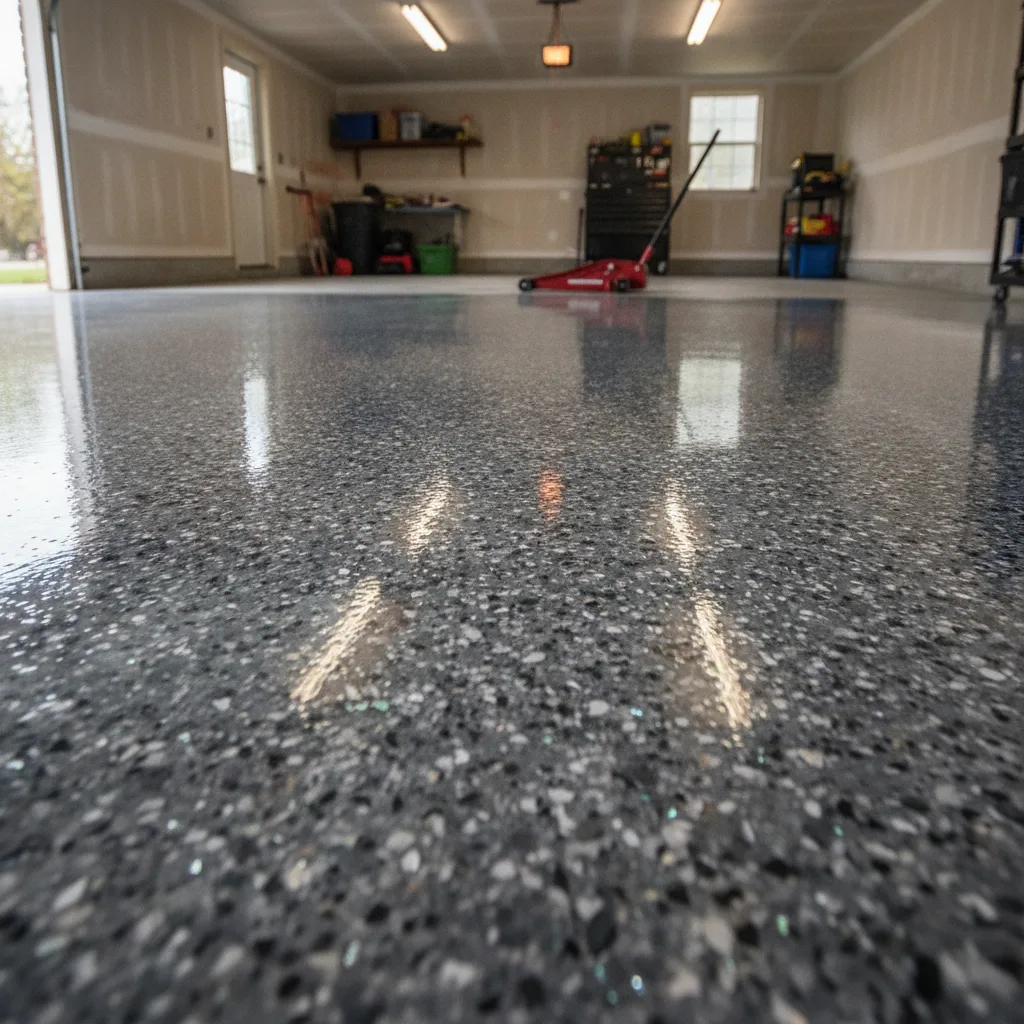
Hybrid systems. The most popular professional approach right now is an epoxy base coat, a decorative vinyl flake broadcast, and a polyurea or polyaspartic topcoat. You get the bond strength and film build of epoxy underneath, the looks of a full-flake finish, and the hardness and UV resistance of a polyurea on top. It is a hard combination to beat for a residential garage or commercial workshop.
How do you match the best concrete floor coating to your specific space?
Match the coating to the space by thinking about three things: traffic type, chemical exposure, and light conditions. A home garage used for parking one car and weekend projects needs a different system than a trade workshop running forklifts and chemicals daily. UV exposure determines whether you need a UV-stable topcoat. Chemical exposure determines the resin type and topcoat hardness you need.
For a standard residential garage in Melbourne, a two-coat epoxy system with a polyurea topcoat and a full-flake broadcast is the most practical choice. The flake layer does double duty: it looks great and it hides minor scratches and scuffs that accumulate over time. A solid-colour single-coat system will show every dropped tool mark and tyre scuff within twelve months.
For a workshop or light-industrial space, you want to step up the film thickness. Epoxy systems can be specified at 150 to 300 microns dry film thickness for heavy-use areas. Some professional applicators use a quartz-broadcast system instead of vinyl flake, which gives a slightly more textured, grippy finish suitable for areas with spills or wet conditions.
For an alfresco area or any slab exposed to direct sunlight, do not use a standard epoxy as your topcoat. Epoxy is not UV stable. Within one summer season in Melbourne it will begin to amber and chalk. A polyaspartic or polyurea topcoat must be specified for any exposed outdoor application.
Anti-slip additive is another consideration that often gets overlooked until after installation. Fine aluminium oxide or a polymer anti-slip aggregate can be broadcast into the topcoat while it is still wet. In a garage where oil drips are a reality, or in a workshop bathroom or amenity area, this is not optional.
What common mistakes should you avoid when choosing a concrete floor coating?
The most common mistake is buying a single-pack DIY floor paint from a hardware chain and expecting professional results. Single-pack products do not chemically cross-link the way two-part epoxy systems do. They sit on the surface rather than bonding to it, and in a garage environment they typically begin to peel within one to two years. A proper two-part epoxy system takes more effort to apply but the bond is fundamentally different.
The second mistake is skipping concrete moisture testing. Melbourne homes on older footings can have slabs with elevated moisture content, particularly in winter. Applying an epoxy coating over a damp slab traps moisture underneath, which causes blistering. A simple calcium chloride moisture test (or a relative humidity probe test to AS 1884 standards) before any coating goes down can save you from an expensive redo.
Third: not getting the surface profile right. Australian Standard AS 1884 specifies surface preparation requirements for resinous floor coatings, and it exists for good reason. An acid etch alone does not produce a reliable enough profile on a dense power-trowelled slab. Mechanical grinding or shotblasting is the professional standard. If the quote you receive does not mention mechanical preparation, ask why.
Fourth: choosing colour and finish without seeing a sample in your actual space. Colour reads differently under fluorescent workshop lighting than it does outdoors in afternoon sun. A good installer will have sample boards or can show you completed jobs with a similar finish. Do not commit to a full-flake broadcast based on a small chip card alone.
How much does a quality concrete floor coating system cost?
A professionally installed epoxy and polyurea floor coating system in Melbourne typically runs between $50 and $120 per square metre, depending on the system specified, the condition of the existing slab, and the size of the area. Larger areas generally attract a lower per-square-metre rate. Small or complex areas with lots of edges, drainage channels or obstacles cost more to prep and coat.
The cheapest quote is not always the best value. If a quote is significantly lower than others, it is worth asking what prep method is included, how many coats are specified, and what the topcoat product is. A three-coat system with mechanical prep, a quality epoxy base, full-flake broadcast and a polyurea topcoat will outperform a budget two-coat system many times over across a ten-year ownership period.
Get a professional concrete floor coating recommendation from Metal and Flake