Epoxy Flooring for Your Garage: What Melbourne Homeowners Need to Know
Epoxy flooring for a garage transforms a bare, dusty concrete slab into a hardwearing, easy-clean surface that holds up to oil spills, tyre marks and heavy foot traffic. A properly installed two-part epoxy system bonds directly to the concrete, giving you a surface that typically lasts 10 to 20 years with basic maintenance. It comes in a range of finishes, from solid colour to metallic and flake systems, so it looks as good as it performs.
Why do Melbourne homeowners choose epoxy flooring for their garage?
Most Melbourne homeowners choose epoxy flooring for their garage because it solves the two biggest problems bare concrete creates: it stains permanently and it sheds dust constantly. Epoxy seals the slab completely, so oil, brake fluid and water bead off the surface. It also handles the city’s temperature swings, from cold Winters in the outer suburbs to hot January days that can crack cheaper coatings.
Beyond practicality, a garage gets used differently now than it did 20 years ago. It’s a workshop, a home gym, a man cave or just the first thing guests see when the roller door goes up. A quality epoxy finish makes that space feel intentional rather than unfinished. Colour flake and metallic epoxy systems in particular turn a plain slab into something that genuinely looks sharp.
There’s also a maintenance angle worth mentioning. Concrete left unsealed absorbs oil and grime into its pores. Once that happens, no amount of scrubbing fully restores it. Epoxy applied early keeps the concrete underneath in good condition for the life of the property.
What types of epoxy flooring finish work best in a garage?
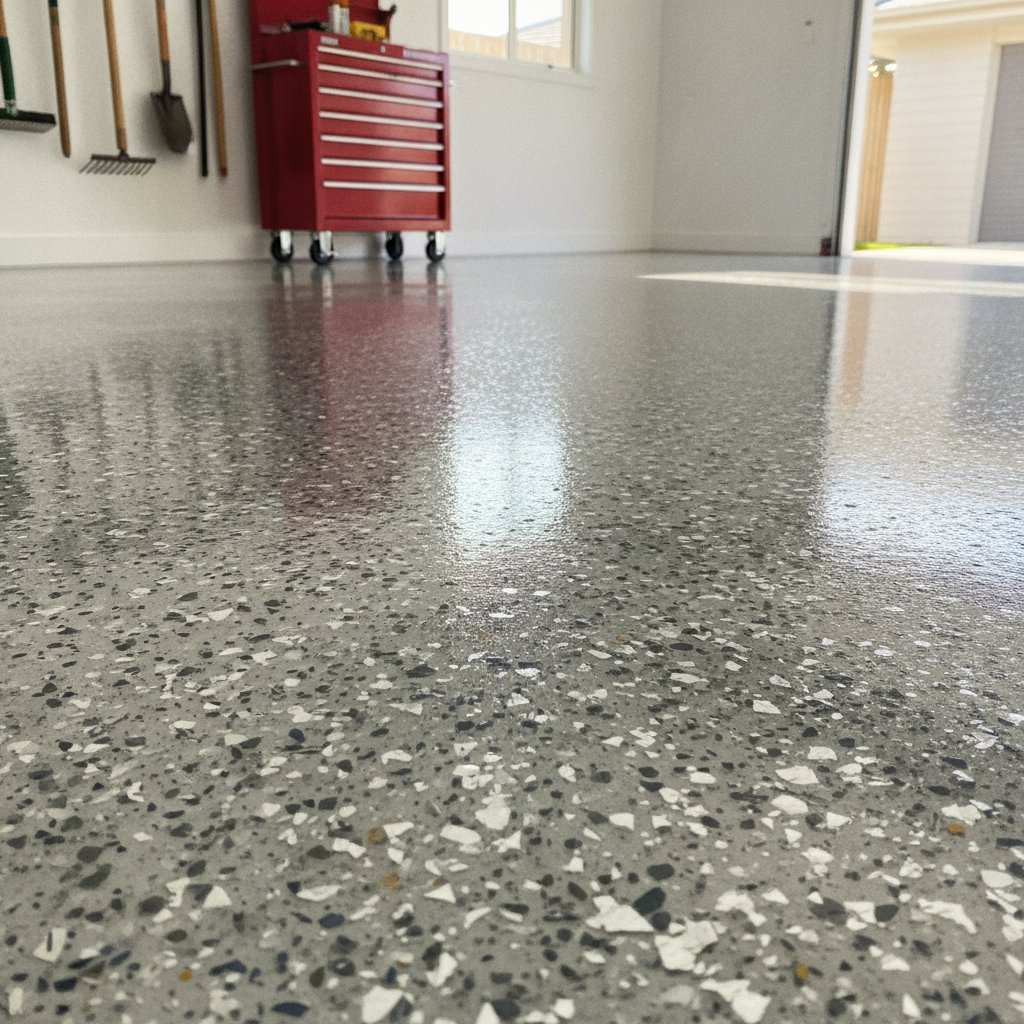
The three finishes that work best in a garage are solid colour epoxy, broadcast colour flake systems and metallic epoxy. Solid colour is the most affordable and gives a clean, commercial look. Colour flake systems broadcast vinyl chips across the wet base coat, creating a textured surface that hides dirt between cleans and adds grip. Metallic epoxy uses pigment blended into the topcoat to create flowing, three-dimensional patterns that make each floor genuinely one-of-a-kind.
For a typical residential garage in Melbourne, colour flake is the most popular choice and for good reason. The texture improves slip resistance when the floor gets wet, which matters on a rainy Melbourne morning when you’re dragging bikes or garden equipment around. The flake also camouages minor scuffs and tyre marks between washes, so the floor keeps looking good with minimal effort.
Metallic epoxy suits homeowners who want a showroom finish and are happy to keep the floor clean regularly. It photographs brilliantly and adds real kerb appeal, but it shows footprints and dust more readily than a flake system.
A solid colour system works well if budget is the priority or if the garage is primarily a utility space. It’s still a massive upgrade over bare concrete and it holds up to the same level of punishment as the more decorative finishes.
How is a garage floor prepared before epoxy flooring is applied?
Before epoxy flooring is applied to a garage floor, the concrete must be mechanically ground or shot-blasted to open up the surface profile. This step is non-negotiable. Epoxy applied to a smooth, unprepped slab will peel within months regardless of the product quality. Grinding removes laitance (the weak top layer of concrete), old paint or sealer, and any contamination from oil or chemicals.
This is where a lot of DIY epoxy jobs fall apart. Hardware store kits rely on acid etching rather than mechanical prep. Acid etching can work on new, clean concrete but it does nothing for contaminated concrete, and most garage slabs have at least some oil penetration near the parking spots. Professional installers use diamond-tipped floor grinders that profile the entire slab evenly and remove contamination at the same time.
After grinding, any cracks, control joint damage or spalling (surface flaking) is repaired with appropriate fillers before the base coat goes down. Skipping repairs at this stage means the epoxy will bridge over the crack initially but eventually flex and crack in the same spot. Getting the prep right the first time saves a costly re-do later.
In Melbourne specifically, garages on clay-heavy soil can experience minor slab movement through the seasons. An experienced installer will account for this when choosing product systems and topcoat thickness.
How much does epoxy flooring for a garage cost in Melbourne?
For a standard double garage (roughly 36 to 40 square metres) in Melbourne, professionally installed epoxy flooring typically costs between $1,500 and $3,500 depending on the finish chosen and the condition of the existing slab. A single garage runs closer to $900 to $1,800. Metallic systems and heavily damaged slabs needing extensive repair sit at the upper end of those ranges.
It’s worth comparing that against the ongoing cost of doing nothing. A concrete sealer from a hardware store might cost $150 and last two to three years before it needs reapplying. Professional epoxy, installed correctly, runs for a decade or more without needing to be redone. Spread over ten years, the cost per year looks very different.
The main variables that shift the price are slab condition, floor size, the number of coats in the system and the finish type. A full metallic system involves more labour and more specialised materials than a single-colour solid coat. If a slab has deep cracks, multiple oil stains or previous coatings that need removing, the prep time goes up and so does the price. Getting a proper on-site measure and quote is the only way to get an accurate number because no two garage slabs are identical.
How long does it take to install epoxy flooring in a garage?
A typical garage epoxy installation takes one to two days of work on-site, with a cure period of 24 to 72 hours before light foot traffic and three to seven days before you can park a car on it. The exact timeline depends on the system used, ambient temperature and humidity. Melbourne’s cooler months can slow cure times slightly, particularly if the garage is unheated and overnight temperatures drop below 10 degrees Celsius.
Day one is almost entirely prep: grinding, crack repair and priming. Day two (or the second half of day one on a smaller floor) is the actual coating work. Most professional systems involve a primer coat, a base coat, the decorative layer (flake or metallic pigment) and a hardwearing polyurethane or polyaspartic topcoat. Each layer needs to reach the right cure state before the next one goes on.
Polyaspartic topcoats are worth mentioning here. They cure faster than traditional polyurethane, which can get the floor back into service in as little as 24 hours. For homeowners who can’t vacate the garage for long, a polyaspartic system is a practical option.
Plan for at least three days where the garage isn’t usable as a carport. Pull the cars out, clear the floor completely and give the installer full access from the start. That’s the simplest thing a homeowner can do to keep a job running on time and on budget.
Ready to see what your slab could look like? Book a free garage floor consult