Garage Floor Coatings: Which Option Suits Your Home?
A garage floor coating is a protective layer applied directly to bare concrete to resist oil stains, tyre marks, moisture and daily wear. The main options available to Melbourne homeowners are epoxy, polyurea, polyaspartic and decorative flake systems. Each has different strength, cure time and appearance characteristics, and the right choice depends on how you use your garage and what finish you want.
What is a garage floor coating and why does bare concrete fall short?
A garage floor coating is any resin-based product that bonds to concrete and forms a hard, sealed surface. Bare concrete is porous, so oil, brake fluid and water soak straight in and cause staining, spalling and long-term structural damage. A proper coating seals those pores and gives you a surface you can actually clean with a mop rather than a wire brush.
Unsealed concrete also dusts. That grey powder you see on tools, tyres and shoes is concrete particulate breaking away from the surface. Even a single coat of a quality floor coating stops that immediately. For anyone who uses their garage as a workshop, a gym or extra living space, that alone is worth the investment.
It is also worth knowing that not every paint or sealer sold at a hardware store qualifies as a true floor coating. Single-part acrylic garage paints are thin, they peel under hot tyres, and they rarely last more than a season or two in a busy Australian garage. A proper two-part system, whether epoxy or polyurea, chemically crosslinks as it cures, creating a surface that is fundamentally harder and more resistant to chemical attack.
What are the main types of garage floor coating available?
The four coating types most commonly used in residential garages are solvent-based epoxy, water-based epoxy, polyurea or polyaspartic, and decorative broadcast systems that combine a base coat with coloured vinyl flakes. Each suits a different set of priorities around budget, cure time, finish and durability.
Solvent-based epoxy is the workhorse of the industry. It penetrates concrete deeply, bonds aggressively and builds to a thick film in fewer coats. The trade-off is fumes during application and a longer cure window, typically 24 to 72 hours before light foot traffic and up to seven days before you drive on it.
Water-based epoxy has a much lower odour, making it easier to apply in enclosed spaces. It is a popular choice for attached garages where fumes can travel into the house. Film build is slightly thinner than solvent-based products, so a water-based system often benefits from an additional topcoat for maximum durability.
Polyurea and polyaspartic coatings cure fast, sometimes within hours, and have excellent UV stability. Standard epoxy will amber over time when exposed to sunlight, which matters for garages with windows or roller doors that let in afternoon light. A polyaspartic topcoat keeps the colour true for years longer. These products also handle temperature extremes better, which is relevant in Melbourne where a concrete slab can swing from cold winter mornings to very hot summer afternoons.
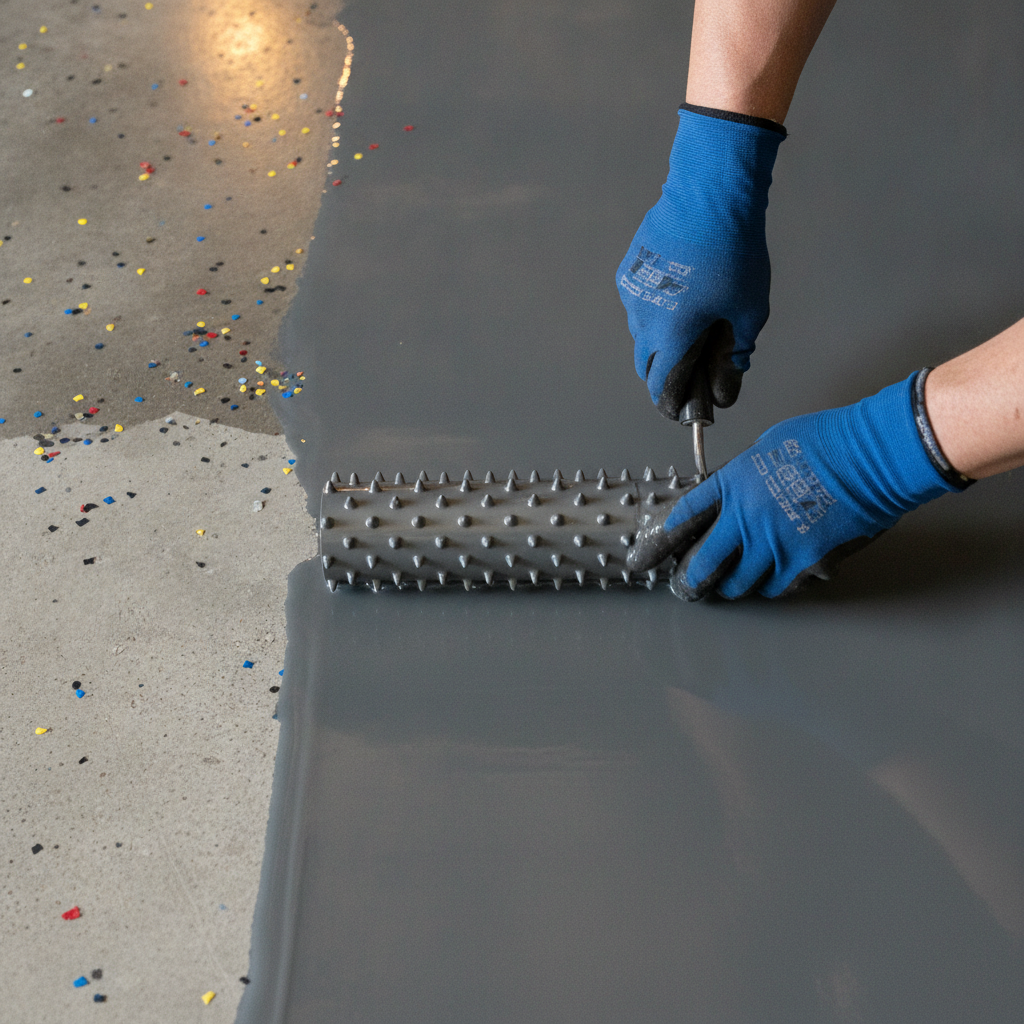
Decorative flake systems broadcast vinyl colour flakes into a wet base coat, then seal them under a clear topcoat. The result hides imperfections in the slab, adds texture for slip resistance and gives a finish that looks sharp enough for a showroom. This is arguably the most popular residential option right now because it delivers both performance and aesthetics in one system.
How do you choose the right garage floor coating for your situation?
Choosing the right garage floor coating comes down to three questions: how much traffic and chemical exposure will the floor see, how much downtime can you tolerate while the coating cures, and what finish do you want to look at every day. Answer those honestly and the field narrows quickly.
For a single-car garage used mainly for storage and occasional DIY work, a water-based epoxy with a clear polyaspartic topcoat is a solid, cost-effective combination. For a working workshop where petrol, oil and solvents are a daily reality, a thicker solvent-based epoxy base coat is worth the extra ventilation effort. For a double garage that doubles as a gym or entertaining area, a full flake broadcast system with a satin or gloss polyaspartic finish will hold up to foot traffic, look great and be easy to keep clean.
Cure time matters more than most people expect. If you need your car back in the garage on day two, a fast-cure polyaspartic system is the practical answer. If the garage is already empty and you can give the floor a full week, a conventional epoxy system is perfectly fine and generally more affordable.
Slab condition is also a factor. If your concrete has existing cracks, pitting or moisture coming up from below, those need to be addressed before any coating goes down. A coating applied over a damp or contaminated slab will delaminate, usually starting at the edges, and no amount of re-coating will fix it until the underlying problem is sorted.
What surface preparation is needed before applying a garage floor coating?
Surface preparation is the single most important factor in how long any garage floor coating lasts. The concrete needs to be clean, dry, structurally sound and mechanically profiled so the resin has a texture to grip. Skipping or rushing this step is the number one reason coatings fail prematurely.
The industry standard for profiling residential concrete is diamond grinding. A walk-behind grinder fitted with diamond segment tooling removes laitance (the weak surface layer), opens the pores of the concrete and leaves a consistent profile. Shot blasting is used on larger commercial slabs but is less common in a standard double garage. Acid etching is sometimes offered as a cheaper alternative, but it is inconsistent on older or contaminated slabs and is generally considered second-best to mechanical grinding.
After grinding, the floor should be vacuumed thoroughly and allowed to dry completely. A moisture test, either a plastic sheet taped down overnight or a calcium chloride test, is worth doing if there is any history of water under the slab. In Melbourne suburbs built on reactive clay, slab moisture can be seasonal, so timing the job to a dry stretch is sensible.
Any cracks wider than a hairline should be filled with a semi-rigid epoxy filler before the base coat goes down. Rigid fillers crack again as the slab moves; semi-rigid products flex with the concrete and hold the repair over the long term.
How long does a garage floor coating last in Melbourne conditions?
A professionally applied, two-coat epoxy or polyaspartic system on a properly prepared slab should last somewhere between ten and twenty years in a typical residential garage. Real-world longevity depends on the quality of the products used, the thickness of the system, how much UV exposure the floor gets and how well the surface is maintained.
Melbourne’s climate is worth factoring in specifically. The city sits in a temperate zone but has a well-documented tendency toward rapid temperature swings, including the famous four-seasons-in-a-day pattern. Coatings that lack flexibility can micro-crack under repeated thermal cycling. That is one reason polyaspartic topcoats have become popular here: they remain slightly more flexible than standard epoxy clear coats at full cure, which helps them handle those temperature changes without crazing.
Maintenance is straightforward. A weekly sweep and a monthly mop with a pH-neutral cleaner is generally all that is needed. Avoid bleach-based cleaners on epoxy surfaces as they can dull the gloss over time. If the topcoat does eventually wear in high-traffic areas, a maintenance coat can often be applied without stripping the whole system back, which extends the life of the investment significantly.
Get a quote for garage floor coating in Melbourne