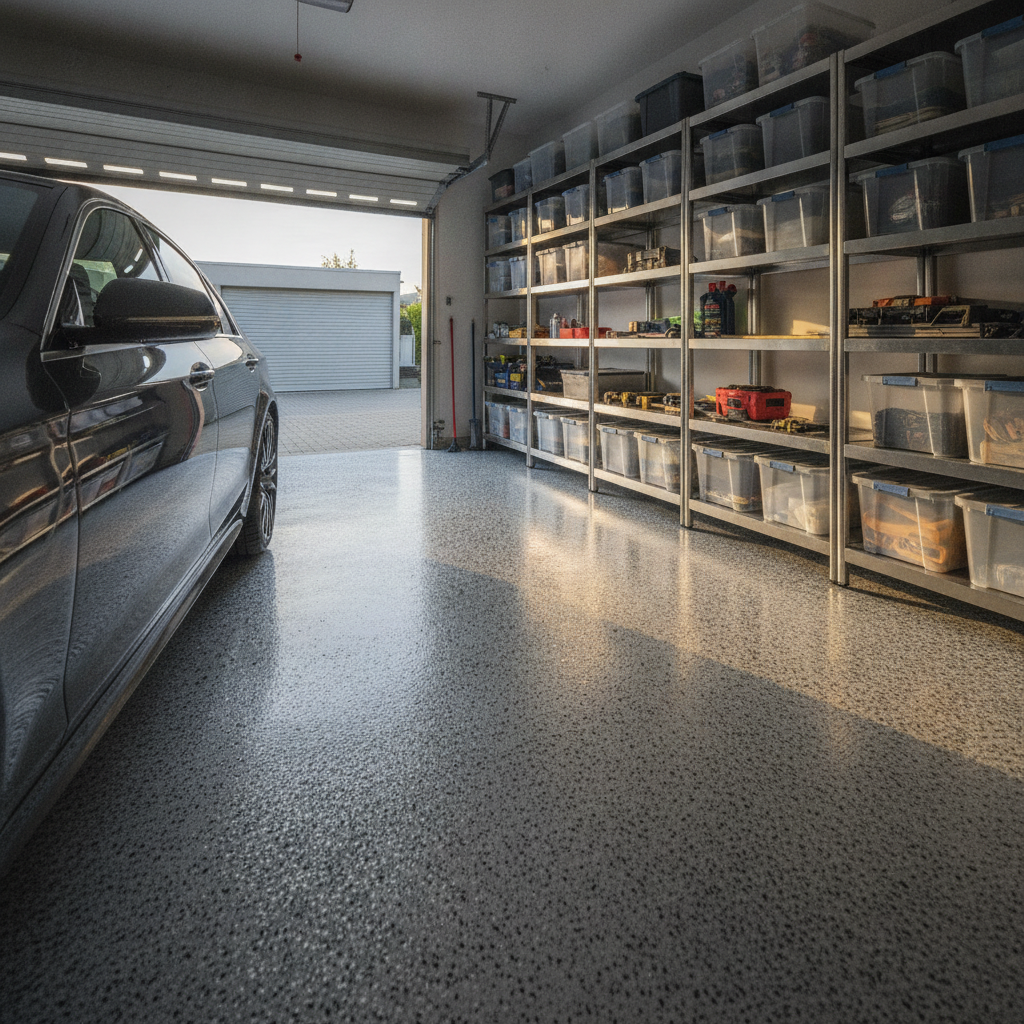
Garage Floor Ideas for Hoppers Crossing Homes: Which Coating Suits You?
The best garage floor ideas for Hoppers Crossing homes come down to three practical options: solid epoxy colour, decorative flake (chip) systems and metallic epoxy finishes. Each suits a different budget, look and use case. Solid colour epoxy is the most affordable, flake adds slip resistance and texture, and metallic delivers a showroom-quality finish with depth and shimmer.
Why does your garage floor in Hoppers Crossing need coating at all?
An uncoated concrete garage floor in Hoppers Crossing will absorb oil, stain from tyre rubber and eventually begin to dust and pit. Melbourne’s western suburbs see genuine temperature swings across the seasons, and bare concrete expands and contracts with that heat, letting moisture push up from below. A quality coating seals the slab, stops dusting, resists chemical spills and makes the whole space easier to sweep clean. You also get a floor that actually looks like part of the house rather than an afterthought.
Most homeowners in the area are using their garages for more than just parking. Workshop benches, gym gear, bike storage, even a second living area. A coated floor makes all of that more comfortable and presentable, and it protects the concrete underneath so you are not looking at a resurfacing job in ten years.
What are the main garage floor coating options worth considering?
The three coatings that come up most often for residential garages are solid epoxy colour coats, vinyl flake (chip) broadcast systems and metallic epoxy. Each has a distinct look and a different set of practical strengths. Solid colour epoxy is a single-tone, high-gloss finish that is clean and modern. Flake systems broadcast coloured vinyl chips into a wet base coat then seal them under a clear topcoat, giving you texture, slip resistance and a speckled terrazzo-style look. Metallic epoxy uses pigment blends that swirl and shift with the light, creating a marbled or liquid-metal appearance.
Here is a quick way to think about each one:
- Solid colour epoxy: Clean, modern, easy to maintain. Works well in workshops where you want to see dropped screws or spills clearly against a plain background. Usually the most cost-effective starting point.
- Vinyl flake (chip) system: The most popular choice for family garages. The texture from the chips gives grip underfoot when the floor gets wet, and the multi-tone pattern hides the odd scuff or small stain between cleans. Systems like these are routinely specified to meet Australian Standards for slip resistance in wet conditions.
- Metallic epoxy: The premium option. Pigment powders mix into the epoxy resin and are worked with a squeegee and blower to create unique swirling patterns. No two floors look identical. Popular in Hoppers Crossing homes where the garage doubles as a showroom for a project car or a tidy home gym.
Which garage floor idea suits the way you actually use your garage?
Match the coating to your real-world use rather than just the look. If your garage is mainly a parking and storage space that sees a fair bit of foot traffic and the occasional oil drip, a full flake broadcast system is your most practical pick. The textured surface grips wet boots and the pattern makes maintenance low-stress. If you run a home workshop and need bright, reflective light bouncing off the floor, a solid light-grey or off-white epoxy coat amplifies your workshop lighting noticeably. If the garage is a showcase space or a converted living area, metallic epoxy delivers a result that genuinely impresses.
Consider what sits on the floor too. Heavyweight car hoists, scissor lifts or racking systems need the concrete prepped and the coating applied at the right film thickness so the anchor points hold properly. A good applicator will discuss this before they start, not after.
How does concrete preparation affect the final result?
Concrete prep is where most cheap DIY kits fall apart, and it is the single biggest factor in how long your coating lasts. The slab surface needs to be mechanically abraded, usually by diamond grinding or shot blasting, to open up the pores and give the epoxy somewhere to grip. Acid etching alone (the approach sold in big-box hardware kits) rarely achieves adequate surface profile on a dense, trowelled garage slab.
Any cracks, spalling or low spots should be filled and levelled before coating goes down. Moisture coming up through the slab is the other common issue in Melbourne’s western suburbs, where older homes sometimes have slabs laid without an adequate vapour barrier underneath. A professional applicator will test moisture levels before they start. If moisture is above acceptable limits and coatings go down anyway, you end up with bubbling and delamination within months. Getting this step right is what separates a coating that lasts a decade from one that peels by the following winter.
What should you look for when getting quotes for garage floor coatings in Hoppers Crossing?
A few things separate a solid quote from a vague one. First, ask what surface preparation method is included. Diamond grinding is the industry standard for garage floors and should be listed explicitly, not just implied. Second, ask how many coats are going down and what the total dry film thickness will be. A proper residential floor system typically involves a primer or base coat, a broadcast layer (for flake systems) and at least one clear topcoat. Skimping on film thickness is the most common way to cut corners on price.
Third, ask about the topcoat. A polyaspartic or polyurethane topcoat is far more UV stable than a standard epoxy clear, which matters for garage doors that face north or west and let in direct afternoon sun. A coating that yellows within a year is nobody’s idea of a good investment. Finally, check that the person quoting is actually going to be on the tools. Subcontracting without telling the homeowner is more common than people realise in the floor coating trade.
How long does a professionally coated garage floor last in Hoppers Crossing?
A professionally installed epoxy floor coating in a residential garage, maintained reasonably well, should last ten to fifteen years before it needs attention beyond a light maintenance coat. The flake chip systems tend to be particularly durable because the clear topcoat takes the daily wear and the decorative layer underneath is protected. Metallic floors with a quality polyaspartic topcoat hold their gloss and colour well even in high-UV situations.
Day-to-day care is simple: a soft broom or dust mop for regular cleaning, a mild ph-neutral cleaner for spills, and avoiding dragging sharp metal objects across the surface. Hot tyre pickup (where rubber transfers from warm tyres onto the floor surface) is reduced significantly by using a polyaspartic or polyurethane topcoat rather than a standard epoxy clear. That is worth asking about specifically when you are comparing quotes, because it is a common complaint with lower-spec installations.
If you are ready to choose a finish and get a proper price on the work, Get a garage floor coating quote in Hoppers Crossing from Metal and Flake.