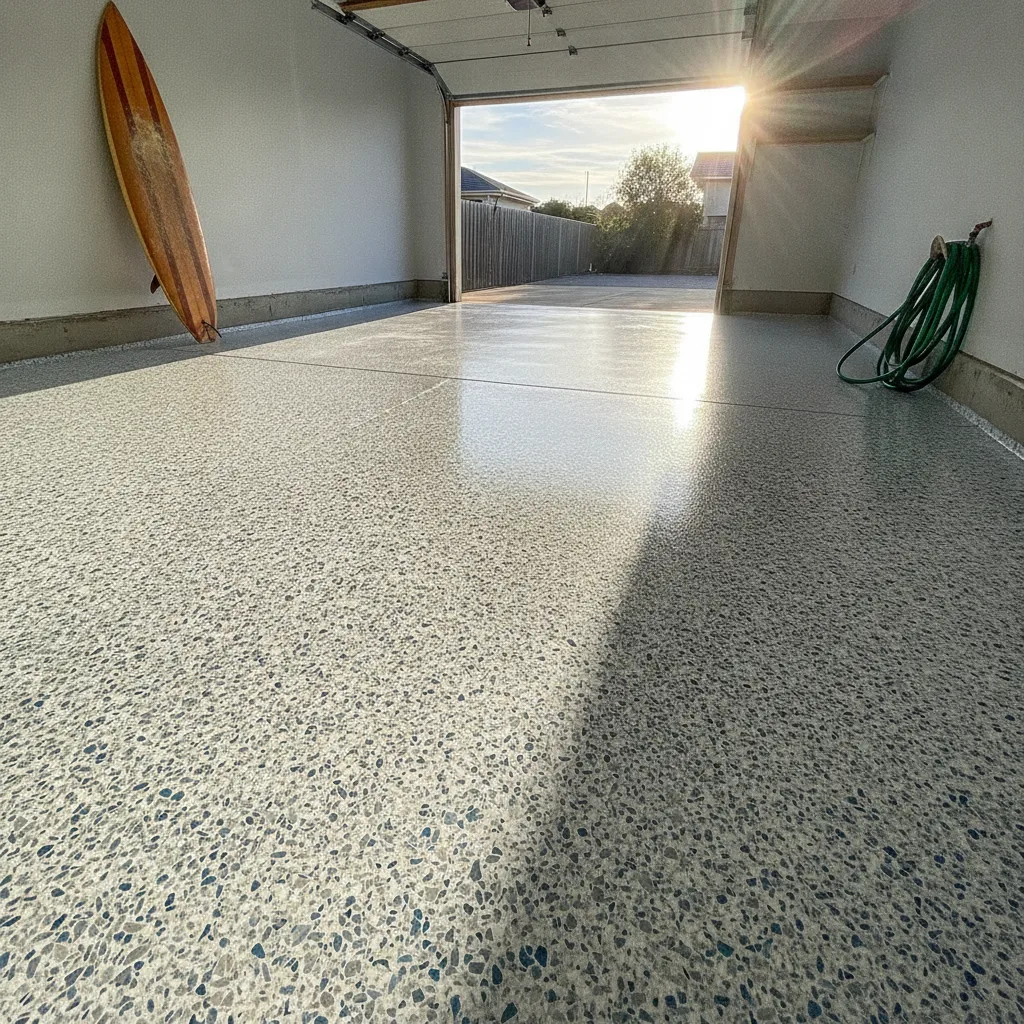
Epoxy Flake Flooring Williamstown: Protect Your Garage Near the Bay
Epoxy flake flooring in Williamstown gives garage and workshop floors a hard, sealed surface that resists the salt air, damp and grime that coastal living throws at bare concrete. A broadcast vinyl flake system bonds directly to the slab, locks out moisture and delivers a slip-resistant finish that holds up for years with minimal maintenance.
Why does living near Port Phillip Bay make epoxy flake flooring Williamstown a smart choice?
Coastal air carries salt particles that work into porous concrete and corrode it from within. In Williamstown, homes sit close enough to the bay that garages and outdoor slabs cop a genuine beating from humidity and salt-laden breezes. Epoxy forms a non-porous barrier that stops moisture migrating up through the slab and keeps salt from making contact with the concrete underneath. The result is a floor that does not pit, spall or stain the way bare concrete does over a Melbourne coastal winter.
Bare concrete is more vulnerable than most people realise. Salt crystallises inside the pores of untreated concrete as it dries, and that crystal growth creates micro-fractures over time. Once those cracks form, water gets in, and in a suburb like Williamstown where the bay breeze is almost constant, that cycle repeats every season. A sealed epoxy floor breaks the cycle entirely.
Beyond protection, there is the practical side. A garage near the water tends to double as a boat maintenance area, a bike workshop or a storage zone for sailing gear. All of those uses mean oil, grease, salt water and general grime on the floor. Epoxy wipes down fast, does not absorb spills and does not hold onto the smell of old bilge water the way raw concrete does.
What exactly is a flake epoxy floor system and how does it work?
An epoxy flake floor system is a multi-layer coating applied to a prepared concrete slab. A basecoat of pigmented epoxy resin goes down first, then vinyl flakes (sometimes called colour chips or decorative flakes) are broadcast across the wet surface at full or partial coverage. Once the base cures, excess flakes are scraped back, and a clear topcoat of either polyurethane or polyaspartic is applied over everything to lock the flakes in place and protect the surface.
The flakes do more than just look good. They create a light texture across the surface that improves grip underfoot, which matters in a garage where wet footwear and oil drips are a given. That texture is subtle enough that the floor is still easy to sweep and hose down, but enough to prevent the glassy slip hazard you get with a plain solid-colour epoxy coat.
Polyaspartic topcoats, which have become the industry standard for residential garages, cure much faster than older polyurethane finishes. A quality polyaspartic topcoat can be walked on within a few hours and ready for vehicle traffic inside 24 hours. That means a typical two-car garage in Williamstown can be done and back in use within a day or two rather than a week.
How long does an epoxy flake floor actually last in a coastal environment?
A properly installed epoxy flake floor in a coastal suburb like Williamstown should realistically last 10 to 20 years with normal use before it needs any significant attention. The longevity depends heavily on two things: how well the concrete was prepared before coating, and whether a UV-stable topcoat was used. Skipping either shortens the life considerably.
Concrete preparation is the part that separates a quality job from a floor that peels in two years. The slab needs to be ground or shot-blasted to open up the surface profile so the epoxy can mechanically bond to it. Any cracks, control joints or moisture issues need to be addressed before the first coat goes down. A floor laid over a damp or poorly profiled slab will delaminate, regardless of how good the product is.
UV-stable topcoats matter especially for Williamstown garages with roller doors that face north or west. Epoxy resins on their own yellow and chalk when hit by direct sunlight, but a quality polyaspartic or aliphatic polyurethane topcoat does not. Specifying UV stability is a small detail that makes a visible difference ten years down the track.
Regular maintenance is straightforward: a sweep, an occasional mop with a mild detergent and prompt cleanup of oil or chemical spills. Avoid dragging heavy steel objects across the surface, and the floor will keep its finish for well over a decade.
What should Williamstown homeowners look for when choosing a flake floor installer?
The first thing to look for is proper surface preparation equipment. Any installer who is not using a diamond grinder or shot blaster on the slab before they coat it is cutting corners that will cost you later. Ask directly what prep method they use and what moisture testing they do before they start, especially for a slab that is close to sea level or has any history of damp.
Check that the topcoat being quoted is UV-stable and appropriate for the use. A residential garage that sees daily vehicle traffic needs a harder, more chemically resistant topcoat than a light pedestrian area. Polyaspartic topcoats from reputable manufacturers such as Duram or Sika carry published technical data sheets that list abrasion ratings and chemical resistance, so you can compare products rather than just taking a salesperson’s word for it.
Ask to see examples of completed work in similar coastal conditions, and ask how long the installer has been working in the Melbourne market. Flake systems applied in Sydney or Brisbane do not always account for Melbourne’s specific climate: cool, damp winters followed by hot, dry summers cause more slab movement than in milder climates, and the coating system needs to be flexible enough to handle that without cracking.
Finally, get a written quote that itemises surface preparation, the specific products being used, the number of coats and the warranty terms. A confident, experienced installer has nothing to hide in those details.
What colour flake options work well in a Williamstown garage?
Neutral blends tend to work best in garages because they hide tyre marks and everyday dirt between cleans. Grey-based blends with white and black flakes are the most popular choice for residential garages across Melbourne’s inner west, and they suit Williamstown’s mix of Victorian-era homes and contemporary renovations equally well. Earthy tones with brown and cream flakes are a good option if the garage connects directly to a living area and you want a warmer feel.
Full broadcast coverage (where the flakes cover the entire floor and hide the basecoat completely) gives a more polished, uniform look and is generally easier to clean than partial broadcast. Partial broadcast leaves some of the basecoat colour visible and creates a more terrazzo-like appearance that some homeowners prefer.
Keep in mind that darker basecoats under a full broadcast system make the overall floor read darker, even when the flake blend itself is light. It is worth asking your installer to lay down a small sample area so you can see how the finished colour lands in your specific garage before committing to the full floor.
Ready to get a durable, good-looking floor that stands up to life near the bay? Book an epoxy flake floor installation in Williamstown with Metal and Flake.