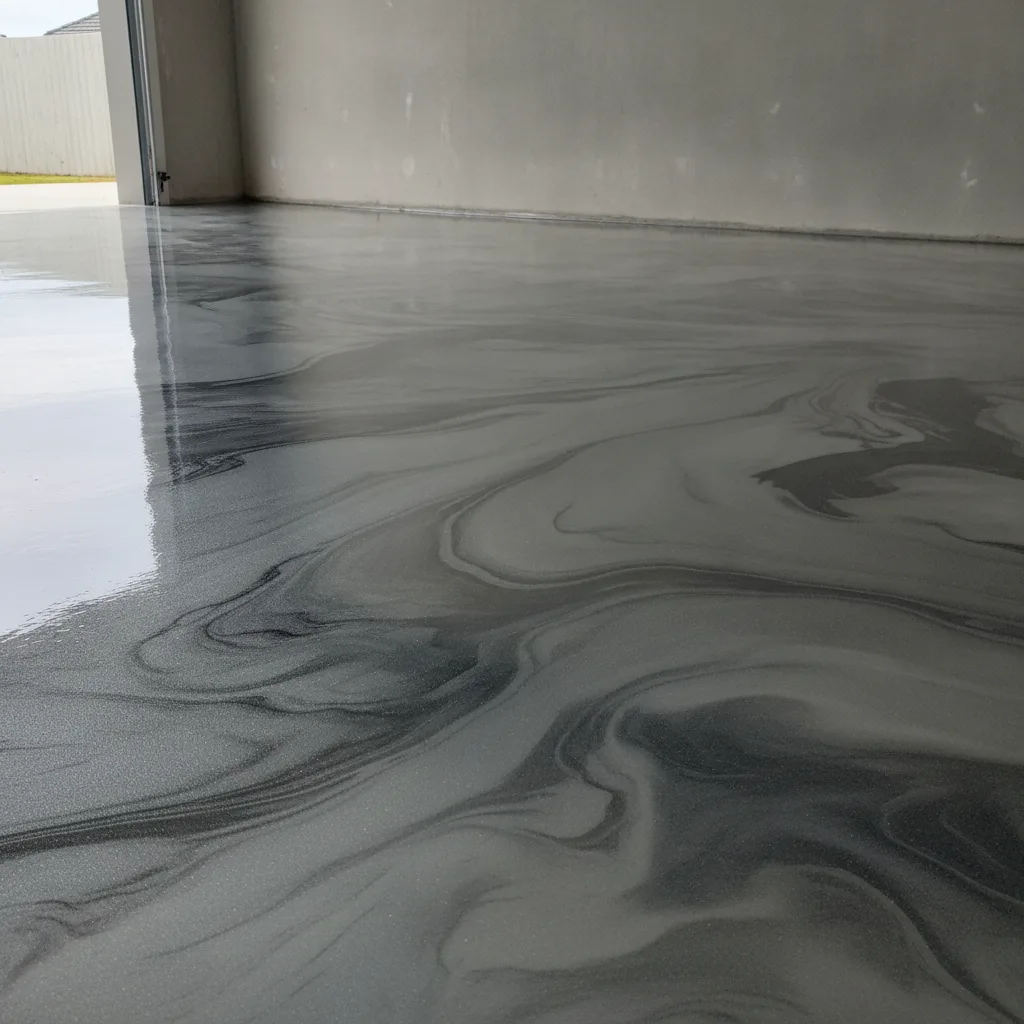
Metallic Epoxy Garage Floors: Are They Right for Your Home?
Metallic epoxy garage floors are a high-gloss, resin-based coating that uses metallic pigments to create a flowing, three-dimensional effect on concrete. They are durable, chemical-resistant and look far more impressive than bare concrete. For most Australian homeowners who use their garage as a showroom, workshop or living extension, they are absolutely worth considering.
What actually makes metallic epoxy garage floors different from standard epoxy?
Metallic epoxy garage floors differ from standard epoxy because they use fine metallic or pearlescent pigment particles suspended in a two-part epoxy resin. As the coat is applied and manipulated with rollers and blowers, the pigments shift and swirl, producing a unique, almost three-dimensional finish that you cannot replicate twice. Standard solid-colour epoxy lays flat. Metallic epoxy moves.
That movement is the whole point. When light hits the floor from a garage door opening, the surface catches it differently at every angle. Depending on the pigment colours chosen, you can get anything from a deep ocean-blue shimmer to a molten-silver lava effect. Every square metre ends up genuinely one-of-a-kind.
The base system is still a two-part epoxy, which means you get all the same structural benefits: a hard, seamless surface that bonds chemically to the concrete rather than just sitting on top of it. The metallic layer is typically applied over a pigmented base coat and then sealed with a clear polyurethane or polyaspartic topcoat that adds UV stability and extra abrasion resistance.
How durable are metallic epoxy garage floors for everyday use?
Metallic epoxy garage floors are very durable for everyday residential garage use. A properly installed system with a quality polyaspartic topcoat can handle car tyres, trolley jacks, oil spills and general foot traffic for well over a decade without losing its gloss. The topcoat is the workhorse here: it protects the metallic layer underneath from scratching and UV yellowing.
A few real-world things to keep in mind. First, hot tyre pickup is a known issue with pure epoxy floors. When a car parks on the surface straight after a long drive, the hot rubber can bond lightly to a low-quality epoxy and pull chips away when the car moves again. A polyaspartic or polyurethane topcoat handles heat much better and reduces this risk significantly. Second, bare epoxy without an anti-slip additive can get slippery when wet. Many installers broadcast a fine quartz or aluminium oxide into the topcoat to give it grip without killing the gloss. Worth asking about if you live somewhere that gets rain blowing into the garage.
In terms of chemical resistance, epoxy shreds most garage nasties. Engine oil, brake fluid, petrol and most household cleaners wipe off clean. Prolonged contact with strong acids or caustic solvents will eventually damage any coating, but day-to-day garage chemistry is not a problem.
What does the installation process for metallic epoxy garage floors involve?
The installation process for metallic epoxy garage floors involves concrete preparation, a primer coat, the metallic colour coat, optional design work and a clear protective topcoat. Surface preparation is the most critical stage: grinding or shot-blasting the concrete opens up the pores so the epoxy bonds properly. Skipping this step is the number-one reason DIY epoxy jobs peel within a year.
Here is a typical sequence for a professional installation:
- Day 1 Preparation: The slab is ground with a diamond grinder or shot-blasted to achieve a concrete surface profile (CSP) of around 2 to 3. Any cracks, control joints or spalling are repaired with epoxy filler. Moisture readings are taken because concrete with high moisture vapour transmission can cause delamination.
- Day 1 Primer: A penetrating epoxy primer is rolled on and left to cure. Some systems use a moisture-tolerant primer to deal with slightly damp slabs.
- Day 2 Base and metallic coat: The pigmented base coat goes down, followed immediately by the metallic epoxy layer. The installer uses a notched squeegee, short-nap roller and sometimes a propane torch or leaf blower to manipulate the pigment into the desired swirl pattern. This is where the artistry comes in.
- Day 2 or 3 Topcoat: Once the metallic layer has cured to a tack-free state, the clear polyaspartic or polyurethane topcoat is applied, often in two passes. Anti-slip aggregate is broadcast into the wet topcoat if required.
- Cure time: Light foot traffic is usually fine after 24 hours. Cars should stay off for at least 72 hours, and full chemical cure takes around 7 days.
Total installation time for a standard double garage of around 36 to 40 square metres typically runs two to three days on site.
How much do metallic epoxy garage floors cost compared to other options?
Metallic epoxy garage floors cost more than plain paint or basic solid-colour epoxy but less than tiling or polished concrete for the same area. In Melbourne, professionally installed metallic epoxy in a standard double garage typically falls in the range of $50 to $100 per square metre, depending on the complexity of the design, the condition of the existing slab and the topcoat system specified. That puts a 40-square-metre double garage somewhere between $2,000 and $4,000 installed.
Compare that to concrete tiles, which can run $80 to $150 per square metre installed and require ongoing grout maintenance, and the value proposition of epoxy starts to look pretty solid. Polished concrete is in a similar price bracket to metallic epoxy but requires a thicker slab and more grinding time, and it does not offer the same decorative range.
The other cost worth factoring in is longevity. A quality metallic epoxy system, properly maintained, should not need replacing for 10 to 15 years. Basic floor paint might look okay for 12 to 18 months before it starts chipping and peeling. When you spread the cost over the usable life, metallic epoxy is genuinely competitive.
Are metallic epoxy garage floors a good fit for your specific situation?
Metallic epoxy garage floors are a good fit if you want a premium-looking, low-maintenance surface and you are prepared to invest in proper professional installation. They suit car enthusiasts who park show vehicles, homeowners converting a garage into a multipurpose room, and anyone who simply wants a finished, clean-looking space rather than bare grey concrete.
They are less ideal in a few situations. If your slab has severe moisture issues, rising damp or major structural cracking, those problems need to be addressed before any coating goes down. A reputable installer will test for moisture and be upfront about it rather than just coating over the problem. If you are running heavy industrial machinery that vibrates or drops metal objects regularly, a harder industrial system might suit you better than a decorative metallic coat.
Climate matters a little too. Melbourne’s temperature swings between seasons mean concrete slabs expand and contract. A flexible topcoat handles this better than a brittle one, so asking your installer what topcoat system they use and why is a fair question.
If you are a renter, check your lease. Some landlords are happy for tenants to upgrade the floor; others are not. Either way, a metallic epoxy floor typically adds to the property’s appeal and resale value, so most owner-occupiers see it as a straightforward improvement rather than an expense.
Ready to see what the finish looks like on your own slab? Book a metallic epoxy garage floor installation with Metal and Flake.