Self-Levelling Epoxy: When Is It the Right Choice for Your Floor?
Self levelling epoxy is the right choice when you have a structurally sound concrete slab with minor surface imperfections, low to moderate slope variation, and you want a seamless, high-gloss finish that cures hard and flat. It works best in garages, workshops and internal slabs where the substrate has been properly prepared and moisture is under control.
What exactly is self levelling epoxy and how does it work?
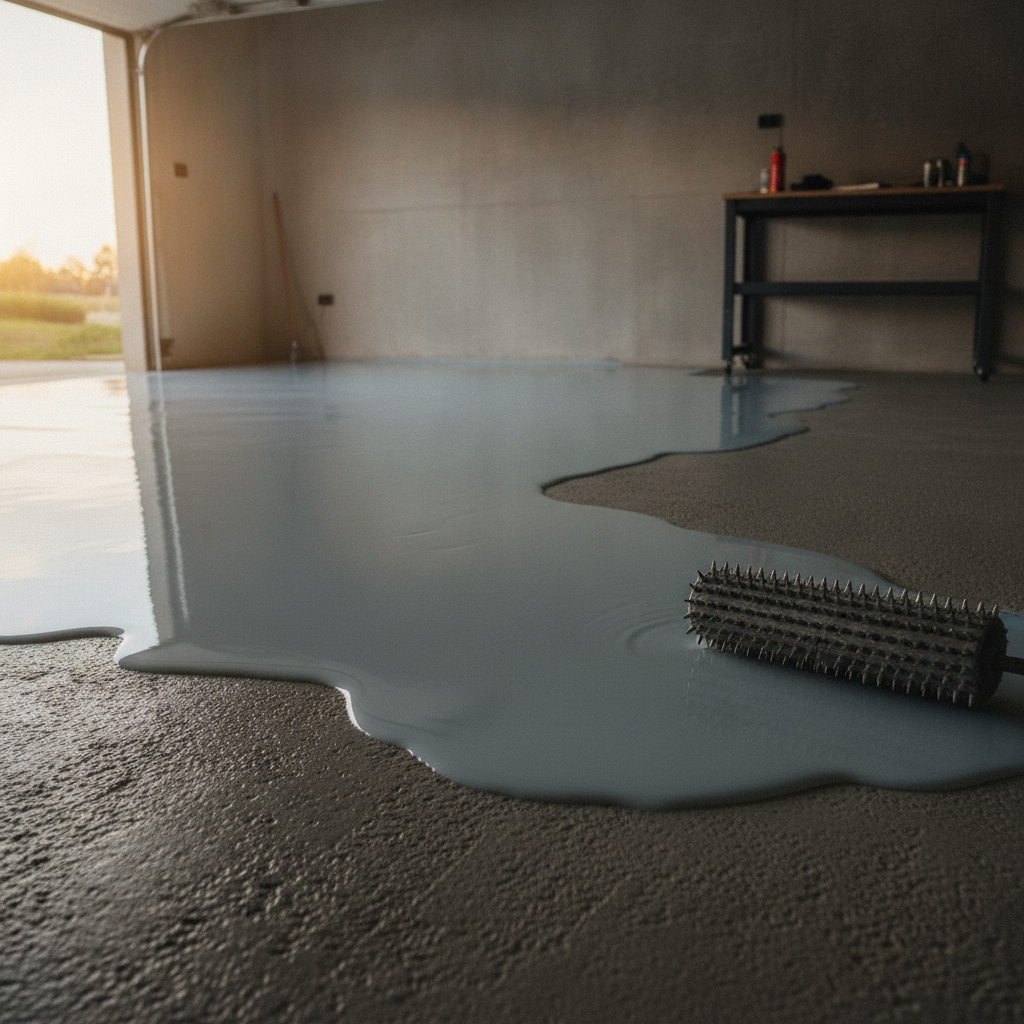
Self levelling epoxy is a low-viscosity, two-part resin coating that flows across a prepared concrete surface under its own weight, settling into a flat, even layer before it cures. Mixed correctly, it finds its own level much like water does, filling minor dips and surface texture to leave a smooth, uniform finish typically between 2 mm and 3 mm thick.
The two parts, a resin and a hardener, are combined in a precise ratio (usually 2:1 or 3:1 by volume depending on the product) and then poured directly onto the floor. A spiked roller is used to break surface tension and release trapped air bubbles before the material begins to set. Working time is tight, usually 20 to 30 minutes at room temperature, so preparation and speed both matter.
Because the product is fluid, it does an excellent job of hiding minor surface irregularities. It won’t, however, fix a slab that is genuinely unlevel or sloping in the wrong direction. A floor that drops more than about 5 mm over a metre is going to pool the product at the low end. That’s when you need to address the substrate first, not just pour more material on top.
Is self levelling epoxy the same as a standard epoxy floor coating?
No. Self levelling epoxy and standard broadcast or roller-applied epoxy coatings are related products but they serve different purposes. A standard epoxy coating is thicker in viscosity and applied by roller in multiple thin coats, relying on the applicator to build an even layer. Self levelling epoxy is poured and flows to its own level, producing a thicker, denser single layer with a glass-smooth surface.
Standard roller-applied systems are more forgiving on textured or slightly rough slabs and are the more common choice for residential garages, especially where a decorative flake or metallic finish is the goal. Self levelling products are more often specified for commercial floors, showrooms, warehouses and internal domestic spaces where a seamless, mirror-flat result is the priority and the slab quality is already good.
The cost difference is real too. Self levelling systems use more material by volume and require faster, more experienced application. Getting it wrong, moving too slowly, mixing the wrong ratio or working on a cold slab, can leave you with fish-eyes, ridges or a floor that never fully cures. That’s not a situation anyone wants to deal with after the fact.
What surface preparation does self levelling epoxy need?
Surface preparation for self levelling epoxy is non-negotiable and probably the most important factor in a successful result. The concrete must be mechanically prepared, meaning diamond grinding or shot blasting to open the surface profile, remove laitance and give the epoxy something to grip. A smooth, trowelled slab finish will cause adhesion failure regardless of how good the product is.
Moisture is the other critical issue. Concrete slabs in Melbourne can hold residual moisture, especially in older homes or slabs without a proper vapour barrier below. Most self levelling epoxy products require a relative humidity reading at the surface below 75 per cent, tested with a calcium chloride or Tramex-style moisture meter. If moisture is present, a moisture-tolerant primer or a separate DPM (damp-proof membrane) coat is needed before the self levelling layer goes down.
Any cracks wider than a hairline need to be chased out and filled with an appropriate epoxy filler or polyurethane joint compound before the self levelling pour. Trying to bridge active cracks with a self levelling product is a short-term fix at best. The crack will telegraph back through the coating, often within a year.
When does self levelling epoxy not make sense for a garage floor?
Self levelling epoxy is not the right call when your garage slab has significant slope for drainage, because the product will simply flow to the lowest point and give you an uneven finished coat. It is also a poor fit for slabs with active moisture, heavy surface contamination from oil or previous coatings, or concrete that is structurally compromised with deep spalling or crumbling edges.
For most residential Melbourne garages, a roller-applied epoxy system with a decorative flake broadcast offers better value. The application process is more controlled, the anti-slip texture built in by the flake layer is genuinely useful underfoot and around vehicles, and the finish holds up well to tyre traffic, petrochemicals and the general punishment a working garage gets. A self levelling floor in a busy two-car garage can show tyre marks and surface wear more readily than a textured flake system.
Temperature also plays a role that catches people out. Self levelling epoxy applied below about 10 degrees Celsius can cure too slowly and leave a tacky or blush-affected surface. Melbourne winters, particularly in outer suburban and regional areas, can push morning slab temperatures well below that threshold. Timing the pour to a mild, dry day with stable temperature for the full cure window, typically 24 to 48 hours, matters more with self levelling products than with almost any other coating type.
How long does self levelling epoxy last and is it hard to maintain?
A correctly installed self levelling epoxy floor in a light to moderate traffic environment can be expected to last 10 to 20 years before recoating becomes necessary. The finish is dense and non-porous, which makes routine cleaning straightforward. A mop with a pH-neutral cleaner is usually all that’s needed. Because there is no open texture, grit and dirt don’t embed themselves the way they can in rougher finishes.
The limitation is scratch and scuff resistance. The high-gloss surface that makes self levelling epoxy so visually impressive is the same surface that shows fine scratches from grit tracked in on tyres or dragged equipment. Adding a polyurethane or polyaspartic topcoat over the self levelling layer significantly extends the surface life and improves chemical resistance. Many commercial installations specify this as standard.
For residential garages that see daily vehicle use, a topcoat is worth the extra outlay. Without it, you may find the finish starts to look dull in the tyre track zones within a few years, even though the structural integrity of the coating is still perfectly fine.
What should you ask a contractor before choosing a self levelling epoxy system?
Before committing to a self levelling epoxy system, ask your contractor these specific things: what moisture testing method they use and what the acceptable threshold is for their chosen product; whether their preparation process includes mechanical grinding or shot blasting (not just acid etching alone); what the mixed-ratio tolerance is for the product they intend to use; and whether a primer coat is included in the quote or priced separately.
Also ask what topcoat, if any, is going over the self levelling layer and what warranty covers both the product and the application. A contractor who gives clear, specific answers to those questions without hesitation is one who knows the work. Vague answers about “industry standard” prep or warranties that only cover the product and not the application should raise a flag.
The product brand matters less than the application quality. Two applicators using the same self levelling epoxy can get very different results depending on surface preparation, mixing accuracy and environmental conditions on the day. Experience with the specific substrate type in Melbourne conditions, which can run from humid coastal air to dry inland heat depending on where you are, is genuinely valuable.
Ask Metal and Flake which epoxy floor coating system suits your garage.