Garage Floor Coating in Reservoir: Which Epoxy System Should You Choose?
The right garage floor coating in Reservoir depends on how you use the space, the condition of your concrete, and the finish you’re after. A single-broadcast flake system suits most residential garages. A full metallic or double-broadcast build suits workshops and showrooms. Getting the substrate prep right matters more than the coating itself.
Why does garage floor coating in Reservoir need a different approach to other floors?
A garage floor takes a specific kind of punishment. Hot tyre rubber, motor oil, hydraulic fluid, and heavy point loads from jack stands all attack a coating differently than foot traffic does. Reservoir’s residential streets mix older post-war concrete slabs with newer poured slabs, and each one behaves differently under a grinder. Knowing which slab you’re dealing with shapes every decision that follows.
Older slabs common in Reservoir’s established streets are often thinner and may have surface carbonation, a dusty top layer that forms over decades and stops epoxy bonding properly. A diamond grind that removes two to three millimetres of the surface solves this. Newer slabs poured in the last twenty years tend to be denser but can trap moisture if the concrete hasn’t fully cured. A moisture test before coating is not optional. Applying epoxy over a slab reading above four percent moisture content is a reliable way to get delamination within twelve months.
Reservoir also sits in Melbourne’s north, which means hot summer days that push concrete surface temperatures above 30 degrees Celsius. Epoxy applied to a hot slab flashes off too quickly, trapping bubbles. Scheduling the job for an early morning start or a cooler week matters on a practical level, not just for aesthetics.
What epoxy systems are available for a garage floor, and which one suits your situation?
There are three main systems worth knowing: a standard solid-colour epoxy, a flake broadcast system, and a metallic epoxy system. Each has a different cost, look, and practical performance profile. A solid-colour system is the entry point, but it shows every tyre mark and scratch quickly. Most homeowners move past it once they see the alternatives.
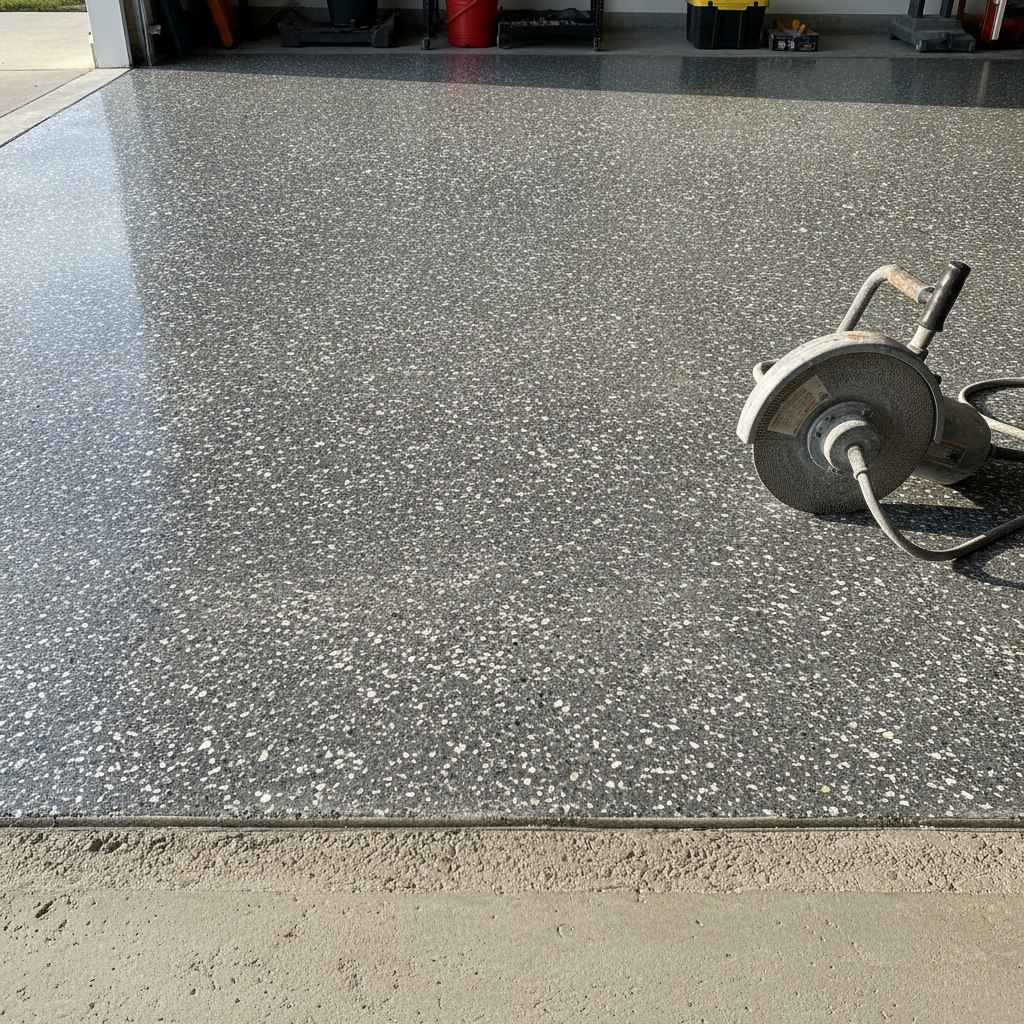
A flake broadcast system is the most popular choice for residential garages in Melbourne’s north. Coloured vinyl flakes are broadcast into a wet epoxy base coat, then locked in with a polyurethane or polyaspartic topcoat. The flakes serve two purposes: they add visual texture that hides dirt and minor surface imperfections, and they break up the glossy surface enough to improve slip resistance when wet. A full-broadcast flake system, where flakes are thrown to rejection (meaning the floor is completely covered), adds a meaningful amount of thickness to the build and makes the finished floor feel solid underfoot.
A metallic epoxy system uses pigmented metallic powders mixed into a clear or tinted epoxy base. The installer manipulates the wet coat with a blower or roller to create a marbled, three-dimensional look. It is a more technical application and takes more time on site. For a Reservoir garage that doubles as a workshop or hobby space, the result is genuinely impressive and holds its look well under fluorescent lights. The polyaspartic topcoat used to seal metallic systems is UV-stable, which matters in a garage that gets afternoon sun through an open roller door.
Polyaspartic coatings are worth mentioning on their own. They cure faster than standard epoxy, meaning a garage can sometimes be walked on within hours of application and driven on within 24 hours. In Melbourne’s variable spring weather, faster cure windows reduce the risk of dust or debris settling into a wet coat. The trade-off is that polyaspartic sets quickly, so application is less forgiving. An experienced installer working in the right conditions gets excellent results. A rushed job on a hot afternoon does not.
How much surface preparation does a Reservoir garage slab actually need?
Surface preparation is the part of the job that determines whether a coating lasts five years or fifteen. For a standard residential garage in Reservoir, preparation typically involves diamond grinding the full slab, vacuuming the surface thoroughly, filling cracks and control joints with a semi-flexible polyurethane filler, and allowing any moisture-mitigation primer to fully cure before the base coat goes down.
Cracks are common in older Reservoir slabs and don’t necessarily indicate a structural problem. A hairline crack filled properly and locked under a full-broadcast flake system is essentially invisible once the job is done. A crack ignored and coated over will reflect through the finished surface within a season as the slab continues its normal thermal movement.
Oil contamination is the other common issue in garages that have seen years of vehicle use. Oil penetrates concrete and has to be mechanically removed, not just degreased. Grinding gets it out. A degreaser alone does not. If there are visible oil stains on your slab right now, factor in extra prep time when budgeting the job.
How long will a garage floor coating last in Reservoir conditions?
A properly prepared and correctly installed epoxy floor coating in a residential Reservoir garage should realistically last ten to fifteen years before it needs any significant attention. The topcoat takes the daily wear, and a quality polyurethane or polyaspartic topcoat handles tyre traffic, chemical spills, and UV exposure far better than epoxy alone. Recoating the topcoat at around the ten-year mark, without stripping the whole floor, is a practical way to extend the system’s life significantly.
The biggest factors that shorten coating life in a garage environment are hot tyre pick-up, which happens when a standard epoxy without a proper topcoat gets soft under a hot tyre and peels when the car moves, and abrasion from grit and sand tracked in on tyres. A doormat at the entry and a quick sweep every couple of weeks makes a real difference to how the floor looks at the five-year mark.
Reservoir gets cold overnight in winter, and concrete will contract slightly. A coating applied at the right thickness and with a semi-flexible primer layer handles this thermal movement without cracking. Thin coatings applied over unprepared concrete do not.
What should you ask a coating installer before booking the job?
Ask whether diamond grinding is included in the quote, or whether the installer uses acid etching instead. Acid etching opens the surface chemically but does not remove carbonation or contamination the way grinding does. Most quality installers in Melbourne use diamond grinders. Ask what topcoat is used and whether it is UV-stable. Ask how long cure time is before vehicle traffic, and whether that timeline accounts for the current season. A genuine answer to those three questions tells you a lot about what kind of job you’re going to get.
Also confirm whether the quote covers crack and joint filling, or whether that’s an extra. On older Reservoir slabs with a few cracks, it’s rarely optional. Getting that detail sorted upfront saves a conversation on the day of installation.
Ready to move forward? Request a garage floor coating quote in Reservoir from Metal and Flake.