Epoxy Floors in Coburg: What Inner-North Homeowners Are Choosing
Epoxy floors in Coburg are a practical, long-lasting upgrade that suits the area’s mix of brick-veneer homes, period weatherboards and converted garages. Homeowners are choosing metallic and flake finishes for garages, laundries and open-plan living areas because epoxy handles Melbourne’s clay-soil movement better than tiles, costs less than polished concrete and is far easier to clean than bare slab.
Why are epoxy floors so popular in Coburg right now?
Coburg’s housing stock is dense with 1950s and 1960s homes that have concrete slabs already poured under the house. These slabs are usually sound but visually tired, and many owners are renovating rather than selling in the current market. Epoxy is a cost-effective way to transform a dull grey slab into a feature floor without a full rebuild, which makes it an obvious choice for the inner north.
The suburb has also seen a steady stream of garage conversions into hobby rooms, home gyms and workshop spaces. An epoxy coating handles the wear from car tyres, tool drops and foot traffic without cracking or chipping the way paint does. Because Coburg sits close to both the Ring Road and Sydney Road retail strip, tradies and tradespeople working from home need floors that can genuinely take a beating.
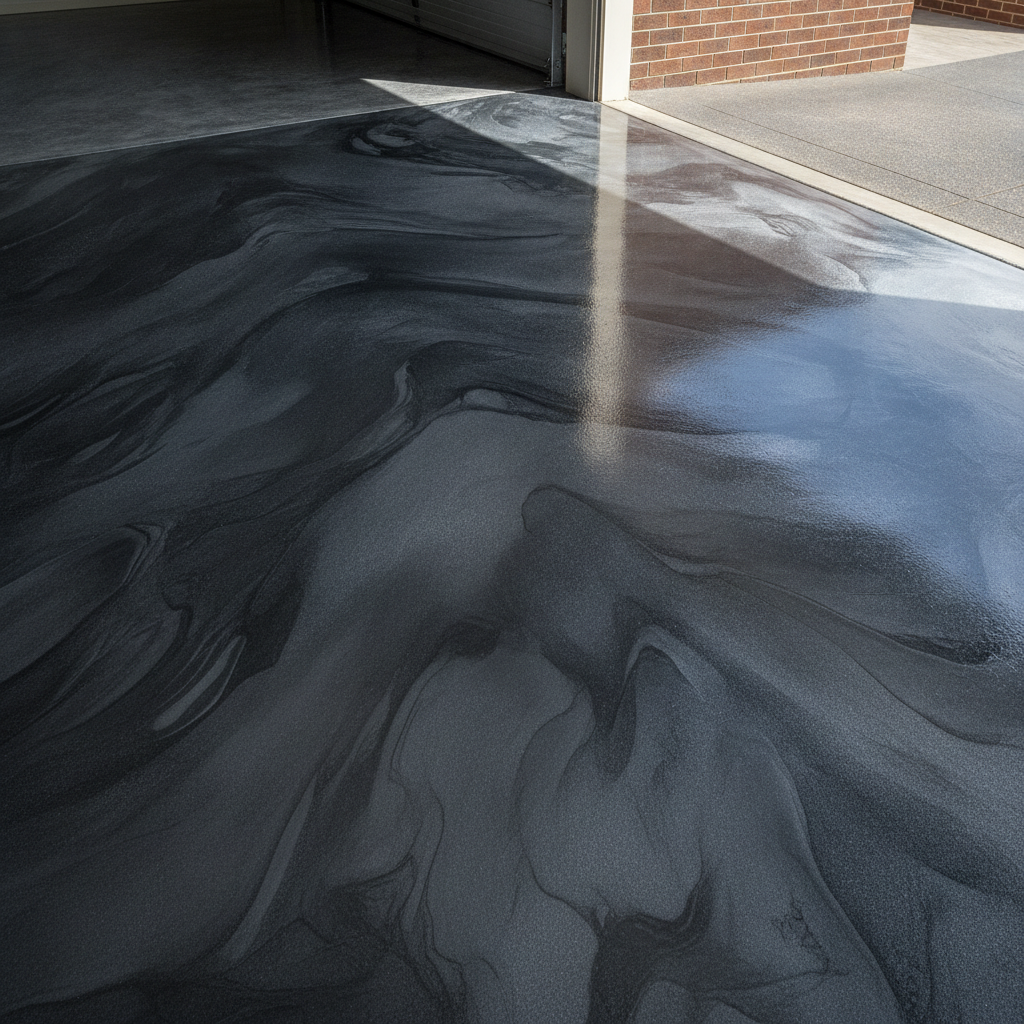
Beyond the practical side, the look matters. Metallic epoxy finishes, particularly pewter and charcoal tones, complement the dark palette many inner-north owners are chasing. Flake systems in grey and white blends are turning up in Coburg garages where the owners want something that reads clean rather than industrial.
What epoxy floor finishes are Coburg homeowners actually picking?
Coburg homeowners tend to choose either a decorative flake system or a solid metallic finish, depending on the room. Flake systems are the most popular for garages and workshops because the texture hides dust, is slip-resistant when wet and disguises the minor imperfections every older slab carries. Metallic finishes are more common in laundries, mudrooms and internal alfresco connections where the homeowner wants a visual statement.
Flake systems work by broadcasting vinyl flake chips over a base coat, then sealing with a clear polyurethane or epoxy top coat. The finish is tough enough to handle a trolley jack and grippy enough to walk on in wet boots. A standard residential flake floor over a two-car garage (roughly 36 square metres) typically involves one day of prep and one day of coating, with a 24-hour cure before light foot traffic.
Metallic epoxy is a different beast. Pigment is mixed through the epoxy resin so the installer can manipulate the wet coat to create depth and movement. No two metallic floors look identical, which suits Coburg’s inner-north homeowners who are often renovating character homes and want something that feels bespoke rather than off-the-shelf.
Solid colour epoxy, usually a mid-grey or slate tone, is a third option that suits utilitarian spaces. It costs less than flake or metallic and still produces a result that is miles ahead of bare concrete or worn floor paint.
How does epoxy hold up in a Coburg home over time?
A properly installed epoxy floor in a residential setting will typically last 10 to 20 years before it needs attention, provided the surface preparation was done correctly. Surface prep is everything. If the concrete is not mechanically ground and any laitance removed before coating, the epoxy will eventually delaminate, no matter how good the product is. A diamond grinder and vacuum system are standard tools for any reputable installer.
Coburg’s clay-heavy subsoils can cause minor slab movement with seasonal moisture changes. This is worth knowing upfront. A flexible epoxy system handles hairline movement better than a rigid one, and a good installer will assess the slab condition, check for moisture vapour transmission with a simple calcium chloride test, and recommend the right primer before any coating goes down. Skipping the moisture test is one of the most common causes of epoxy failure in Melbourne’s inner suburbs.
Day-to-day maintenance is simple. A regular sweep and an occasional mop with warm water and a pH-neutral cleaner keeps an epoxy floor looking sharp. Avoid bleach-based products, which can dull the top coat over time. For garage floors, a quick rinse after driving in on wet days is all that is needed. The sealed surface means oil drips and brake dust wipe off without staining.
What should Coburg homeowners ask before getting an epoxy quote?
Before you commit to any installer, there are a few practical questions worth asking. First, will they grind the concrete or just acid etch it? Mechanical grinding gives epoxy far better adhesion than acid etching alone, especially on older slabs. Second, how many coats are in the system? A single-coat job looks fine on day one but will show wear sooner than a two or three-coat system with a dedicated primer, body coat and top seal. Third, what is the top coat product and what is its abrasion rating? A quality polyurethane or polyaspartic top coat rated for vehicle traffic will outlast a basic epoxy clear by years.
It is also worth asking about cure times before you book. A full cure for vehicle traffic is usually 72 hours after the final coat. Light foot traffic is often fine at 24 hours. If an installer tells you the car can go back in the same day, that is worth pressing them on.
Finally, get the warranty in writing. Reputable installers will back their work for at least two years against delamination. If delamination occurs within a reasonable timeframe on a properly prepped slab, that is an installer problem, not a product problem.
Is epoxy the right choice for every Coburg space?
Epoxy works brilliantly in garages, workshops, laundries, alfresco areas and internal living spaces over concrete slabs. It is not a good fit over timber subfloors, which flex too much for a rigid coating system. If you have a raised timber floor in your Coburg period home, polished boards or a floating floor product will serve you better.
Wet areas like bathrooms are also generally better served by tiles. Epoxy can be used in commercial wet environments with the right slip-resistant aggregate, but for a domestic bathroom the grout lines of tile give better drainage and grip in a smaller, busier space.
For the spaces where epoxy does fit, the value proposition is hard to argue with. You are turning a plain slab into a sealed, attractive, easy-clean surface for a fraction of what a tile job or polished concrete grind would cost, and with a faster install time. In Coburg, where tradies are booked out and homeowners want minimal disruption, that turnaround matters.
Get an epoxy floor quote in Coburg from Metal and Flake.