Residential Epoxy Flooring: Best Options for Melbourne Homes
Residential epoxy flooring is a hard-wearing, seamless coating applied directly to a concrete slab. It bonds chemically to the concrete, producing a surface that resists oil, water, impact and daily foot traffic far better than bare or painted concrete. For Melbourne homes, the most popular options are full flake systems, metallic epoxy and solid-colour coatings, each suited to different spaces and budgets.
What makes residential epoxy flooring different from a commercial job?
Residential epoxy flooring differs from commercial work mainly in scale, foot traffic expectations and finish preference. A home garage or internal floor sees far less heavy vehicle traffic and forklift movement than a warehouse, so the coating system can be tailored for appearance as well as toughness. Homeowners also have a much wider range of colours, flake blends and gloss levels to choose from, making the finish genuinely personal.
That said, the prep work is just as serious. Concrete still needs to be ground back with a diamond-grinding machine to open the surface profile so the epoxy can bond properly. Skip that step and no matter how good the product is, you will get delamination within a year or two. Any cracks or control joints also need to be addressed before the coating goes down, or they will ghost through the finished surface.
The other residential-specific consideration is moisture. Melbourne homes built on reactive clay soils can have slabs that hold more moisture than expected, especially in garages on the south side of the house. A moisture test before quoting is not optional; it is what separates a coating that lasts a decade from one that bubbles up in the first summer.
Which residential epoxy flooring system suits a Melbourne garage?
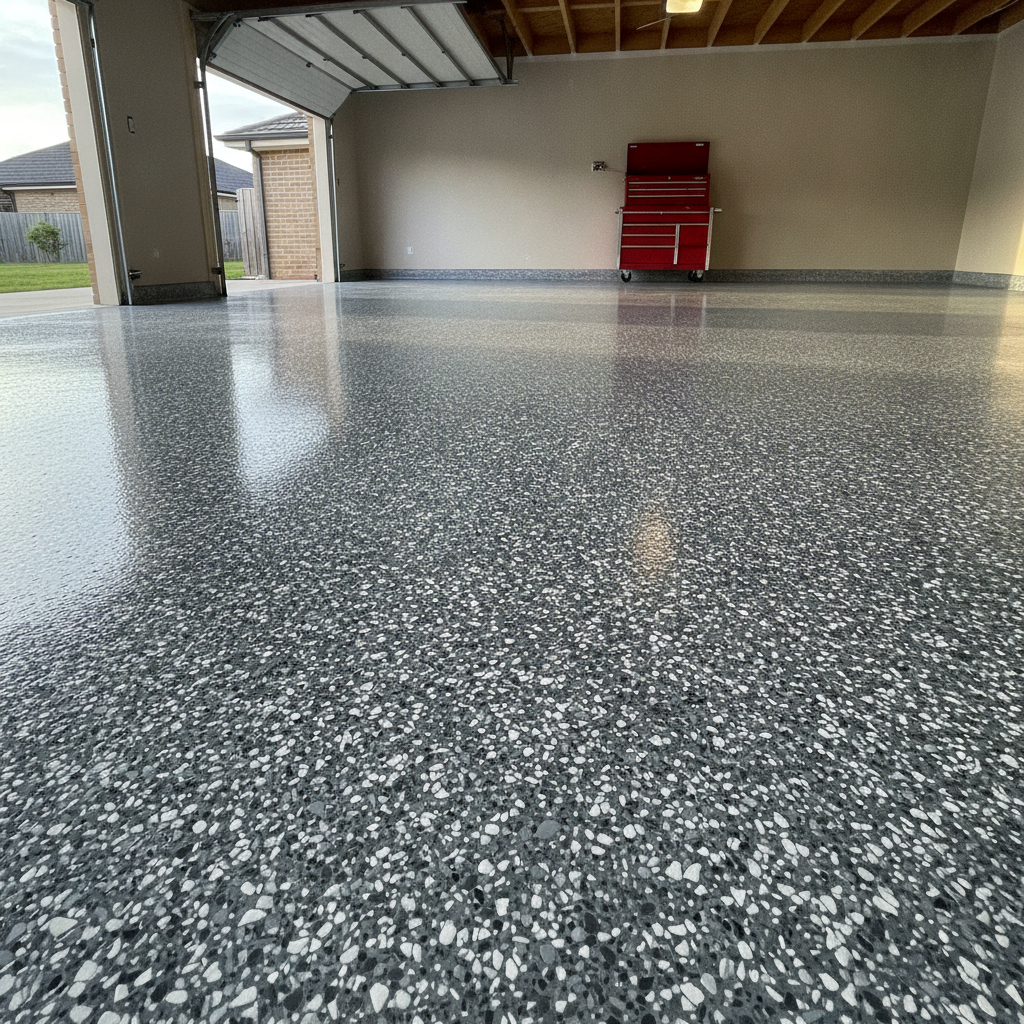
For a Melbourne residential garage, a full broadcast flake epoxy system is the most practical choice. It combines a pigmented base coat, a generous broadcast of coloured vinyl flakes and a clear polyurethane or epoxy topcoat. The result hides tyre marks, dirt and the occasional oil drip far better than a solid-colour system, and the texture from the flakes provides grip underfoot when the floor is wet.
The flake system is also the most forgiving when it comes to minor imperfections in the slab. Because the flakes are broadcast edge-to-edge, small surface inconsistencies disappear under the density of the chip. Colour options are broad: everything from a subtle grey-and-white blend that reads almost like stone, through to bold charcoal or tan combinations that suit a more styled home.
Metallic epoxy is the other popular pick for garage floors, particularly in homes where the garage doubles as a workshop or showroom space. A metallic system uses fine aluminium or mica pigment suspended in the epoxy, which creates a swirling, three-dimensional look as the coating is worked across the slab. It is a striking finish, but it does show tyre marks and scuffs more readily than a flake system, so it suits lighter-use garages better.
Solid-colour epoxy sits at the more affordable end and works well for utility spaces, but it is worth knowing that it shows every dust particle and tyre mark quite clearly on a gloss finish. A satin or matte topcoat reduces this significantly if you go that route.
How long does a residential epoxy floor coating actually last?
A properly installed residential epoxy floor coating in a Melbourne home garage should last between 10 and 20 years before any major re-coating is needed. The range comes down to how the floor is used, how well the concrete was prepared and what topcoat was specified. A polyurethane topcoat adds UV stability and scratch resistance that a straight epoxy topcoat cannot match, which matters in a garage with natural light exposure.
Day-to-day maintenance is straightforward. A weekly sweep and a mop with a pH-neutral cleaner is all most residential floors need. Avoid dragging heavy metal objects across the surface and use furniture pads under shelving units. If a heavy toolbox drops and chips a corner, small touch-ups are possible without re-coating the whole floor.
One thing that does shorten the life of any epoxy coating is hot tyre pick-up. This happens when a car that has been driven sits on an epoxy surface and the hot tyre essentially bonds to the coating, pulling bits of it away when the car moves. A quality polyurethane topcoat raises the heat-deflection temperature of the surface enough to largely eliminate this issue, which is why specifying the right topcoat matters as much as the base system itself.
What should Melbourne homeowners expect during the installation process?
The installation process for residential epoxy flooring typically runs across two days for a standard double garage of around 36 to 40 square metres. Day one is preparation: the slab is diamond-ground, cracks are filled, expansion joints are addressed and the space is vacuumed clean. This is the most critical part of the job and takes the longest. Day two is the coating application: base coat, flake broadcast or metallic work, and the topcoat.
Light foot traffic is usually possible within 24 hours of the topcoat going down. Full cure, where the floor reaches its maximum hardness and chemical resistance, takes around seven days. Driving a car onto the floor before the 72-hour mark is not recommended, and the installer should give you a clear timeline specific to the product they are using.
Weather plays a role in Melbourne more than in drier cities. High humidity and temperatures below about 10 degrees Celsius slow the cure and can affect the final finish. A good installer will check conditions before committing to a job date, and will not push product onto a slab that has recorded high moisture readings without a moisture mitigation primer.
The space needs to be cleared completely before the crew arrives. That means removing every car, toolbox, shelf, fridge and bin from the garage. If items cannot be moved out, the job cannot be done properly. Plan for that in advance and the whole process is genuinely painless.
How much does residential epoxy flooring cost in Melbourne?
Residential epoxy flooring in Melbourne typically costs between $50 and $120 per square metre installed, depending on the system, the condition of the existing slab and the complexity of the space. A standard full flake system for a double garage sits toward the middle of that range. Metallic systems cost more because of the material and the additional skill involved in working the finish. Solid colour is generally at the lower end.
What drives cost up is preparation work beyond a standard grind. If the slab has significant cracking, previous paint or a contaminated surface from years of oil spills, more time and more product go into getting it ready. Getting a proper on-site quote is the only way to get an accurate number because no two slabs are identical.
It is also worth understanding what you are paying for relative to alternatives. Good quality floor tiles for a garage run $40 to $60 per square metre just for materials, before any labour. Polished concrete is comparable in price to epoxy but requires a slab in excellent condition. Rubber matting is cheaper upfront but it traps moisture underneath and looks tired within a few years. For the combination of durability, finish quality and ease of cleaning, epoxy flooring represents solid value for a residential garage.
Book a residential garage floor coating quote with Metal and Flake