Epoxy Garage Floors in Essendon: Options for Every Home
An epoxy garage floor in Essendon transforms a dull concrete slab into a hard-wearing, easy-clean surface that lifts the whole feel of your home. Depending on the finish you choose, a professionally applied coating resists oil, tyre marks and moisture while lasting well over a decade with minimal upkeep. This guide walks through every main option so you can make the right call for your space.
Why is epoxy such a popular garage floor coating in Essendon?
Epoxy bonds directly to concrete at a chemical level, creating a surface that is dramatically harder and more resistant to impact than bare concrete. For Essendon homeowners, that means a garage that holds up to daily parking, weekend projects and the occasional dragged toolbox without chipping, staining or absorbing spilled fuel. It is also far simpler to hose down than raw concrete.
Essendon’s housing stock is a real mix: Federation-era homes with older slabs, post-war brick veneer garages, and newer double-storey builds with polished double garages. That variety is exactly why no single off-the-shelf product suits everyone. The right system depends on the condition of the existing slab, how the space is used, and the finish you want to wake up to every morning.
Beyond looks, epoxy flooring adds genuine value. A clean, well-finished garage is increasingly something buyers notice at inspection. Whether you are renovating to stay or to sell, the investment tends to repay itself in both livability and perceived property quality.
What are the main epoxy garage floor options available to Essendon homeowners?
The four most common systems for residential garages are solid-colour epoxy, metallic epoxy, flake (broadcast) epoxy and polyaspartic topcoats. Each has a different look, texture and performance profile, so the best choice comes down to your priorities around aesthetics, slip resistance, cure time and budget. Most professional installers combine elements from more than one system.
Solid-colour epoxy is the clean, contemporary option. A single pigmented coat creates a smooth, uniform finish in any colour from warm grey to deep charcoal. It suits homeowners who want something tidy and minimal without a lot of visual texture. The trade-off is that swirl marks and fine scratches can show up on high-gloss versions over time, so a matte or satin topcoat is often the smarter call for a working garage.
Metallic epoxy uses pigment blends and a manipulation technique during application to produce a flowing, three-dimensional effect. No two floors look identical. The result can evoke polished stone, molten metal or ocean waves depending on the palette. This finish is increasingly popular in Essendon’s renovated Federation homes where owners want something that feels considered rather than industrial. Because metallic epoxy is applied in a single layer of variable thickness, surface preparation is critical: any crack or hollow will telegraph through the finished coat.
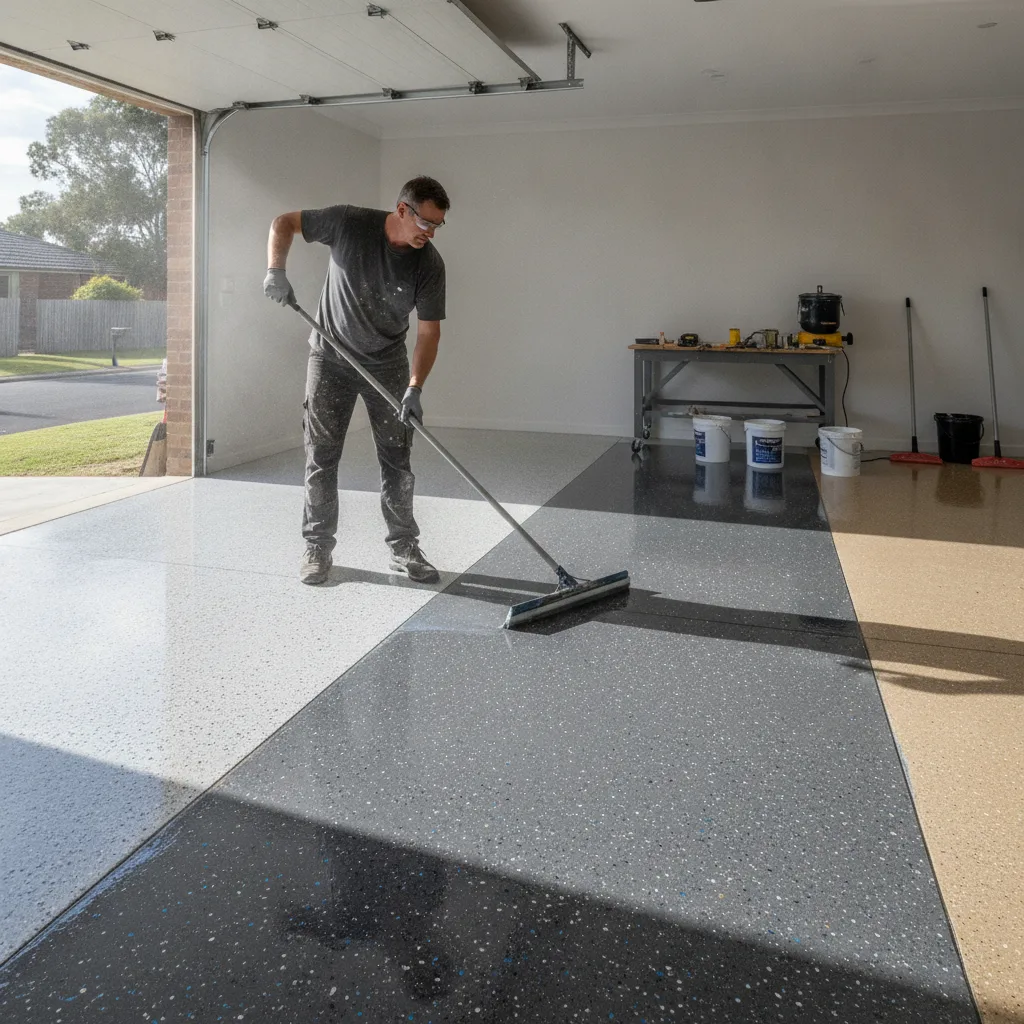
Flake epoxy, sometimes called chip or broadcast flooring, is the workhorse of the residential garage market. Coloured vinyl flakes are scattered across a wet epoxy base coat, then sealed with a clear topcoat. The flakes do two important things: they add grip underfoot, and they hide the scuffs and tyre marks that accumulate in a real working garage. Full-broadcast flake (where the base coat is completely covered) is particularly forgiving in daily use, which is why it accounts for a large share of garage floors installed across Melbourne’s northern suburbs.
Polyaspartic coatings are technically a separate chemistry from epoxy but are almost always discussed alongside it. They cure faster (a single-car garage can be done in one day and driven on within 24 hours), handle UV exposure better, and tend to resist yellowing. Many professionals apply a polyaspartic topcoat over an epoxy or flake base to get the best of both worlds: epoxy’s adhesion and build, polyaspartic’s clarity and durability at the surface.
How does surface preparation affect the result of an epoxy garage floor?
Surface preparation is the single biggest factor separating a floor that lasts fifteen years from one that peels within two. Before any coating goes down, the concrete must be profiled so the epoxy has a mechanical key to grip. Diamond grinding is the industry standard for residential garages, opening the concrete’s pores evenly across the full slab rather than just etching the surface with acid.
Cracks, control joints and surface defects need to be assessed and filled before coating begins. A hairline crack in raw concrete can become a visible fault line in a finished floor if it is simply coated over. Moisture is the other hidden risk: concrete that transmits ground moisture will eventually lift any coating applied on top of it, regardless of product quality. A moisture test before work starts is not optional; it is essential.
Older Essendon garages, particularly those attached to homes built before the 1980s, sometimes have contamination from decades of oil, fuel and cleaning chemicals. These need to be degreased and, in some cases, mechanically removed before any primer is applied. Skipping this step is the most common reason a DIY epoxy kit fails within months of application.
What should Essendon homeowners expect to spend on a garage floor coating?
Cost varies with floor size, the system chosen and the amount of preparation required. As a general guide, a standard double garage in Melbourne’s northern suburbs (roughly 35 to 45 square metres) with a full flake system professionally installed sits in a range that reflects both the materials and the labour-intensive preparation that good work demands. Metallic finishes typically cost more per square metre than flake because the application is more time-sensitive and less forgiving of error.
It is worth being cautious of very low quotes. A price that undercuts the market by a significant margin usually means one of three things: thinner product, skipped preparation steps, or a coating that will need to be replaced in three to five years rather than ten to fifteen. When comparing quotes, ask specifically what preparation method will be used, how many coats are being applied, and what the topcoat product is. Those three questions will tell you almost everything you need to know about the quality on offer.
A well-applied professional coating on a properly prepared slab is genuinely a long-term investment. The concrete underneath is protected from spills, abrasion and moisture ingress. The surface stays cleanable for years without special treatments. And the garage simply looks like part of a well-kept home rather than an afterthought bolted onto the back of it.
How long does an epoxy garage floor installation take in Essendon?
A standard residential garage installation typically takes one to two days on site, with a further curing period before the floor is ready for foot traffic and then vehicle traffic. Diamond grinding and preparation usually occupy the first part of the job, with coating applied in sequence once the slab is confirmed clean, dry and profiled. Flake systems with a polyaspartic topcoat can be walked on in as little as 12 to 16 hours and driven on within 24 hours. Traditional epoxy systems are generally more conservative, with full cure taking up to seven days for maximum chemical resistance.
Weather plays a role, particularly in Melbourne’s changeable climate. Temperature and humidity affect how epoxy flows, levels and cures, which is one reason professional installers pay close attention to conditions before and during application. A floor laid in ideal conditions will look and perform noticeably better than one rushed through in extremes of heat or cold.
Planning ahead matters. If you are renovating a garage to use as a home workshop, gym or extra living space (a trend that has accelerated significantly across Melbourne’s inner north), booking the floor coating early in the project timeline means it can cure fully before other trades come through and introduce traffic and dust.
Metal and Flake works across Essendon and Melbourne’s broader northern suburbs, applying the kind of considered, properly prepared coatings that hold up through years of real use. Whether you are after a clean solid colour, a show-stopping metallic finish or a practical full-broadcast flake system, the options are wider than most people realise until they sit down and talk it through.
Get a free quote from Metal and Flake for garage floor coating in Essendon.