Garage Floor Ideas for Brunswick Homes: Colours and Styles
The best garage floor ideas for Brunswick homes lean into the suburb’s mix of character terraces, converted warehouses and modern infill builds. A decorative epoxy or polyaspartic floor coating, finished with colour flake or a metallic tint, gives you a durable, easy-clean surface that also looks sharp. Expect colour choices from neutral grey blends to bold charcoal, slate and earthy tones that complement Brunswick’s distinct aesthetic.
Why do Brunswick homeowners bother upgrading their garage floor?
Most Brunswick garages see double duty as a workshop, studio or extra living space, so a bare concrete floor just doesn’t cut it. A quality epoxy coating seals the slab against oil, tyre marks and moisture, while the decorative finish turns a grim grey square into a room worth showing off. It also adds resale appeal in a suburb where buyers look closely at every square metre.
Brunswick sits in Melbourne’s inner north, where property is expensive and space is tight. That means garages are often the most under-utilised room in the house. Homeowners here are increasingly treating the garage as an extension of the living area, fitting it out with storage, a beer fridge, a workbench or a home gym. When a floor coating lifts the whole feel of the space, it pays for itself in daily use well before you ever think about selling.
Concrete, left unsealed, also absorbs oil and brake fluid within minutes, leaving stains that grinding alone cannot fully remove. A garage floor coating system, properly applied to a mechanically prepared slab, bonds to the concrete rather than sitting on top of it, so it doesn’t peel or flake even under hot tyre traffic.
What colour and style options suit Brunswick’s garage floor ideas?
The most popular garage floor ideas for Brunswick properties fall into three style directions: neutral industrial, warm earthy and bold statement. Neutral industrial uses charcoal, mid-grey or salt-and-pepper flake blends that reference the suburb’s warehouse roots. Warm earthy tones, think tawny, sandstone or a subtle brown flake mix, suit the older brick terraces. Bold statement floors use darker base coats with contrasting fine flake for a showroom look.
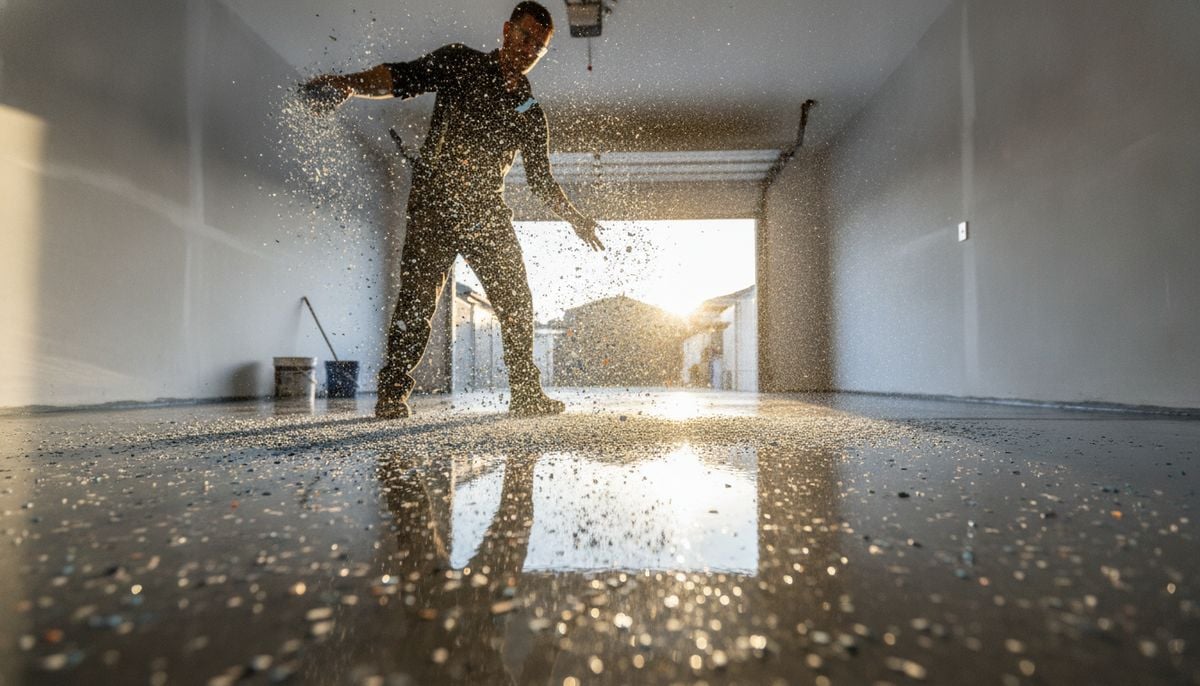
Colour flake, also called broadcast flake or vinyl flake, is the most popular decorative choice for garage floors in this area. Flakes are broadcast by hand across a wet epoxy base coat, then locked in under a clear polyurethane or polyaspartic topcoat. The result hides minor surface imperfections in the slab, adds texture for slip resistance and gives the floor a depth that plain painted concrete never achieves.
Here are the style directions worth considering for a Brunswick garage:
- Charcoal and black flake blend. Works brilliantly in converted warehouse-style properties. Picks up the dark steel joinery and exposed brick that are common in this pocket of Melbourne.
- Grey and white salt-and-pepper. The most versatile option. Reads as clean and modern without competing with anything else in the space. A staple choice for new infill homes on Sydney Road’s back streets.
- Warm tan or sandstone flake. Softens the industrial edge for families using the garage as a multi-purpose room. Pairs naturally with timber cabinetry and warm pendant lighting.
- Full flake with a high-gloss topcoat. Maximum visual impact. The floor reflects overhead lighting and makes a compact single garage feel noticeably larger.
- Solid colour with a satin finish. A cleaner, more contemporary option for garages that double as studios or creative spaces. Mid-grey and slate are popular picks.
How does the application process actually work for a garage floor coating?
A professional garage floor coating starts with surface preparation, always. The concrete is diamond-ground or shot-blasted to open the surface profile so the epoxy can mechanically bond to the slab. Any cracks or spalling are filled. Then a primer or base coat goes down, flake is broadcast while it is still wet, excess flake is scraped back, and one or two clear topcoats seal everything in. The whole job typically takes two days.
Day one covers the prep and base coat. Day two, once the base has cured, the installer scrapes back the loose flake, applies the topcoats and leaves the floor to cure. Most coatings are ready for foot traffic within 24 hours and light vehicle traffic within 72 hours, though a full cure to maximum hardness can take up to seven days depending on the product system and the ambient temperature.
The topcoat matters as much as the base. A polyaspartic topcoat cures faster and offers better UV stability than a standard polyurethane, which means it won’t yellow near garage door openings where sunlight hits the floor daily. For Brunswick properties with north-facing garages, that UV resistance is worth asking about specifically.
One concrete detail worth knowing: a standard single garage in Melbourne is roughly 18 to 20 square metres. That’s a manageable area where a professional crew can complete surface prep and a full flake system in a single working day, leaving the topcoat for the following morning. Smaller jobs don’t mean cut corners; the prep-to-finish ratio is the same regardless of size.
What should you check before choosing a garage floor coating product?
Before settling on a product or colour, check whether your slab has a moisture problem. A simple plastic sheet test, taping a 300mm square of plastic to the floor overnight, will show condensation on the underside if moisture is rising through the slab. A high-moisture slab needs a moisture-tolerant primer, otherwise the coating can delaminate within months regardless of how good the topcoat is.
Also confirm whether your concrete has ever been sealed or painted before. Old paint or penetrating sealer will interfere with adhesion if it’s not removed first. A reputable installer will assess this during a site visit and factor the extra prep into the quote rather than discovering it on job day.
Finally, think about sheen level. A high-gloss finish looks spectacular in photos but shows every speck of dust and every wet footprint. A satin or matte finish is more forgiving day-to-day and still looks excellent. Many Brunswick homeowners opt for satin as the practical middle ground.
How do you keep a coated garage floor looking good long-term?
Coated garage floors are low maintenance, but not zero maintenance. A weekly sweep and an occasional mop with a pH-neutral cleaner is all most floors need. Avoid bleach and ammonia-based cleaners, as these can dull the topcoat over time. For oil spills, wipe them up promptly rather than letting them sit; while epoxy is oil-resistant, prolonged contact with petroleum products can soften some topcoat formulations.
Place rubber mats or anti-fatigue mats under heavy workbenches and vehicle jack stands. Sharp point loads from metal feet can dent or scuff a coating just as they would timber flooring. The coating itself is tough, but it’s not indestructible, and a few simple habits will keep it looking new for a decade or more.
Most quality coating systems applied over properly prepared concrete will last well beyond ten years in a residential garage. The topcoat may show light wear in high-traffic zones over time and can be recoated without stripping the entire floor back, which is a much cheaper refresh than a full reinstall.
Ready to sort out your garage? Book a garage floor consultation in Brunswick with Metal and Flake.