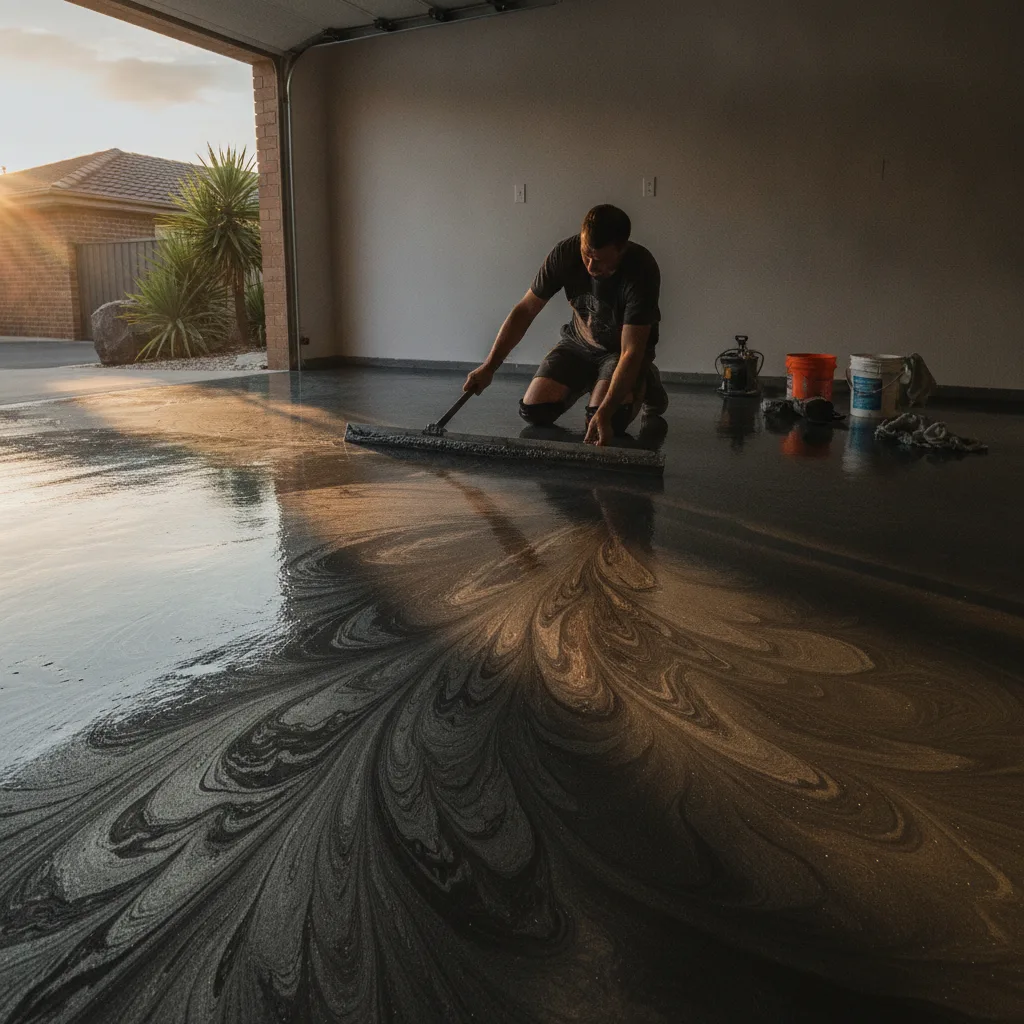
Metallic Epoxy Floors in Essendon: What to Ask Your Installer
A metallic epoxy floor in Essendon transforms a plain concrete slab into a high-gloss, swirling surface that holds up to daily traffic, oil spills and moisture. Before you commit to any installer, ask about diamond grinding, product thickness, the number of coats and the topcoat warranty. Those four things separate a job that lasts from one that peels within two years.
What is a metallic epoxy floor and how does it work?
A metallic epoxy floor is a two-part epoxy resin mixed with metallic pigment powders, then poured and manipulated on the slab to create flowing, three-dimensional patterns. Once a polyurethane or polyaspartic topcoat is applied, the finish is seamless, non-porous and hard enough to take heavy foot traffic, vehicle loads and workshop spills without scuffing or staining.
The metallic effect comes from the way the pigment particles settle and move as the epoxy levels out. Installers use air blowers, rollers and special tools to push the pigment into waves, cells or marble-like veins. No two floors look identical, which is a big part of why homeowners in Essendon and across Melbourne’s north-west are choosing it over plain painted concrete or standard chip coatings.
The system typically runs at least two to three millimetres thick when you count the base coat, metallic layer and topcoat. Anything thinner than that is a warning sign worth asking about.
Why does surface preparation matter so much for a metallic epoxy floor in Essendon?
Surface preparation is the single biggest factor in how long a metallic epoxy floor lasts. The coating bonds to the concrete profile created by diamond grinding or shot blasting. Without mechanical preparation, even the best epoxy product will eventually lift, bubble or peel, usually starting at the edges or around moisture points.
Ask every installer you speak to exactly how they prep the slab. The two industry-standard methods are diamond grinding (using a plate grinder fitted with diamond segments) and shot blasting (firing steel pellets at the surface to open the concrete pores). Acid etching alone does not produce a reliable enough profile for a metallic system and any installer who relies on it for a full metallic install is cutting corners.
Also ask how they handle cracks and control joints. Existing cracks should be filled with a semi-rigid filler before the coating goes down, otherwise they telegraph through the finished floor over time. A good installer will walk the slab with you, point out problem areas and quote for remediation as part of the job, not as a later surprise.
Moisture is another Essendon-specific consideration. Homes built on Melbourne clay can see seasonal slab movement and moisture vapour transmission. Ask whether your installer does a moisture test before quoting. If the reading is high, a moisture-mitigation primer may be needed as an extra layer under the epoxy.
What questions should you ask about products and coatings?
Not all epoxy products are equal, and the difference between a commercial-grade system and a hardware-store kit is significant. Here are the practical questions to ask:
- What brand and system are you using? Reputable Melbourne installers work with proven industrial brands and can show you a technical data sheet. If the installer is vague about the product, that is a problem.
- What is the total dry film thickness? A quality metallic system should achieve at least 1.5 mm of cured material, often closer to 2 to 3 mm with the topcoat included.
- How many coats are in the system? A proper metallic install generally includes a primer or base coat, the metallic epoxy layer and at least one topcoat. Some high-traffic floors warrant a second topcoat.
- What topcoat are you using? Polyaspartic topcoats cure faster and resist UV yellowing better than standard polyurethane. If your garage gets direct sunlight through the door opening, this matters.
- How long before I can drive on it? Most quality systems are light-foot-traffic ready in 24 hours and vehicle-ready in 72 hours. Be cautious if a quote promises faster than that without explaining why.
How do you compare metallic epoxy quotes in Essendon without getting burned?
Getting three quotes is sensible, but comparing them line by line matters more than just looking at the bottom number. A quote that comes in 30 percent cheaper than the others almost always reflects a thinner system, less prep time or a cheaper product. The floor might look fine on day one and start delaminating by year two.
Ask each installer for a written scope of work that lists the prep method, the specific products, the number of coats and the cured thickness. Then compare those scopes, not just the prices. A one-page quote that says “supply and install epoxy floor” tells you almost nothing useful.
Ask for photos of completed jobs, ideally in similar environments (residential garages, workshops, showrooms) and in suburbs close to Essendon so you can see how the work holds up in local conditions. A good installer will have a portfolio they are genuinely proud of.
Warranties are worth asking about too. Industry-standard warranties on residential metallic epoxy floors typically run two to five years on workmanship. Ask exactly what the warranty covers. Delamination due to poor prep should always be covered. Wear from dragging heavy tools across the floor might not be, which is fair enough.
What should you do to get your garage or space ready before the installer arrives?
Once you have chosen your installer, there are a few things you can do to make the job go smoothly and protect your quote price from blowing out.
Clear the space completely. Every car, shelf, toolbox, bike and bin needs to come out before the grinder arrives. Most installers do not move heavy items as part of a standard quote, and leaving them in the garage can mean extra charges or a delayed start.
Check for any existing coatings. If the slab has been painted before, tell your installer upfront. Old paint can affect adhesion and may need to be removed first, which adds time and cost. Hiding it and hoping for the best is never the right move.
Plan for the cure time. You will not be able to use the space for at least 24 to 72 hours after the final coat, sometimes longer depending on the system and ambient temperature. Melbourne winters slow cure times, so if you are scheduling a job in July, factor that in.
Finally, think about your colour and pattern choice before the consultation. Metallic epoxy comes in a wide range of base colours, from gunmetal and charcoal to copper, pearl and deep ocean blue. Looking at installed examples online or asking your installer for a sample board means you go into the job confident rather than making a rushed decision on the day.
Asking the right questions before a metallic epoxy floor installation in Essendon is the difference between a floor you will still be showing off in ten years and one that causes a headache at the two-year mark. Get the prep right, nail down the product spec and compare scopes rather than just prices. Book a metallic epoxy quote in Essendon with Metal and Flake.