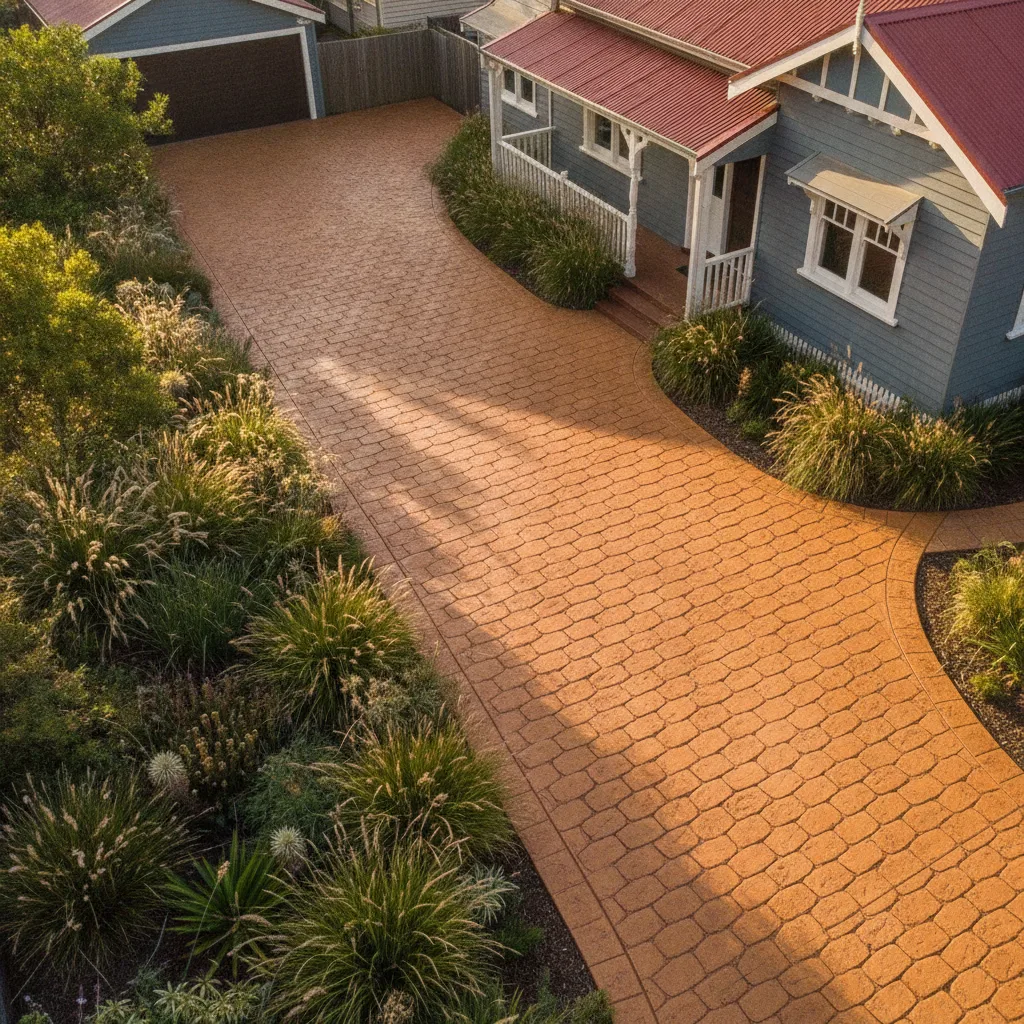
Cement Stenciling for Melbourne Driveways and Paths: A Style Guide
Cement stenciling is a technique where a paper or plastic stencil is laid over freshly poured concrete and a coloured hardener or oxide is broadcast on top, then the stencil is removed to leave a raised, textured pattern that mimics pavers, cobblestones, slate or timber. It gives plain concrete the look of expensive paving at a fraction of the cost, and it suits Melbourne’s mix of classic weatherboard homes and modern townhouses equally well.
What patterns work best for cement stenciling on a Melbourne driveway?
The most popular cement stenciling patterns for Melbourne driveways are ashlar slate, cobblestone and the running-bond brick. Ashlar slate suits federation and Californian bungalow homes because the irregular shapes echo the stonework already on those facades. Cobblestone reads as heritage but scales up well on wide double driveways. Running-bond brick works on contemporary builds where a clean, repetitive grid is the goal.
Beyond those three, there are fan and European fan patterns that suit curved paths and front garden walkways. They draw the eye toward an entry door and add a sense of arrival that plain concrete simply cannot match. The pattern you choose should complement the roof line, fence material and garden style of the property, not compete with them. A good rule of thumb: if the facade already has a strong texture, choose a simpler stencil; if the facade is rendered and plain, a bolder pattern adds the detail that ties the street appeal together.
What colours suit cement stenciling in Melbourne’s climate and street aesthetic?
Earthy mid-tones, charcoal greys and sandstone creams are the colours that hold up best visually and physically in Melbourne’s climate for cement stenciling. They do not show the tan dust that blows in from the north on hot days, they complement the red brick and cream render that dominates inner and middle-ring suburbs, and they absorb less heat than a near-black surface in summer.
Melbourne’s unpredictable weather is worth factoring in from the start. A surface that looks striking on a showroom sample board can feel oppressive when it surrounds a north-facing driveway in January. Lighter tones reflect more radiant heat, which matters for families using that space as an outdoor area after school. Darker tones, like a charcoal slate or deep terracotta, photograph beautifully and suit contemporary homes with dark fascias and dark window frames, but they benefit from a sealer with a UV-stabilising additive to slow colour fade.
Two-tone finishes are also possible. A border colour that differs from the field colour breaks up a long driveway run and makes the property look more considered. Think of it as the concrete equivalent of a feature wall.
How does cement stenciling actually get applied?
Cement stenciling is applied during the concrete pour, not after, which makes preparation and timing the most critical parts of the job. Once the concrete is poured and screeded flat, the stencil sheets are rolled out and pressed into the surface. A coloured hardener powder is then broadcast evenly over the stencil, trowelled in to consolidate and harden the surface, and the stencil is pulled away before the concrete sets hard. The result is a recessed grout line and a textured, coloured field that is part of the concrete slab itself, not a coating sitting on top of it.
Because the pattern is integral to the pour, the finished surface is durable. There is no risk of a decorative layer peeling off like a paint or a thin coating would. The slab is then sealed, typically with an acrylic sealer, which locks in the colour, adds a sheen and makes the surface easier to clean. Resealing every three to five years keeps the colour vivid and protects against oil and surface staining. A concrete surface that is resealed on schedule can look close to new for fifteen or twenty years with minimal effort.
Is cement stenciling a good fit for paths and entertaining areas, not just driveways?
Yes. Cement stenciling works well on front paths, side access paths, alfresco slabs and pool surrounds, anywhere you are pouring a new concrete slab and want a decorative result without the cost or ongoing maintenance of individual pavers. Paths look especially good in a narrow cobblestone or fan pattern that suits the smaller width. Alfresco areas benefit from a lighter ashlar pattern that creates the feel of a courtyard without the weeding and re-sanding that real stone pavers require over time.
Paths that connect the driveway to the front door can be stenciled in the same pattern and colour family as the driveway to create a cohesive look, or in a contrasting border design to frame the entry. Either approach is a straightforward decision to make at the quoting stage when the concreter can see the layout in person.
How does cement stenciling compare to plain concrete or other decorative options?
Plain broom-finish concrete is the cheapest option per square metre and there is nothing wrong with it structurally. But it offers no visual warmth and it shows oil stains and tyre marks readily. Exposed aggregate is a popular step up: it has texture and a speckled, natural appearance, but the pattern options are limited to the aggregate blend chosen. Stenciled concrete sits above both in terms of visual flexibility because the pattern and colour combination can be tailored specifically to the home.
Compared to loose pavers or natural stone, stenciled concrete is poured as a single slab so there are no joints to crack, no individual units to shift with ground movement, and no weeds finding their way through gaps. The upfront cost sits between plain concrete and natural stone, which is why it has become a go-to choice for Melbourne homeowners wanting kerb appeal without a premium stone budget.
For context, decorative concrete finishes in Australia have been widely adopted in residential construction since the early 2000s, and stenciling remains one of the most cost-effective ways to achieve a high-end look on a standard residential pour.
What should you check before committing to a cement stenciling job?
Three things matter most before signing off on a stencil concrete job: the subbase preparation, the drainage plan and the sealer specification. A poorly prepared subbase is the number one cause of cracking in decorative concrete. The ground needs to be compacted properly, reinforced with steel mesh or fibres appropriate to the load, and the formwork needs to account for any slope required to drain water away from the house. These are concreting fundamentals, but they matter even more on a decorative pour because any cracking is more visible against a coloured, patterned surface than it is on plain grey concrete.
Ask the contractor which sealer they use and how often it needs reapplying. A quality solvent-based acrylic sealer applied at the right film thickness will last three to five years between coats. Water-based sealers are lower odour but sometimes need reapplying more frequently. Neither is wrong, but knowing what you are getting helps you plan the maintenance schedule.
Also check whether the contractor has experience with stencil work specifically. Stenciled concrete requires a tighter pour window than plain concrete because the stencil must come off at exactly the right time. Too early and the grout lines are messy; too late and the stencil tears and takes surface material with it. Experience with the technique is non-negotiable.
At Metal and Flake, we specialise in decorative concrete coatings and floor finishes across Melbourne, including epoxy and flake systems for garages and commercial spaces. If you are weighing up surface options for an upcoming project, we are happy to talk through what suits your space. Get a quote for stencil concrete in Melbourne