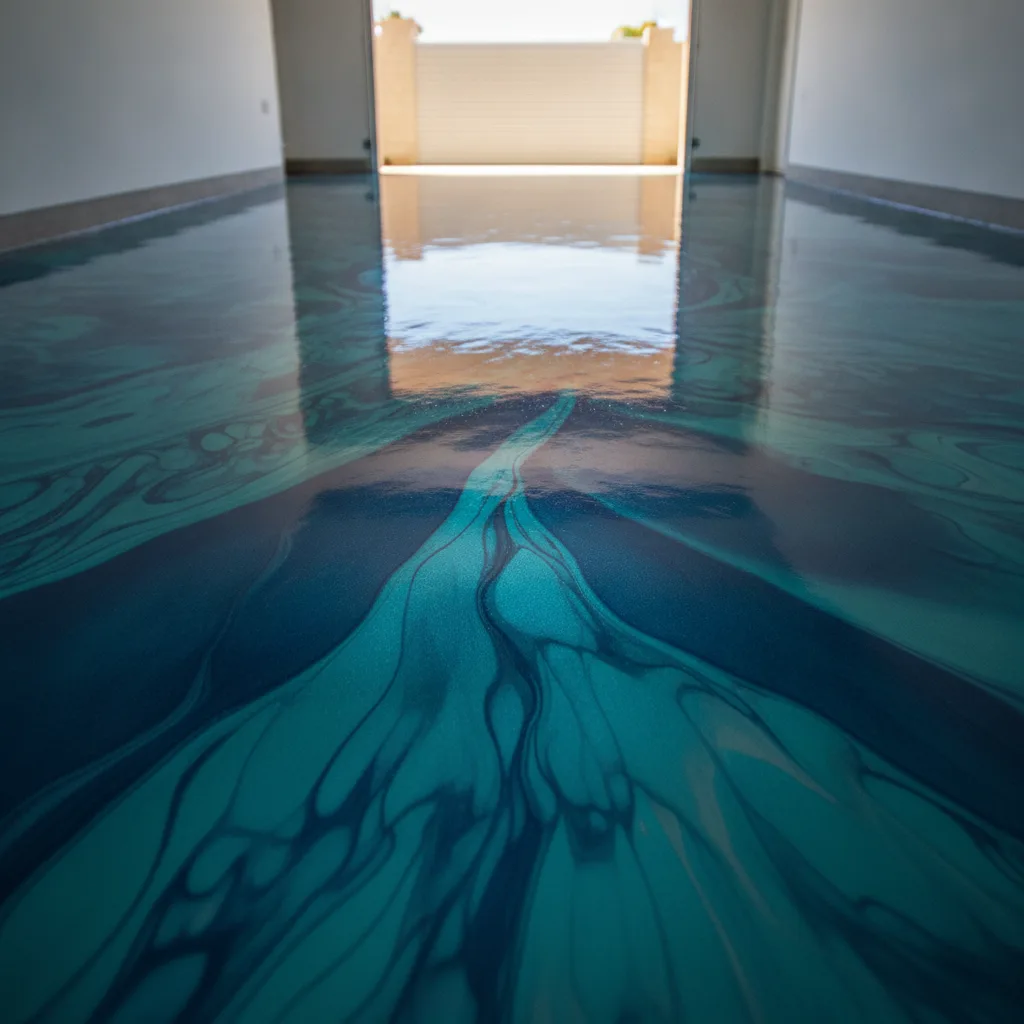
Metallic Epoxy Flooring in Williamstown: Styles and Costs Explained
Metallic epoxy flooring in Williamstown typically costs between $80 and $150 per square metre installed, depending on the floor condition, colour complexity and finish selected. The process uses metallic pigment powders suspended in a two-part epoxy resin to create a flowing, three-dimensional effect that is completely unique to each pour. No two floors ever look identical.
What makes metallic epoxy flooring different from a standard epoxy coat?
Standard epoxy coatings give you a solid, uniform colour with good protection. Metallic epoxy does all of that and adds a depth of movement to the surface. Metallic pigment powders, usually mica-based, are blended into the epoxy resin before it is spread across the floor. As the installer works the material with rollers, squeegees and sometimes a heat gun or air blower, the pigment shifts and swirls into patterns that look like flowing lava, ocean waves or polished marble. The result is a seamless, high-gloss floor that genuinely looks like a design feature rather than a coating.
The chemistry also makes metallic epoxy a practical choice. A properly installed system is resistant to petrol, oil, brake fluid and household chemicals. It bonds hard to concrete, and a clear topcoat adds scratch resistance so the finish holds up to regular foot traffic and light vehicle use in a garage setting. For Williamstown homes and commercial spaces close to the bay, the non-porous surface also resists the humidity and salt air that can degrade other flooring options over time.
What styles of metallic epoxy flooring suit Williamstown properties?
Williamstown’s mix of heritage Victorian homes, industrial conversions and modern waterfront builds means there is genuine demand for metallic epoxy styles right across the aesthetic spectrum. The most popular finishes locally fall into three broad looks: the deep ocean pour, the smoky marble effect and the warm copper or bronze swirl. Each uses a different pigment combination and application technique, but all three are achieved within the same core installation process.
The deep ocean pour layers shades of blue, teal and white to mimic the colour movement you get looking down into Port Phillip Bay on a clear day. It suits modern open-plan garage floors, warehouse studio spaces and café fitouts equally well. The smoky marble effect uses charcoal, silver and pearl pigments manipulated to look like natural stone veining. This is a strong choice for indoor entertaining areas, showrooms and retail floors where you want the impact of real marble without the maintenance cost or the weight load. The warm copper and bronze swirl draws on earth tones and suits heritage renovation projects, hospitality venues and any space where you want warmth rather than cool drama.
Colour choice is not the only variable. Sheen level matters too. A high-gloss topcoat maximises the depth and movement in the metallic pigment. A satin finish softens the look and reduces glare in rooms with a lot of natural light. An anti-slip additive can be broadcast into the topcoat for outdoor areas, pool surrounds or any surface where a wet floor is a genuine hazard.
How does the metallic epoxy flooring installation process work?
The installation process is straightforward but it cannot be rushed. Every quality metallic epoxy job starts with concrete preparation, and that preparation is where the long-term performance of the floor is decided. Concrete is diamond-ground or shot-blasted to open the surface profile so the epoxy has something to bond to mechanically. Any cracks, holes or low spots are filled with an epoxy filler and allowed to cure before the main coat goes down.
Once the slab is prepped and clean, a primer coat is applied and left to cure. Then the metallic basecoat goes down. This is the creative stage. The installer spreads the pigmented epoxy and works it while it is still wet, using different tools and techniques to build the pattern. A propane torch or heat gun is often passed over the surface to encourage the pigment to move and create the characteristic cloud or cell effect. This stage requires a skilled hand because you cannot go back and redo it once the epoxy starts to set.
After the metallic layer cures (typically 12 to 24 hours depending on temperature), one or two coats of clear polyurethane or polyaspartic topcoat are applied to lock everything in and protect the surface. The topcoat also adds the UV stability that keeps the colour from yellowing over time, which matters for any floor exposed to sunlight. Most residential jobs in Williamstown are back in use within 24 to 48 hours of the topcoat going down, though full cure takes around seven days before heavy loads should be placed on the surface.
What does metallic epoxy flooring in Williamstown actually cost?
Cost is the question most homeowners and business owners want answered before anything else, so here is a practical breakdown. For a straightforward residential garage floor in good condition, the installed price generally sits between $80 and $110 per square metre. A standard double garage of around 36 square metres would come in at roughly $2,900 to $4,000 all up. Commercial floors or spaces with complex colour work, multiple layers or significant concrete repairs will push toward the higher end of the $80 to $150 per square metre range.
The variables that move the price are concrete condition, floor size, number of colours and layers, and the topcoat system chosen. Polyaspartic topcoats cure faster and are more UV stable than standard polyurethane, but they cost more. They are worth it for floors in direct sun or for commercial jobs where you need the space back quickly. Floors that need grinding down significantly, crack repair or moisture treatment before coating will also add to the prep cost, but skipping that prep is how floors fail early, so it is money well spent.
It is also worth knowing that metallic epoxy holds its value as a feature. Real estate agents and buyers in the inner west increasingly view a quality garage or showroom floor as a genuine selling point rather than an afterthought. A floor installed properly will look sharp for ten to fifteen years with minimal maintenance beyond the occasional mop.
How do you maintain a metallic epoxy floor once it is installed?
Maintenance is one of the strongest arguments for metallic epoxy flooring. The seamless, non-porous surface means there are no grout lines, no timber boards to warp and no carpet fibres to trap dust. Day-to-day care is a dry dust mop or a damp mop with a pH-neutral cleaner. Oil drips and chemical spills wipe up without staining if you get to them reasonably quickly.
Avoid abrasive scrubbing pads on the topcoat surface. For garage floors, fit rubber furniture feet or soft pads under any heavy shelving or workshop equipment, and place an anti-fatigue mat at workbenches where tools might be dropped. Keeping sand and grit off the floor with a door mat at entries helps preserve the topcoat gloss. Beyond that, metallic epoxy floors are genuinely low-maintenance compared to polished concrete, which needs periodic resealing, or timber, which scratches and swells.
Get metallic epoxy flooring in Williamstown from Metal and Flake.