Concrete Floor Sealing in Coburg: What Local Homeowners Should Know
Concrete floor sealing in Coburg protects bare or polished slabs from moisture, stains, tyre marks and the general wear that Melbourne’s inner-north climate dishes out year-round. A quality sealer penetrates or coats the surface to repel liquids, reduce dusting and extend the life of the floor by a decade or more when correctly applied and maintained.
Why does concrete floor sealing matter for Coburg homes?
Unsealed concrete is genuinely porous. It absorbs spills, harbour bacteria, and in a suburb like Coburg where older double-brick homes sit on original 1950s and 1960s slabs, that porosity is a real problem. Moisture wicks up through the slab, salt deposits form, and within a few seasons you are dealing with spalling, staining and a floor that looks a decade older than it should.
Coburg and the broader inner-north also gets a solid dose of temperature swings. Concrete expands and contracts, and an unsealed surface cracks more readily at those stress points. A penetrating silicate sealer or a topcoat system bonds into or over those micro-pores and gives the slab something to flex against rather than just fracturing.
For garages, a sealed floor also resists the oil drips and petrol splashes that are pretty much unavoidable if you park inside. Those hydrocarbons stain unsealed concrete permanently within hours but bead off a properly sealed surface and wipe up cleanly.
What are the main types of concrete sealer available?
The two broad camps are penetrating sealers and topcoat sealers, and each suits a different situation. Penetrating sealers (silicates, silanes, siliconates) soak into the concrete and chemically react with the substrate. They leave no visible film, they do not change the look of the floor, and they are the right call for driveways, paths and any slab that needs to breathe. They do not provide a high-gloss finish but they are extremely durable because there is nothing on the surface to peel or chip.
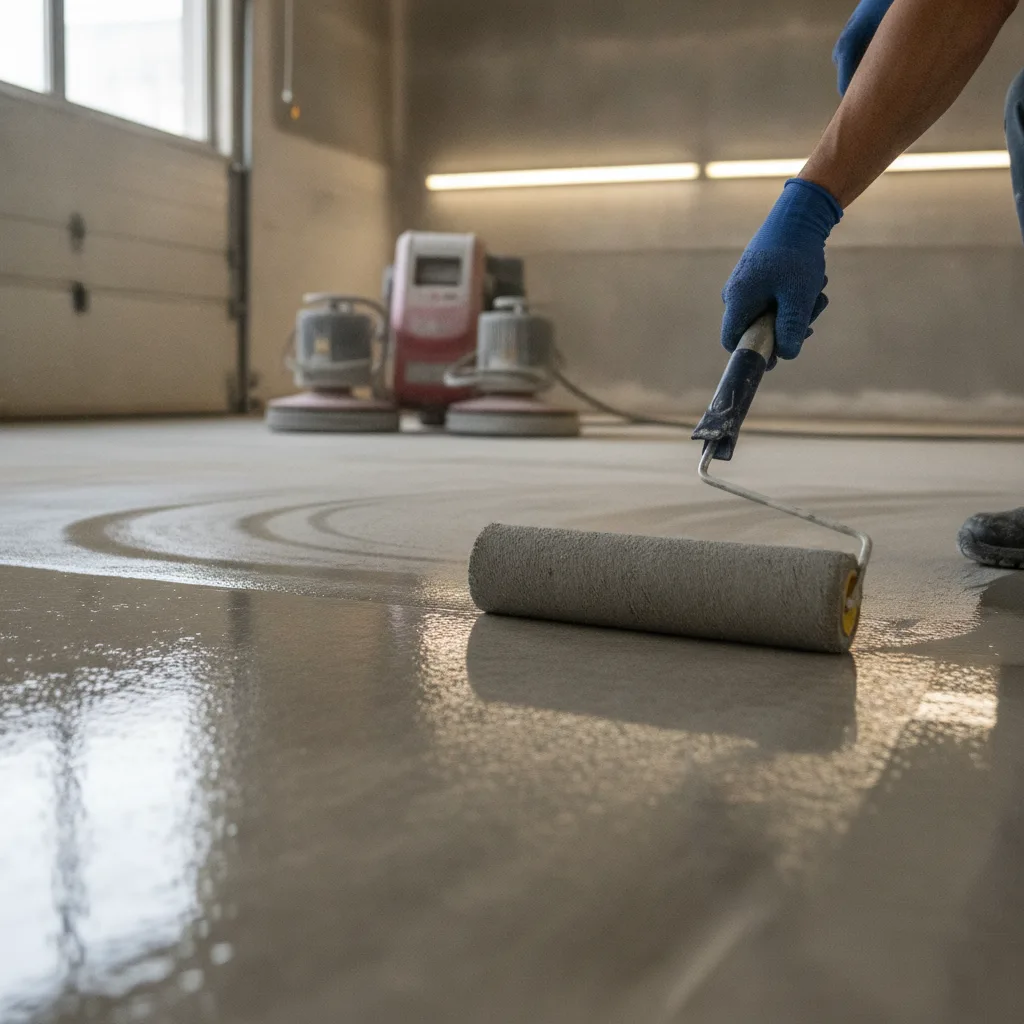
Topcoat sealers sit on top of the slab and include polyurethane, acrylic and epoxy-based systems. These are what most Coburg homeowners are after when they want a polished or semi-gloss finish on a garage floor, a workshop, a laundry or a basement. They create a film that can be satin, satin-gloss or full gloss depending on the product and the number of coats.
Epoxy floor coatings sit at the premium end of the topcoat category. A two-part epoxy bonds hard to the slab and handles heavy foot traffic, trolley loads and dropped tools far better than a single-part acrylic. For residential garages and internal concrete floors that take a beating, epoxy is the benchmark.
How should a concrete floor be prepared before sealing?
Surface prep is where most DIY sealing jobs fall apart. A sealer can only be as good as the surface it goes onto. If there is contamination, moisture, or a weak layer of old coating sitting between the sealer and the slab, adhesion fails and you get peeling within six to twelve months.
For a topcoat system, the standard process starts with mechanical diamond grinding or shot blasting to open the surface profile. This gives the coating something to grip rather than just sitting on a glassy or dusty surface. Any cracks wider than a hairline get filled with a flexible polyurethane or epoxy mortar, and any areas of delaminating concrete get cut back and patched. A moisture test (a simple plastic-sheet tape-down test left for 24 hours) should always be done before applying any coating, particularly on older Coburg slabs where damp-proof membranes were not standard practice.
For penetrating sealers the prep is lighter: a clean, dry, etched or lightly ground surface is usually enough. Acid etching opens the pores on smooth-trowelled slabs so the silicate can get in. Even so, it is worth sweeping, degreasing and rinsing the slab thoroughly before you touch it with any chemical.
How long does concrete floor sealing last in Melbourne’s climate?
Longevity depends on the product type, the prep quality and how hard the floor is used. A well-applied two-part epoxy floor coating in a residential garage typically lasts eight to fifteen years before it needs a recoat or refresh. Single-part acrylics are simpler to apply but generally need attention every three to five years. Penetrating silicate sealers, once they have cured, are essentially permanent because the compound has become part of the concrete itself. However, a silicate sealer on a driveway does not prevent surface staining the way a topcoat does, so many homeowners layer a topcoat over the penetrating sealer for the best of both worlds.
Melbourne’s UV levels are worth keeping in mind if the floor gets direct sun. A standard epoxy yellows under prolonged UV exposure, which is why a UV-stable polyurethane topcoat is often used as the final layer over an epoxy base. That combination keeps colour true and adds a level of scratch resistance that epoxy alone does not have.
Can concrete floor sealing be done as a DIY project?
Technically yes, particularly with penetrating sealers and single-part acrylics sold in trade stores. But the honest answer is that the gap between a DIY result and a professional result is large, and it shows up within the first year. Grinding to the right profile requires hired machinery and some experience to use it safely without gouging the slab. Mixing two-part epoxies has a short working window (typically 20 to 40 minutes depending on ambient temperature) and mistakes cannot be undone once the product sets. Getting the coat thickness even across a full garage is harder than it looks.
For a laundry or a small internal area where aesthetics matter less, a DIY penetrating sealer is perfectly reasonable. For a garage, showroom or any floor where you want a smooth, even, glossy result that holds up for years, professional application pays for itself by avoiding costly re-dos.
What should Coburg homeowners look for when choosing a sealing contractor?
Ask to see photos of finished jobs on similar slabs in similar conditions. A good contractor will walk the slab with you before quoting, check for moisture and existing coatings, and explain exactly what prep they plan to do and why. If a quote skips surface prep entirely or the price seems too low to cover grinding, be cautious. Preparation labour is typically 40 to 60 percent of the total job cost on a quality application, so a cheap quote usually means prep is being cut short.
Check that the contractor uses commercial-grade two-part products rather than single-part DIY coatings sold at hardware chains. The chemical resistance, abrasion resistance and adhesion are not in the same league. Ask about the specific products being used and look up the technical data sheets if you want to compare.
Metal and Flake works with homeowners across Melbourne’s inner-north, including Coburg, to assess concrete slabs and apply epoxy floor coatings that are built to last. Whether your slab needs a hard-wearing garage coat, a decorative metallic finish or a solid colour epoxy, the team can walk you through the right system for your floor and your budget.
Book concrete floor sealing in Coburg with Metal and Flake