Floor Coating for Concrete: Which System Gives the Best Result?
The best floor coating for concrete depends on how you use the space. Epoxy delivers the hardest, most durable surface for garages and workshops. Polyaspartic cures faster and handles UV better outdoors. Polyurethane is flexible enough for areas that see temperature swings. Choosing correctly means matching the system to the traffic, moisture levels and look you want.
Why does the right floor coating for concrete matter so much?
Bare concrete is porous, dusty and surprisingly fragile under heavy traffic. A quality floor coating for concrete seals those pores, resists chemicals and oil, and turns a dull grey slab into something you actually want to look at. Without a proper coating, concrete stains permanently, flakes around edges and turns into a maintenance headache inside a year or two.
Think about a standard garage floor. Tyre rubber grinds in, brake fluid eats the surface, and engine oil soaks right through unprotected concrete. One good spill on a bare slab leaves a stain that no amount of scrubbing removes. A coated floor wipes clean in seconds. That is a practical difference you feel every single week.
There is also a structural argument. Concrete that is left exposed to moisture cycles. Water works its way in during wet weather, then the surface dries out and contracts. Over years, that repeated movement causes surface scaling and small cracks. A proper coating acts as a barrier that slows that process right down.
What are the main types of concrete floor coating available?
There are four systems you will realistically encounter for residential and light commercial work: epoxy, polyaspartic, polyurethane and penetrating sealers. Each has a different chemistry, a different cure time and a different performance profile.
Epoxy floor coatings are the industry workhorse. A two-part system, resin plus hardener, that chemically bonds to the concrete surface when properly prepared. When the mix ratio is right and the concrete has been ground back to open the profile, epoxy builds an extremely hard film, typically 2 to 4 millimetres thick in a full broadcast flake system. It handles heavy vehicles, foot traffic and most common chemicals without flinching. The limitation is UV. Standard epoxy yellows in direct sun over time, which is why it is better suited to indoor spaces like garages, workshops and commercial floors.
Polyaspartic coatings are a newer generation of aliphatic chemistry. They cure in a fraction of the time compared to epoxy (some systems are walkable within a few hours) and they do not yellow in UV light, making them suitable for covered outdoor areas, patios and pool surrounds. The trade-off is the working time. Because polyaspartic goes off quickly, it demands an experienced applicator. Rushing the broadcast or the topcoat on a warm Melbourne day can cause adhesion issues.
Polyurethane topcoats are rarely used alone as a full floor system but are commonly applied over epoxy as a finishing layer. They add flexibility, abrasion resistance and a harder gloss. In environments with significant temperature variation, like a shed that bakes in summer and sits cold in winter, a polyurethane topcoat helps the system flex slightly rather than crack.
Penetrating sealers are the budget option. They soak into the surface and reduce moisture absorption but do not build a film. You will not get a high-gloss finish, decorative flake or meaningful chemical resistance. They are fine for a warehouse floor you just want to keep dust-free, but they are not the right call for a garage or living space where appearance matters.
How does surface preparation affect the final result of a concrete floor coating?
Surface preparation is where most DIY attempts and cheap operators fall apart. No floor coating for concrete, regardless of brand or price, will perform well on a surface that has not been properly opened up. The concrete needs a mechanical profile, meaning tiny peaks and valleys for the coating to grip. The standard method for quality work is diamond grinding, not acid etching.
Acid etching was common practice for decades and you will still see it recommended on hardware store tins. The problem is that acid etching is inconsistent. It reacts differently across a slab depending on mix ratios, age and contamination. Diamond grinding removes the weak laitance layer, the powdery top skin of concrete, and creates a reproducible surface profile every time. The Concrete Surface Profile (CSP) scale, developed by the International Concrete Repair Institute, runs from 1 to 10. A CSP of 2 to 3 is the target for most thin-film floor coatings.
Any oil contamination also needs to come out before grinding, not after. Oil soaks down through the slab over time. If you grind first and then try to degrease, the grinding opens the pores and drives the contaminant deeper. The right order is degrease, then grind, then coat.
What finish options can you get with a concrete floor coating system?
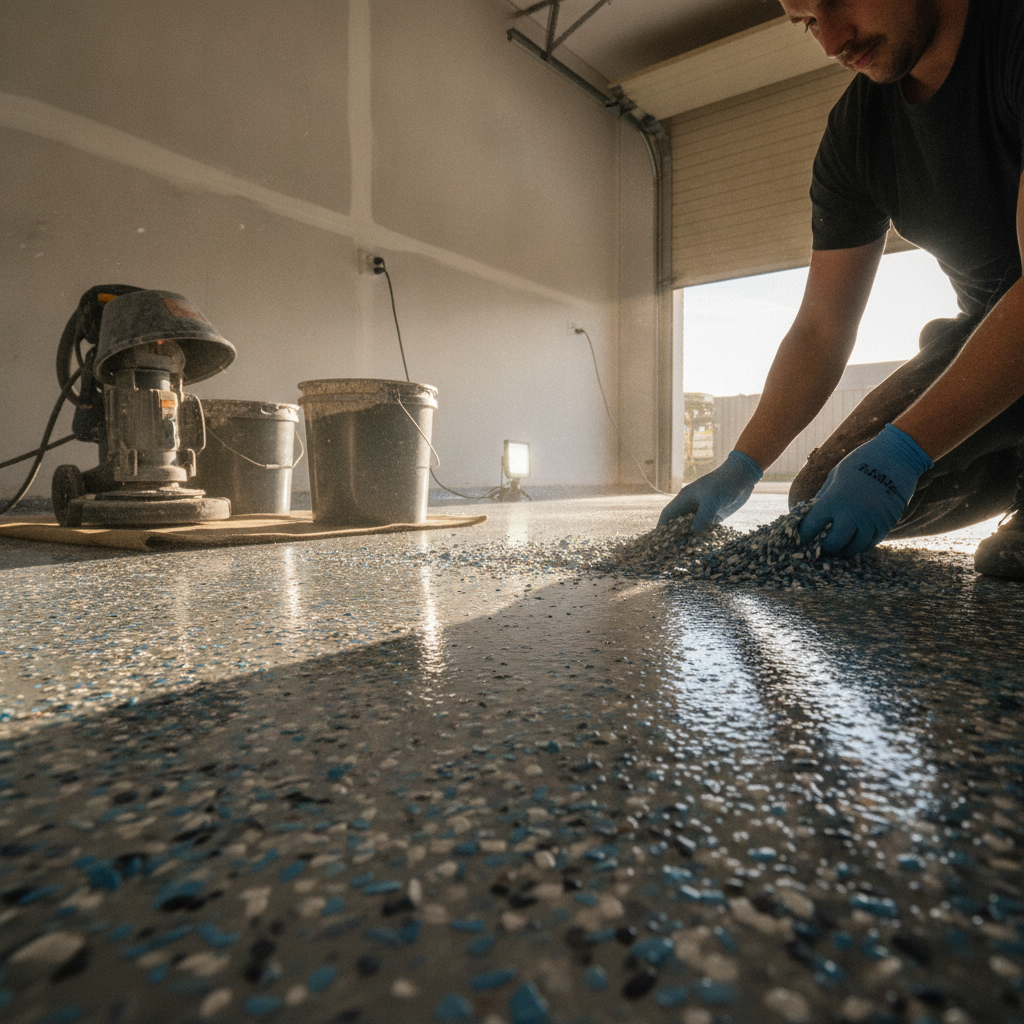
The most popular finish for residential garages and commercial spaces in Melbourne right now is the flake broadcast system. Coloured vinyl flakes are scattered into a wet epoxy base coat, allowed to cure, scraped back flat, and then sealed with a clear polyaspartic or polyurethane topcoat. The result is a surface with depth and texture, non-slip underfoot because the flakes create a subtle profile, and genuinely easy to clean because there are no grout lines or joints to trap dirt.
Solid colour epoxy is the other common choice. It gives a clean, single-tone look that suits workshops and industrial spaces. Metallic epoxy systems use metallic pigment powders that create a swirling, lava-lamp effect when worked into the wet coat. Each one turns out slightly different because the pigment moves as the installer manipulates it, so you get a floor that is genuinely one of a kind.
Gloss level is adjustable too. A full-gloss clear topcoat bounces light around a space and makes it feel larger and brighter. A satin or matte finish hides minor imperfections in the slab and gives a more understated result. Most installers offer both.
How long does a concrete floor coating last, and what maintenance does it need?
A well-installed epoxy or polyaspartic floor coating, on properly prepared concrete, will realistically last 10 to 20 years in a residential garage with normal use. The coating does not require waxing, polishing or any specialist chemicals. A mop with warm water and a neutral pH cleaner is genuinely all the regular maintenance needed.
The things that shorten coating life are using harsh solvents directly on the surface, dragging heavy sharp-edged objects across it without protection, and allowing hot tyre pickup in very hot weather. Hot tyre pickup is what it sounds like: a car tyre that has been driven hard sits on the coating while still very warm, softens it slightly, and pulls a patch of the coating away when the car moves. A good quality polyaspartic topcoat is far more resistant to this than a straight epoxy, which is one reason experienced installers almost always recommend a topcoat as part of the system.
Is a concrete floor coating a DIY job or should you use a professional?
Hardware stores sell epoxy kits, and some of them produce a passable result on a small, clean, lightly trafficked slab. But the gap between a kit and a professional system is significant. Professional installers use commercial-grade two-part products with higher solids content, which means a thicker, harder finished film. They have diamond grinders that reach the correct surface profile in one pass. They know how to manage pot life, temperature and humidity on the day.
The most common outcome of a DIY epoxy attempt is peeling within 12 to 18 months. The coating lifts not because the product failed but because the surface was not prepared to the depth the product needed. Fixing a failed DIY coat means grinding the whole thing back anyway, so the saving disappears fast.
If the slab has cracks, previous coatings, oil staining or moisture issues, a professional assessment before any product goes down is worth every cent. Those variables change which system is appropriate, what primers to use and whether the slab needs remediation first.
Get a professional concrete floor coating quote from Metal and Flake