Commercial Floor Coating in Sunbury: Epoxy Options for Local Businesses
Commercial floor coating in Sunbury means applying a protective resin system, most commonly epoxy, to a concrete floor inside a business premises. The right coating hardens the surface, resists chemical spills and heavy foot or vehicle traffic, and gives the space a clean, professional look that lasts well over a decade with basic maintenance.
Why do Sunbury businesses need a dedicated commercial floor coating?
Commercial floor coating in Sunbury protects concrete from the daily punishment that warehouses, workshops, retail spaces and food businesses dish out. Bare concrete dusts, stains and cracks under load. A properly applied epoxy or polyurethane coating seals those pores, stops contaminants soaking in and makes the floor far easier to clean, which matters for both safety compliance and presentation.
Sunbury has grown quickly over the past decade. Light industrial estates along Quarry Road, trade businesses near the Calder Freeway corridor and the steady stream of new retail and hospitality fit-outs in the town centre all share one problem: standard concrete floors were never built to handle the volume and variety of use that a busy commercial operation throws at them.
A raw slab absorbs oil, harbours bacteria and turns into a slipping hazard the moment it gets wet. Once you coat it correctly, you have a surface that can take forklift tyres, food-grade hose-downs and heavy foot traffic in a single room. That versatility is why epoxy floor coatings have become the go-to solution for Melbourne’s north-western growth corridor, Sunbury included.
What epoxy floor coating options work best for commercial spaces?
The best epoxy options for commercial spaces depend on what the business actually does. Solid-colour epoxy suits workshops and warehouses needing pure durability. Metallic or decorative flake systems suit retail, hospitality and showroom floors where appearance counts. Polyurethane topcoats add UV stability and scratch resistance on top of an epoxy base. Each system can be tailored in thickness, texture and slip rating to match the specific site.
Here is a straightforward breakdown of the most common systems used on commercial floors:
- Solid epoxy (two-part system). Typically applied at 2 to 3 mm thickness, this is the workhorse for warehouses, automotive workshops and food manufacturing facilities. It bonds chemically to the slab, bridges minor cracks and provides a surface rated to withstand continuous forklift traffic.
- Epoxy flake or broadcast system. Vinyl flakes are broadcast onto a wet epoxy base, sealed with a clear polyurethane or polyaspartic topcoat. The texture hides minor imperfections, adds grip underfoot and gives showrooms and retail spaces a premium finish without looking industrial.
- Metallic epoxy. Pigment powders are mixed into a clear epoxy base and manipulated to create flowing, three-dimensional patterns. Popular in hospitality venues, gyms and high-end retail. The finish is genuinely striking and no two floors look the same.
- Polyurethane and polyaspartic topcoats. These are rarely used alone on commercial floors. Instead, they cap an epoxy base to add UV resistance (epoxy alone yellows under sunlight), chemical resistance and a faster return-to-service time. Polyaspartic in particular can cure fast enough to reopen a floor within a day.
For most light-industrial or trade businesses in Sunbury, a solid epoxy base with a polyurethane or polyaspartic topcoat hits the sweet spot between cost, durability and turnaround time. Retail and hospitality operators tend to push toward flake or metallic systems where the look of the floor becomes part of the brand.
How does the commercial floor coating process actually work?
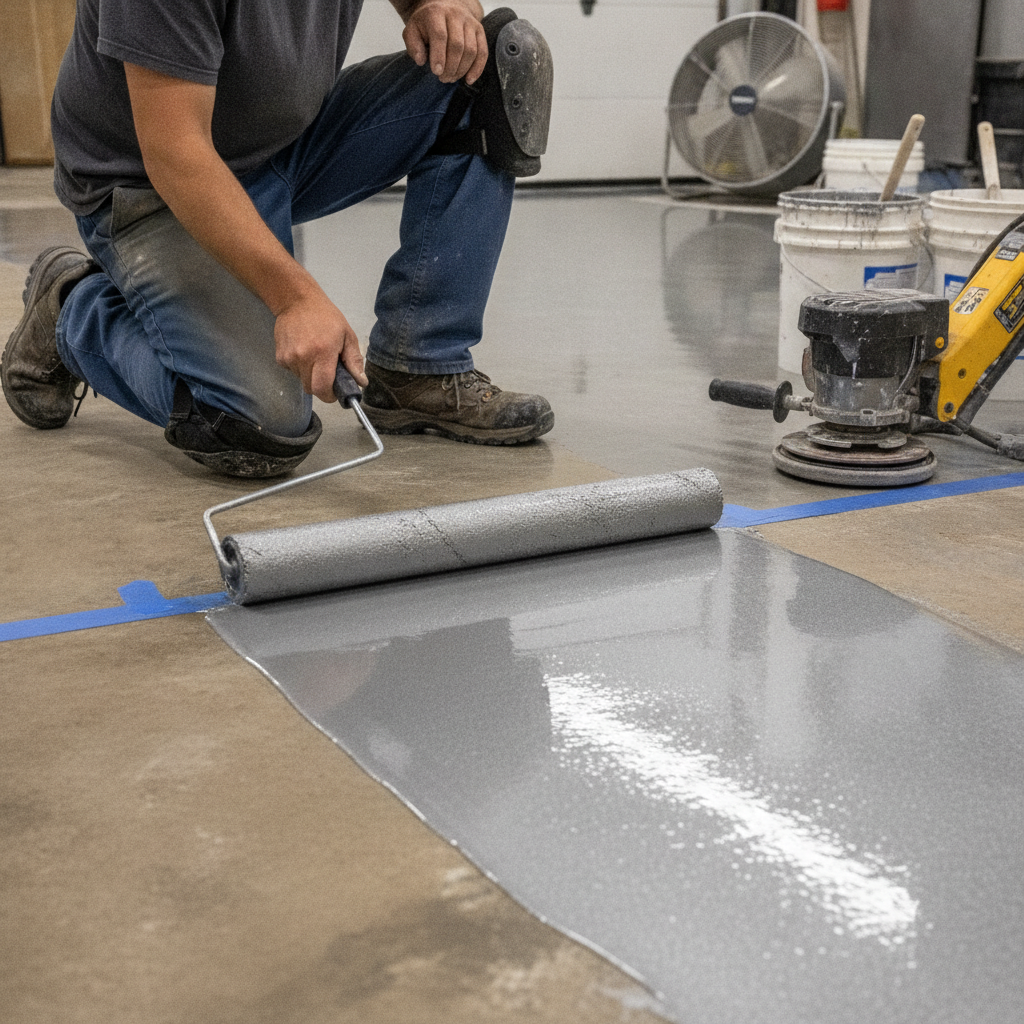
The commercial floor coating process starts with surface preparation, which takes up more time than the coating itself. The concrete is ground or shot-blasted to open the pores and remove any existing sealers, paint or contamination. After prep, the epoxy primer goes down, followed by the body coat, any decorative broadcast, and finally a clear protective topcoat. Most commercial jobs are complete and walkable within two to three days.
Surface preparation is the step that separates a coating that lasts from one that peels within a year. Professionals use diamond-grinding equipment or shot-blasting machines to achieve a concrete surface profile (CSP) of around 3, which is the texture recommended by the SSPC (Society for Protective Coatings) for most heavy-duty epoxy systems. Without that profile, the coating simply cannot grip the slab properly no matter how good the product is.
Once the slab is prepped, any cracks or expansion joints are filled and repaired before anything goes down. Then the epoxy primer seals the surface and gives the body coat something solid to bond to. On a broadcast flake system, the vinyl chips are tossed across the wet epoxy until the surface is fully covered, excess is swept back, and the whole thing is locked in with one or two clear topcoats.
Temperature and humidity matter throughout. Most epoxy systems require an ambient temperature above 10 degrees Celsius and relative humidity below 85 percent to cure correctly. Winter jobs in Sunbury can be tight on those conditions, so timing and site setup are part of the planning process.
How long does a commercial epoxy floor coating last?
A professionally installed commercial epoxy floor coating typically lasts between 10 and 20 years in a business environment, depending on traffic intensity and how well it is maintained. Lighter-traffic retail or office floors sit at the upper end of that range. High-traffic workshops or warehouses with heavy machinery may need a maintenance topcoat applied at the 8 to 10 year mark to restore the surface without stripping back to the concrete.
The maintenance required is genuinely low. Sweep regularly to keep abrasive grit off the surface (that is the main thing that dulls a coating over time), mop with a pH-neutral cleaner, and avoid dragging sharp steel edges across the floor. Those three habits make a serious difference to how long the coating holds its gloss and its protection.
It is worth noting that not all epoxy products are equal. Industrial-grade, two-part epoxy systems bought through a commercial coating professional are a completely different product from the single-component “epoxy paint” sold at hardware stores. The latter is easy to apply yourself but typically fails within two to three years under any real commercial load. The performance gap is substantial enough that it changes the economics of the whole project.
What should a Sunbury business consider before getting a floor coating quote?
Before getting a floor coating quote, Sunbury businesses should document the floor area in square metres, identify any existing coatings or contamination on the slab, note the business’s operating hours to plan around downtime, and think about what the floor actually needs to resist, whether that is vehicle traffic, chemical spills, food and moisture or just heavy foot traffic. That information lets a contractor quote accurately from the start.
A few practical points worth sorting out before anyone shows up on site:
- Moisture in the slab. If the building is older or was built without a proper moisture barrier, the slab may push moisture vapour upward. Epoxy coatings are not breathable and moisture vapour pressure can cause blistering and delamination. A good contractor will test for this before quoting, usually with a calcium chloride test or a relative humidity probe.
- Downtime tolerance. Most coating systems need at least 24 hours of no foot traffic after the final coat and 72 hours before heavy vehicle traffic. If the business cannot close for two days, a polyaspartic system with its faster cure time might be a better fit.
- Slip resistance rating. Workplaces in Victoria are governed by the Occupational Health and Safety Act, which requires employers to provide a safe working environment. For wet areas, a Pendulum Test Value (PTV) of 36 or above is typically needed. This can be built into the coating system through the choice of topcoat or by adding an anti-slip aggregate during application.
Getting two or three quotes from local contractors who actually come out and look at the slab will always produce better results than going on price alone from a phone call. The condition of the concrete, the level of prep required and the specific system recommended should all be reflected in the quote.
Sunbury businesses looking for a reliable, experienced team that services the north-western Melbourne corridor are in good hands with Metal and Flake. The team handles commercial and industrial floors across the region, using quality two-part epoxy systems and proper surface preparation every time.
Book a commercial floor coating service in Sunbury with Metal and Flake.