Epoxy Floors in Sunbury: Garage and Residential Options Explained
Epoxy floors in Sunbury are a practical, long-lasting upgrade for garages, workshops, laundries and living areas. A quality epoxy system bonds directly to concrete, resists oil, water and heavy foot traffic, and can last well over a decade with minimal upkeep. Options range from solid colours to decorative metallic and flake finishes, covering most budgets and styles.
Why are epoxy floors so popular in Sunbury homes and garages?
Epoxy floors suit Sunbury properties because the area’s mix of new estates and established homes means lots of plain concrete slabs just waiting for a proper finish. Epoxy seals the concrete against moisture rising from the ground, resists the grime that comes with rural and semi-rural living, and cleans up with a mop. That combination of toughness and low maintenance is hard to beat for the price.
Sunbury sits on Melbourne’s north-western fringe, which means properties often have larger garages, sheds and outdoor-adjacent spaces than you’d find closer to the CBD. Those big concrete slabs are exposed to temperature swings, tyre rubber, oil drips and garden mud on a daily basis. A bare concrete slab absorbs all of that. An epoxy coating keeps it on the surface where you can wipe it away.
There’s also the look. A freshly coated floor with a metallic or flake finish genuinely changes the feel of a garage or workshop. Plenty of homeowners who come in asking about a practical solution end up just as excited about the result aesthetically. Both outcomes are worth chasing.
What epoxy floor finishes are available for Sunbury garages?
For garage floors in Sunbury, the main finish options are solid colour epoxy, decorative flake (also called chip or flake broadcast) and metallic epoxy. Solid colour is the most affordable entry point, flake is the most popular for garages because it hides imperfections and adds grip, and metallic epoxy gives a high-end marbled look suited to showroom-style spaces or premium home interiors.
Here is a quick breakdown of how each system works in a real garage setting:
Solid colour epoxy. A base coat and topcoat in a single colour, usually grey, charcoal or white. Clean, easy to spec, and the most budget-friendly option. Works well in workshops where looks take a back seat to function.
Flake broadcast epoxy. Coloured vinyl flakes are scattered across a wet base coat, then sealed under a clear topcoat. The flakes add texture that improves grip underfoot and under tyres. They also break up the visual field so small cracks or surface variations in the concrete are much less obvious. This is by far the most common system installed in residential garages around Melbourne’s north-west.
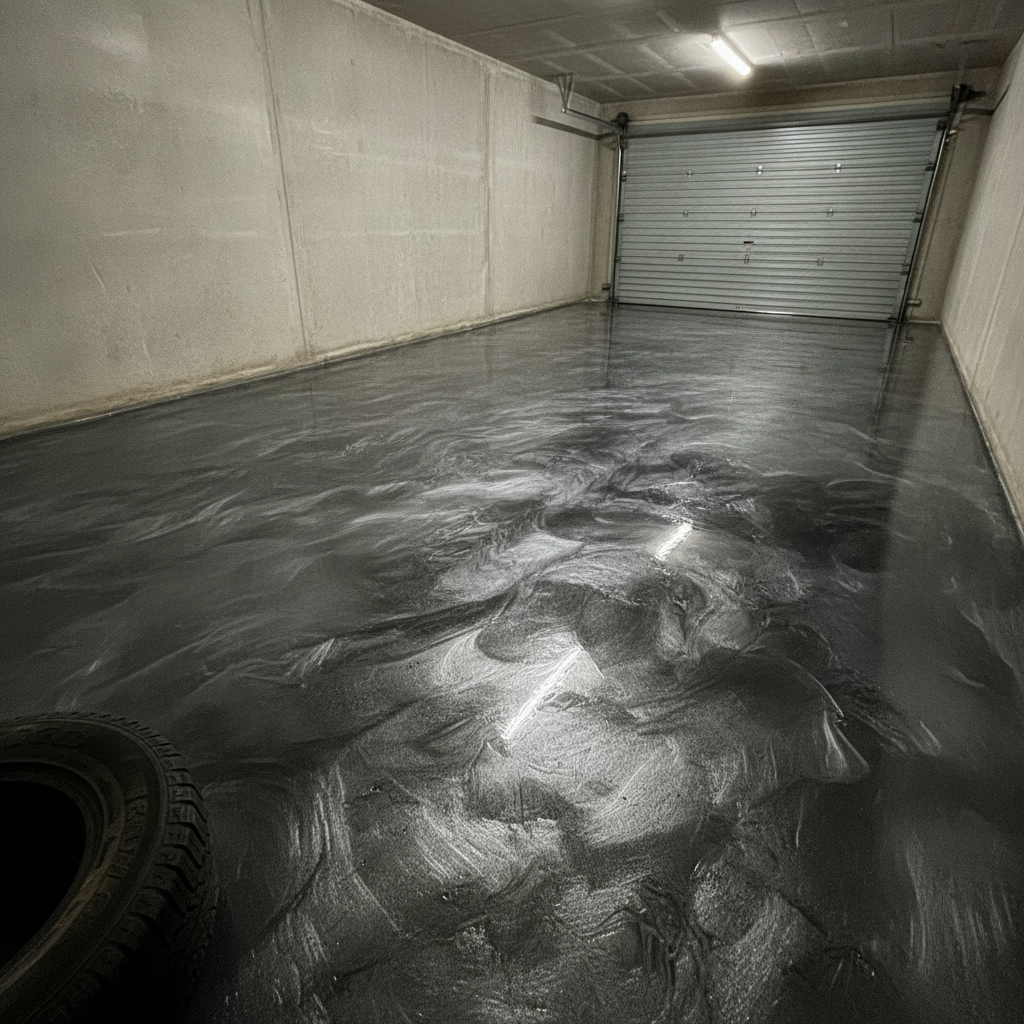
Metallic epoxy. A pigmented metallic base coat manipulated while wet to create swirls, waves and depth. The result looks closer to polished concrete or marble than a painted floor. Popular for internal living areas, home gyms and high-end double garages. Requires a more skilled application because the effect is created by hand during the pour.
All three systems can be finished with either a gloss or satin topcoat. Gloss is the most common in garages because it reflects light and makes the space feel larger. Satin suits living areas where a subtler sheen is more appropriate.
How does epoxy floor installation work for a Sunbury residential slab?
The installation process for a residential epoxy floor in Sunbury follows the same core steps regardless of the finish chosen. Surface preparation comes first and is non-negotiable. Skipping or rushing prep is the single biggest reason epoxy floors fail early, with delamination (the coating peeling away from the concrete) being the most common outcome of poor prep work.
A proper prep job involves diamond grinding the concrete surface to open the pores and give the epoxy something to bond to. Any cracks, spalls or expansion joints are filled and levelled before coating begins. On a standard double garage (around 36 to 40 square metres), prep alone can take three to four hours.
After prep, the base coat goes down. Depending on the system, flakes are broadcast or the metallic pigment is worked across the surface. The floor then needs cure time before the topcoat is applied. Full cure time varies by product and conditions, but most residential epoxy floors are walk-ready within 24 hours and ready for vehicles within 48 to 72 hours.
A few things to sort out before the installer arrives: clear everything off the floor, arrange for the space to be at a reasonable temperature (extremely cold concrete in winter can slow curing), and check whether any moisture testing is required. Slabs with high moisture vapour emission can cause adhesion issues and a good installer will test before committing to a system.
What does epoxy flooring cost in Sunbury?
Epoxy floor pricing in Sunbury varies based on the system chosen, the size of the area, and the condition of the concrete. As a general guide, a basic solid colour system in a single garage (around 18 to 20 square metres) will come in lower than a full metallic system in the same space, largely because the metallic finish requires more skilled labour and higher-cost materials.
Per square metre rates across Melbourne’s north-west typically range from around $50 to $120 per square metre all-inclusive, with flake systems sitting in the mid-range and metallic at the upper end. Larger areas often attract a better rate per square metre because setup time is spread across more floor. A 60 square metre garage floor will usually cost less per square metre than a 20 square metre laundry for that reason.
Be cautious of very low quotes. Installers cutting corners on surface prep or using thin, single-coat systems can deliver a floor that starts peeling within a year. A quality epoxy system applied correctly should last ten to fifteen years with normal residential use before needing any significant maintenance.
How do you maintain an epoxy floor in a Sunbury home?
Maintaining an epoxy floor is genuinely straightforward, which is one of the reasons homeowners keep choosing it. Regular sweeping or blowing out dust and grit is the main task. Grit acts like sandpaper underfoot and under tyres, so keeping it off the floor extends the life of the topcoat. Beyond that, a damp mop with a mild detergent is all that is needed for a proper clean.
Avoid harsh chemical cleaners, particularly anything with a strong acid or solvent base. Most household cleaners are fine. Oil spills in garages should be wiped up promptly rather than left to sit, though a quality topcoat will resist penetration for a reasonable amount of time if you get to it within a day or so.
Anti-fatigue mats near workbenches and wheel chocks under car tyres are worthwhile in a workshop or garage setting. Hot tyre pickup (where a warm tyre bonds slightly to the topcoat and then pulls at it when the car moves) is a known issue with lower-quality coatings. A proper polyaspartic or high-build polyurethane topcoat significantly reduces this risk compared to a thin DIY kit.
Every few years it is worth inspecting the floor for any small chips or scratches in the topcoat and addressing them before moisture or chemicals can reach the base coat beneath. Catch it early and a spot repair is straightforward. Leave it and you can end up with a larger problem.
Book an epoxy floor installation in Sunbury with Metal and Flake