Concrete Floor Epoxy Coating: Which System Suits Your Space?
A concrete floor epoxy coating is a two-part resin system applied directly to prepared concrete to create a tough, seamless surface. The right system depends on your traffic load, moisture conditions and aesthetic goals. Garage floors, commercial warehouses, showrooms and domestic living areas all have different demands, and choosing the wrong product leads to peeling, bubbling or premature failure.
What are the main types of concrete floor epoxy coating?
There are four main types of concrete floor epoxy coating: water-based epoxy (entry-level, low odour, best for light foot traffic), solvent-based epoxy (harder film, stronger adhesion, suits garages and workshops), 100% solids epoxy (no solvents, maximum thickness and durability for heavy industrial loads) and epoxy mortar systems (aggregate-filled, used where serious impact or chemical resistance is needed). Each system has a different film build, cure time and price point.
Water-based epoxy is the easiest to apply and the safest to work with indoors. It sits at around 30 to 50% solids content, meaning a lot of the product evaporates as it cures. That thinner dry film is fine for a laundry or home gym, but it will not hold up under a car doing burnouts or a forklift running daily routes. It is also the most affordable option, which makes it popular for DIY weekend projects.
Solvent-based systems carry a stronger smell and need good ventilation during application, but the trade-off is a denser, harder film that bites into concrete better. Most residential garage floors and workshops sit comfortably in this category. If you have an old concrete slab with some porosity, a solvent-based product tends to penetrate and anchor more effectively than a water-based one.
100% solids epoxy lays down at full thickness with virtually zero shrinkage during cure. You get exactly what you put on. This is the product of choice for showroom floors, commercial kitchens and anywhere that needs a thick, mirror-flat finish. It is also the system most commonly used as a base coat under decorative flake or metallic finishes. The catch is that it has a short pot life, usually 20 to 30 minutes once mixed, so applicators need to work fast and methodically.
Epoxy mortar systems mix a standard epoxy resin with graded aggregate, producing a surface that can be 6 to 12 millimetres thick. These are used in breweries, food processing facilities and loading docks where thermal shock, heavy impacts and constant cleaning with harsh chemicals are everyday realities. They are not something most homeowners will ever need, but it is worth knowing they exist if you are fit-ting out a serious commercial space.
How does surface preparation affect the performance of your epoxy coating?
Surface preparation is the single biggest factor in how long a concrete floor epoxy coating lasts. The industry benchmark is to achieve a concrete surface profile (CSP) of 3 to 4, which means the surface has enough texture to grip the resin. Diamond grinding or shot blasting are the two standard methods used to reach that profile. Skipping prep, or using acid etching alone on a dense slab, is the most common reason epoxy floors fail within 12 months.
Moisture is the other major risk factor. Concrete holds water, and if that moisture vapour pushes up through the slab while the epoxy is curing, it breaks the bond and creates bubbles or whitish blush marks across the surface. A simple test is to tape a sheet of plastic film to the bare slab for 24 hours. If condensation forms underneath, you have a moisture issue that needs a moisture-tolerant primer or a moisture vapour barrier coat before any topcoat goes on.
Cracks, control joints and damaged areas need attention before coating too. Hairline cracks can be filled with a low-viscosity epoxy crack filler. Larger structural cracks are a different problem and may need a professional assessment before any coating work begins. Skimming over a crack with a topcoat just means the crack telegraph through the finished surface within weeks.
Oil contamination is another prep headache, particularly in garages and workshops that have seen years of vehicle use. Oil soaks into porous concrete and creates a barrier that prevents epoxy from bonding. Degreasers help, but in badly affected spots, grinding back to fresh concrete is the only reliable fix. This is one of the reasons a professional diamond grind makes such a big difference over a DIY acid etch.
Which epoxy coating system works best for a residential garage?
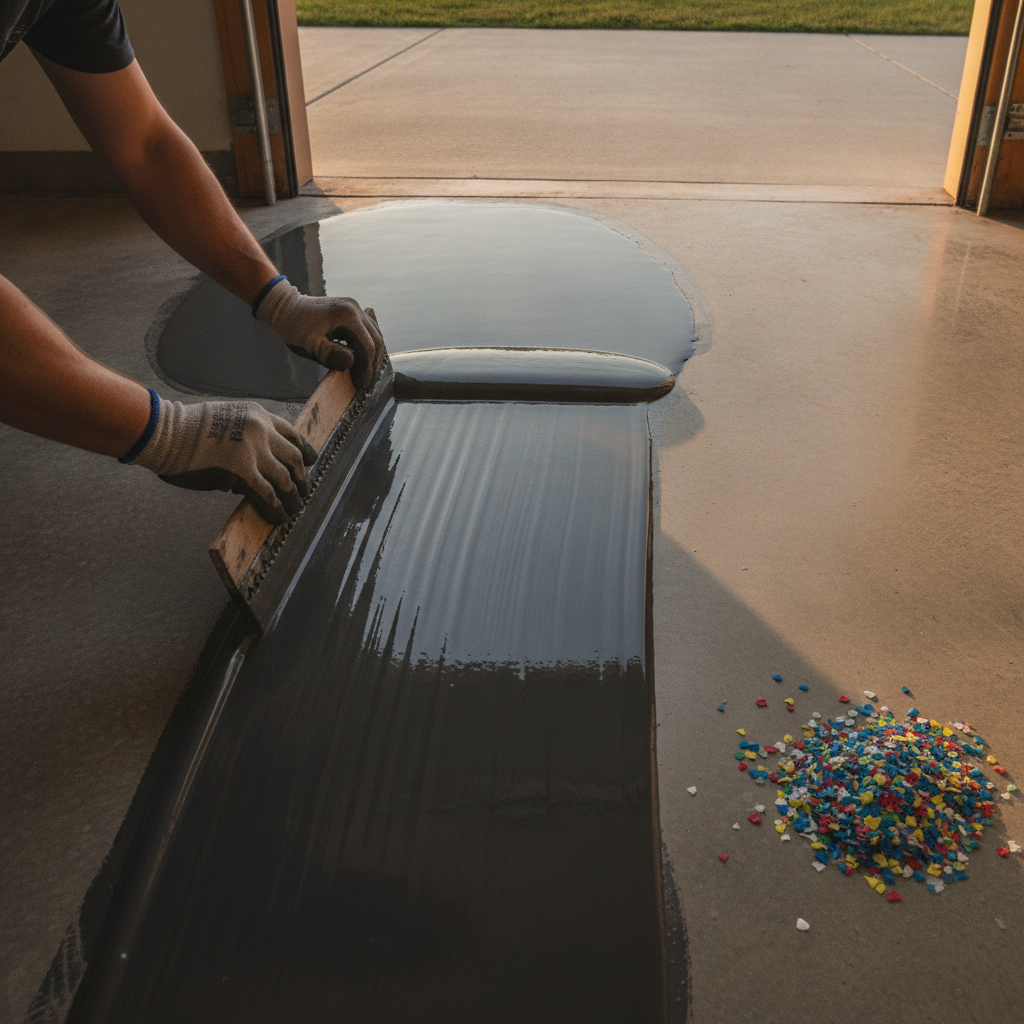
For a standard residential garage, the best concrete floor epoxy coating system is a 100% solids broadcast flake system: a pigmented base coat of 100% solids epoxy, followed by a broadcast of decorative vinyl flakes, then a polyaspartic or polyurethane clear topcoat. This combination gives you a thick, durable base, excellent slip resistance from the flakes and a UV-stable clear that resists tyre marks, oil drips and hot-tyre pickup.
The flake layer does more than look good. It creates a textured surface that hides minor imperfections, adds grip underfoot, and makes it much harder to see everyday wear. Full-broadcast flake systems, where the flakes are thrown wall-to-wall until the base coat is fully covered, produce a seamless, terrazzo-like result that holds up well for 10 or more years with basic maintenance.
A polyaspartic clear topcoat is worth the extra investment over a standard epoxy topcoat for one simple reason: UV resistance. Standard epoxy yellows when exposed to sunlight. A garage with a roller door that opens to the sun will show yellowing on a standard epoxy topcoat within a year or two. Polyaspartic does not yellow, and it cures faster, meaning the floor can often be walked on within 24 hours and driven on within 48.
What about decorative systems for showrooms and living spaces?
Metallic epoxy and full-flake broadcast systems are the two most popular decorative options for spaces where appearance matters as much as durability. Metallic epoxy uses pigmented metallic powders suspended in a 100% solids base coat to create flowing, three-dimensional colour effects that look different from every angle. No two metallic floors are identical, which makes them a strong design choice for showrooms, cafes and high-end residential interiors.
The trick with metallic epoxy is in the application technique. Applicators move the resin with squeegees, rollers and sometimes a heat gun to push the metallic pigment into different patterns. Experience and product knowledge make a real difference to the final result. A rushed or poorly mixed metallic pour looks flat and muddy rather than the liquid-metal effect most people are after.
For domestic living areas, the main concern after appearance is comfort underfoot and the ability to clean easily. A well-applied epoxy or polyaspartic system on a fully prepped slab ticks both boxes. It is seamless, so there are no grout lines or joins to trap dust and bacteria, and it wipes clean with a damp mop. Compared to tiles or timber, a sealed concrete floor in a living area is genuinely low maintenance once it is properly installed.
How do you maintain a concrete floor epoxy coating once it is down?
Maintaining a concrete floor epoxy coating is straightforward: sweep or vacuum regularly to remove grit (which acts like sandpaper underfoot), mop with a pH-neutral cleaner, and avoid dragging heavy objects with sharp metal edges across the surface. Placing felt pads under furniture legs helps too. A well-maintained system in a residential garage or living area can realistically last 10 to 15 years before any remediation is needed.
One thing to watch is UV exposure. Even with a polyaspartic topcoat, prolonged direct sunlight through glass can affect the surface over many years. Where large windows face west or north, some owners add a UV window film to reduce heat and light intensity on the floor. It is a minor step that extends the life of the coating noticeably.
If the surface eventually dulls or shows light scratches, a maintenance coat (a single thin layer of clear topcoat applied over the existing system) can refresh the floor without the cost or disruption of a full strip and recoat. This is a much cheaper option than starting from scratch, and it is only viable because the underlying system was properly prepared and installed in the first place. Cut corners on the original install and a maintenance coat will not save you.
Getting the system choice and the prep right from day one is the whole game. Whether you are fitting out a double garage in the eastern suburbs, a commercial showroom in the CBD or a polished living area in a new build, the fundamentals are the same: correct profile, moisture control, the right product for the load, and a topcoat matched to the environment.
Book concrete floor sealing and preparation with Metal and Flake