Epoxy Floors Price in Melbourne: What Affects the Final Cost?
Epoxy floors price in Melbourne typically ranges from $30 to $80 per square metre for a residential or commercial installation, depending on floor size, surface condition, finish type and the number of coats applied. A simple single-colour garage coat sits at the lower end, while a full metallic or decorative flake system with primer and topcoat sits higher. Getting multiple quotes for your specific slab is the only reliable way to nail down your number.
What is the average epoxy floors price per square metre in Melbourne?
For most Melbourne homeowners and business owners, a standard two-coat epoxy floor system lands between $40 and $60 per square metre fully installed. A basic single-broadcast flake floor in a double garage (roughly 36 sqm) typically comes in between $1,400 and $2,200. Decorative metallic finishes or high-build systems on larger warehouse floors can push past $70 per square metre once prep, primers and a polyurethane topcoat are factored in.
Those ballpark figures get thrown out the window pretty quickly once a few real-world variables kick in. Here is what actually moves the needle on your final quote.
How does floor size affect the epoxy floors price?
Larger floor areas cost less per square metre than small ones because the fixed costs of the job, including mobilisation, mixing equipment, primer materials and labour travel time, get spread across more ground. A 10 sqm laundry is going to cost you more per sqm than a 100 sqm workshop, even if the product and finish are identical. Most installers have a minimum call-out charge, so very small areas rarely benefit from economies of scale.
On the flip side, unusually large commercial floors can also carry extra costs if multiple pours, extra mixing batches or a second crew day are required. Square metreage is the starting point for any quote, but it is never the whole story.
Does the condition of the existing concrete change the price?
Yes, significantly. Surface preparation is the most labour-intensive part of any epoxy floor installation, and a concrete slab in poor condition can double the prep time. Diamond grinding is the industry standard for opening up the concrete profile so the epoxy bonds properly. If your slab has old paint, adhesive, oil contamination, cracks, spalling or moisture issues, each one adds time and materials before a single drop of epoxy goes down.
A moisture reading above about 75% relative humidity in the slab is a common problem in Melbourne, particularly in older homes and ground-level garages. Addressing that means applying a moisture-tolerant primer or a dedicated moisture barrier coat, which adds cost but protects the bond for the long term. Skipping that step is how you end up with bubbling and delamination six months later.
Crack repairs, control joint filling and patching are usually quoted as separate line items. If you have a heavily cracked or uneven slab, expect those items to add anywhere from a few hundred dollars to significantly more depending on the extent of the damage.
How does the finish type affect the epoxy floors price?
The finish you choose is one of the biggest levers on cost. Here is a rough breakdown of how common finishes stack up:
- Single-colour solid epoxy: The most affordable option. Great for workshops, warehouses and utility areas. Usually a two-coat system: primer plus topcoat.
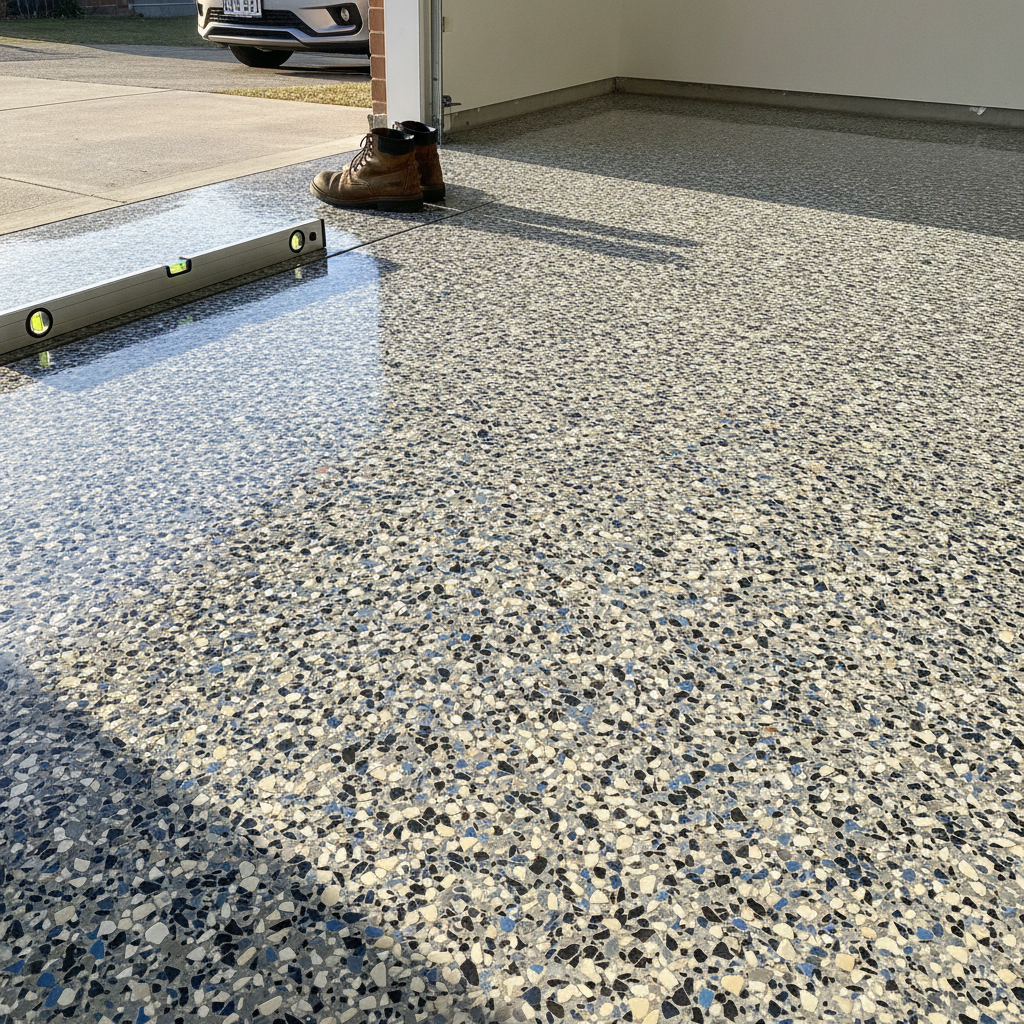
- Decorative flake (also called broadcast chip): A coloured vinyl flake is broadcast into the wet epoxy base coat, then sealed with a clear polyurethane topcoat. This is one of the most popular residential finishes in Melbourne, particularly for garages. The flake adds texture, hides small imperfections and gives a clean, showroom look.
- Metallic epoxy: A pigmented metallic powder is blended into the epoxy resin to create a swirled, three-dimensional effect. More material cost, more skill required, more time on site. Expect to pay a premium for this finish.
- Quartz or aggregate systems: Common in commercial kitchens, food-processing facilities and wet areas where slip resistance is critical. The aggregate adds material cost and a more involved broadcast process.
The topcoat also matters. A standard epoxy topcoat is cheaper than a polyurethane or polyaspartic topcoat, but the latter two offer better UV stability and abrasion resistance, making them worth the extra spend in high-traffic areas or where the floor gets direct sunlight.
Does the number of coats change what you pay?
Every additional coat adds product and labour time, so yes, it adds to the price. A minimum viable system for a residential garage is usually a penetrating primer, a base coat and a clear topcoat: three coats total. Some installers quote a two-coat system to win on price, but thinner builds wear faster and can be harder to maintain.
For commercial or industrial floors, a four or five coat system is common to hit the required build thickness, typically measured in microns. A floor carrying forklift traffic needs a much heavier build than a home workshop. Always ask what the total dry film thickness (DFT) will be. That number tells you more about the quality of the job than the per-sqm price alone.
What other costs should Melbourne customers budget for?
A few line items regularly catch people off guard:
- Concrete grinding: This should always be included in a professional quote, but confirm it. Some operators quote supply and application only, leaving grinding as a separate cost.
- Move-out and move-back: The floor needs to be completely clear before grinding starts. If you need help moving heavy equipment or vehicles, factor that in.
- Cure time downtime: Most epoxy systems require 24 hours of foot traffic cure time and up to 72 hours before you drive a vehicle on them. A polyaspartic topcoat can cut that to a few hours, which is worth paying for if downtime is a real issue.
- Warranty terms: A reputable installer backs their work with a written warranty. Ask what it covers and for how long. A cheap job with no warranty is rarely a bargain.
Location within Melbourne also plays a small role. Travel time to outer suburbs like Pakenham, Sunbury or Mornington Peninsula can add a modest travel charge compared to inner-metro work. It is always worth asking upfront.
Is a cheaper quote always a worse job?
Not always, but it is worth understanding why a quote is lower. Common reasons a quote comes in cheap include: thinner product build, minimal surface preparation, cheaper product brands, no primer coat or a cut-rate topcoat. Any one of those shortcuts will show up within a year or two of use.
Ask every installer the same set of questions: How many coats? What products are you using? How do you prep the surface? What is the total DFT? A professional will answer those without hesitation. If someone cannot tell you the product they are applying or avoids the prep question, that is a red flag.
The best value job is not always the cheapest quote, and it is rarely the most expensive one either. It is the one where the prep is done properly, the build is appropriate for the use, and the installer stands behind their work.
Ready to see what your floor will actually cost? Get an epoxy floor price estimate