Concrete Floor Sealant Options: Which One Is Best for You?
The best floor sealant for concrete depends on where the slab is, how much traffic it takes, and the finish you want. Penetrating sealers suit bare outdoor slabs, acrylic sealers work for light indoor use, polyurethane suits commercial floors, and epoxy coatings deliver the toughest, best-looking result for garages, warehouses and living spaces.
Why does choosing the right floor sealant for concrete matter so much?
Get the wrong sealer on a concrete slab and you are either recoating within twelve months or peeling up a film that bubbled because moisture had nowhere to go. The right product protects the slab, holds its look under real-world conditions, and saves you money because you are not doing the job twice. Concrete is porous by nature. Every litre of rain, every oil drip, every cleaning chemical that soaks in is quietly breaking the slab down from the inside. A matched sealer stops that process before it starts.
It also pays to understand that “sealer” is used loosely in the trade. Some products sit on top of the concrete and form a film. Others soak in and chemically react with the concrete itself. Those two categories behave completely differently under foot traffic, UV light and moisture, so knowing which category you are buying matters before you spend a cent.
What are the main types of concrete sealer and what does each one do?
There are four main types of floor sealant for concrete: penetrating sealers, acrylic sealers, polyurethane topcoats, and epoxy coatings. Each fills a different role. Penetrating sealers soak into the slab and repel moisture without changing the surface look. Acrylics form a thin film and are fast and cheap. Polyurethane is tougher and more chemical-resistant. Epoxy coatings bond tightly to the slab and deliver a hard, seamless surface that can handle serious punishment.
Penetrating sealers (silane and siloxane). These go below the surface, react with the concrete and leave nothing sitting on top. That means no peeling, no film to scuff, and no change to the way the floor looks. They are ideal for driveways, exposed aggregate paths and outdoor entertaining areas where you want weather protection without a shiny finish. The trade-off: they offer zero resistance to oil stains or heavy abrasion. A penetrating sealer on a garage floor will still let a transmission oil spill soak straight in.
Acrylic sealers. Water-based or solvent-based, these are the most common sealers sold at hardware stores. They are easy to roll on, dry fast and give concrete a mild sheen or a wet look depending on the product. Acrylic is fine for a shed floor, a lightly used workshop, or a covered outdoor area. The problem is durability. In a garage with vehicle traffic, a good acrylic sealer is typically worn through within two to three years, sometimes less if you park hot tyres on it regularly.
Polyurethane topcoats. A step up from acrylic in every measurable way. Polyurethane is more flexible, handles UV exposure better and resists chemicals including petrol, brake fluid and most cleaning agents. It is often used as a clear topcoat over a coloured base on commercial floors. On its own it bonds reasonably well to concrete, but surface prep is still critical. Skip the grind and the poly will lift. Expect a lifespan of five to eight years in a busy commercial setting if the prep was done properly.
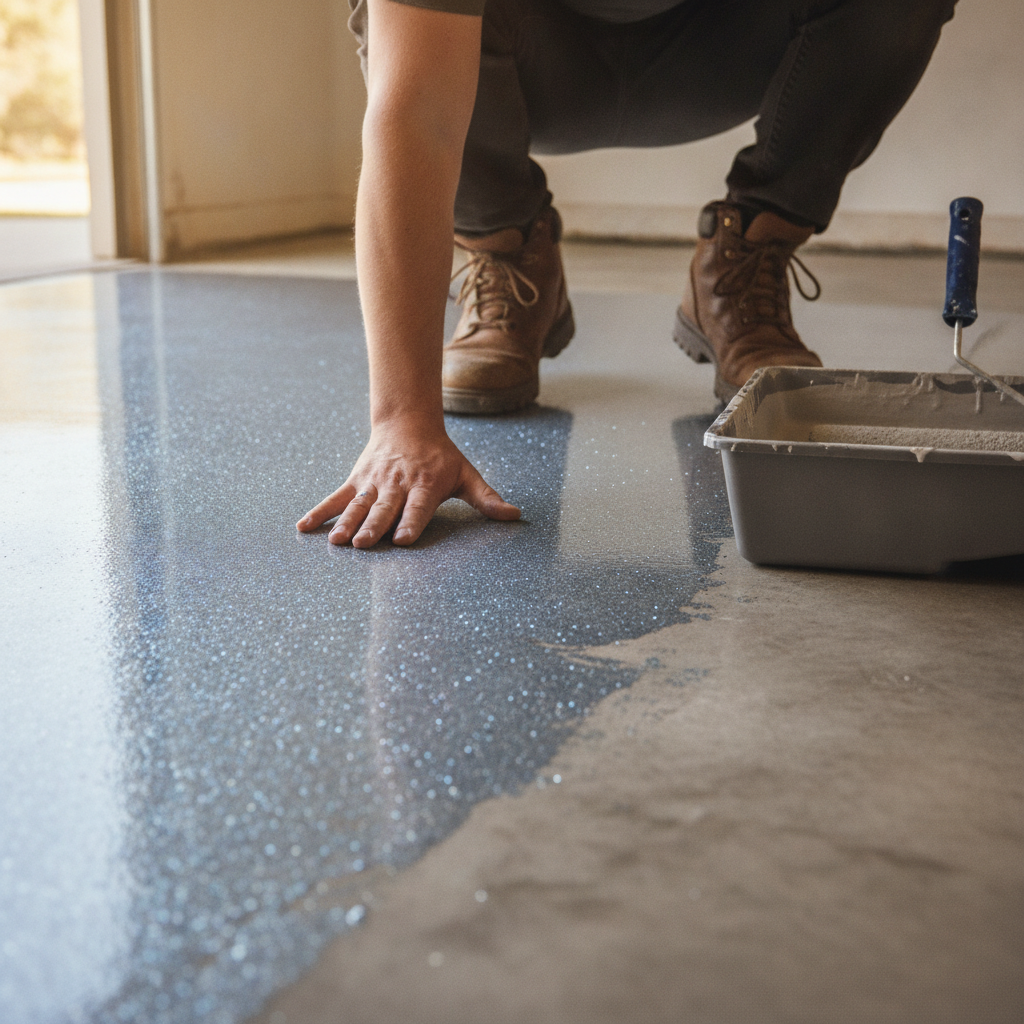
Epoxy floor coatings. Epoxy is a two-part product: a resin and a hardener that you mix together just before application. Once cured, it chemically bonds to the concrete and produces a surface that is dense, seamless and genuinely hard. Correctly applied epoxy can handle forklift traffic, heavy vehicle use, chemical spills and constant foot traffic for well over a decade. It can also be finished with colour flakes (often called flake or chip systems), metallic pigments, or left as a solid colour. That versatility makes it the most popular choice for garage floors, warehouses, showrooms and increasingly for residential living areas where people want a polished, low-maintenance floor.
Which floor sealant for concrete suits different spaces?
Matching the sealer to the space is the most important call you make. For outdoor driveways and paths, a penetrating silane-siloxane sealer is usually the most practical option because it handles freeze-thaw cycles and UV without peeling. For light-duty indoor slabs like a storage room or laundry, a quality water-based acrylic does the job without the cost or complexity of a two-part system. For anything that takes regular vehicle traffic, chemical exposure or needs to look sharp for years, epoxy is the clear frontrunner.
Garages are a good example. A standard single-car garage floor is roughly 25 to 30 square metres. Roll an acrylic on that and you might get two decent years before hot tyre pickup starts lifting the film in patches near the door. Lay a proper epoxy system with a prepared substrate and you are looking at a floor that holds up for ten-plus years and still looks good. The upfront cost is higher but the cost per year works out lower, and you are not tearing the floor back to bare concrete every couple of years to start again.
Showrooms, gyms, retail spaces and open-plan living areas often lean toward metallic epoxy or flake finishes because they deliver the durability of an industrial coating with a finish that actually looks intentional. A metallic epoxy floor in a home gym or a renovated garage workshop shifts the whole feel of the space. That is the gap between a sealer that just protects and a coating system that protects and improves.
What surface preparation is needed before applying a concrete sealer?
Surface preparation is the step that determines whether your floor sealant for concrete lasts or fails. At minimum, the slab needs to be clean, dry and free of any previous coatings, oil contamination or laitance (that weak, dusty surface layer that forms during concrete curing). For penetrating sealers, a thorough clean is usually enough. For acrylic and polyurethane, the surface should be lightly abraded. For epoxy, diamond grinding or shot blasting to open the concrete profile is not optional. It is the difference between a floor that bonds and a floor that peels.
Moisture is the other prep issue that catches people out. Concrete that holds moisture below the surface will push that moisture up through a film sealer over time, causing bubbles and delamination. A simple plastic sheet tape test left for 24 hours will show you whether moisture is an issue. If condensation forms under the sheet, the slab needs more drying time or a moisture-tolerant primer before any coating goes on.
How do you know when a concrete floor needs resealing?
The clearest sign is water absorption. Splash a small amount of water on the floor. If it beads up and sits on the surface, the sealer is still doing its job. If it soaks in within a few seconds, the sealer has worn through and the concrete is exposed. Other signs include visible scuffing or peeling of a film sealer, staining that will not clean off, or a dull patchy appearance where the floor used to have a consistent sheen.
For epoxy-coated floors, wear typically shows first in the highest-traffic zones: near entry points, under workbenches and along vehicle paths. A topcoat recoat over a sound epoxy base can extend the floor’s life considerably without the need to start from scratch, as long as the base coat is still well adhered.
Get advice on the best floor sealer for your space