Epoxy Floors 101: Everything You Need to Know Before You Buy
Epoxy flooring is a resin-based coating applied directly to concrete. Two components, a resin and a hardener, are mixed on site and spread over a prepared slab. They react chemically, curing into a hard, seamless surface that bonds tightly to the concrete beneath. Done right, it lasts well over a decade and handles heavy traffic, chemical spills and daily wear without complaint.
What exactly is epoxy and how does it differ from a regular floor paint?
Epoxy is a two-part thermosetting polymer, not a paint. Standard floor paint is a single-component product that sits on top of concrete and peels under load. Epoxy undergoes a chemical cure that fuses it to the slab at a molecular level. The cured film is typically two to three millimetres thick for a full broadcast system, compared to the thin coat of paint that can be scraped off with a key. The difference in durability is enormous.
Regular floor paint is water or solvent-based and relies on evaporation to dry. Epoxy relies on a catalytic reaction between the resin and the hardener. Once those two parts are mixed, the clock is ticking. You have a working window, usually 20 to 40 minutes depending on temperature, to get the product laid out. That is why surface preparation and job planning matter so much with epoxy work.
In practical terms, paint bubbles, flakes and fades within a year or two on a garage floor. A properly installed epoxy system with colour flakes and a polyurethane topcoat will still look sharp after ten or fifteen years of daily use. That is the value proposition in plain terms.
What types of epoxy floor systems are available?
There are several epoxy floor systems, and the right one depends on your use case. A solid-colour self-levelling epoxy suits commercial kitchens and workshops where hygiene and chemical resistance matter most. A decorative flake system, where vinyl colour chips are broadcast into the wet epoxy, suits garages, showrooms and living areas where appearance counts. Metallic epoxy uses pigmented mica powder to create a three-dimensional swirl effect. Each system has different performance characteristics and price points.
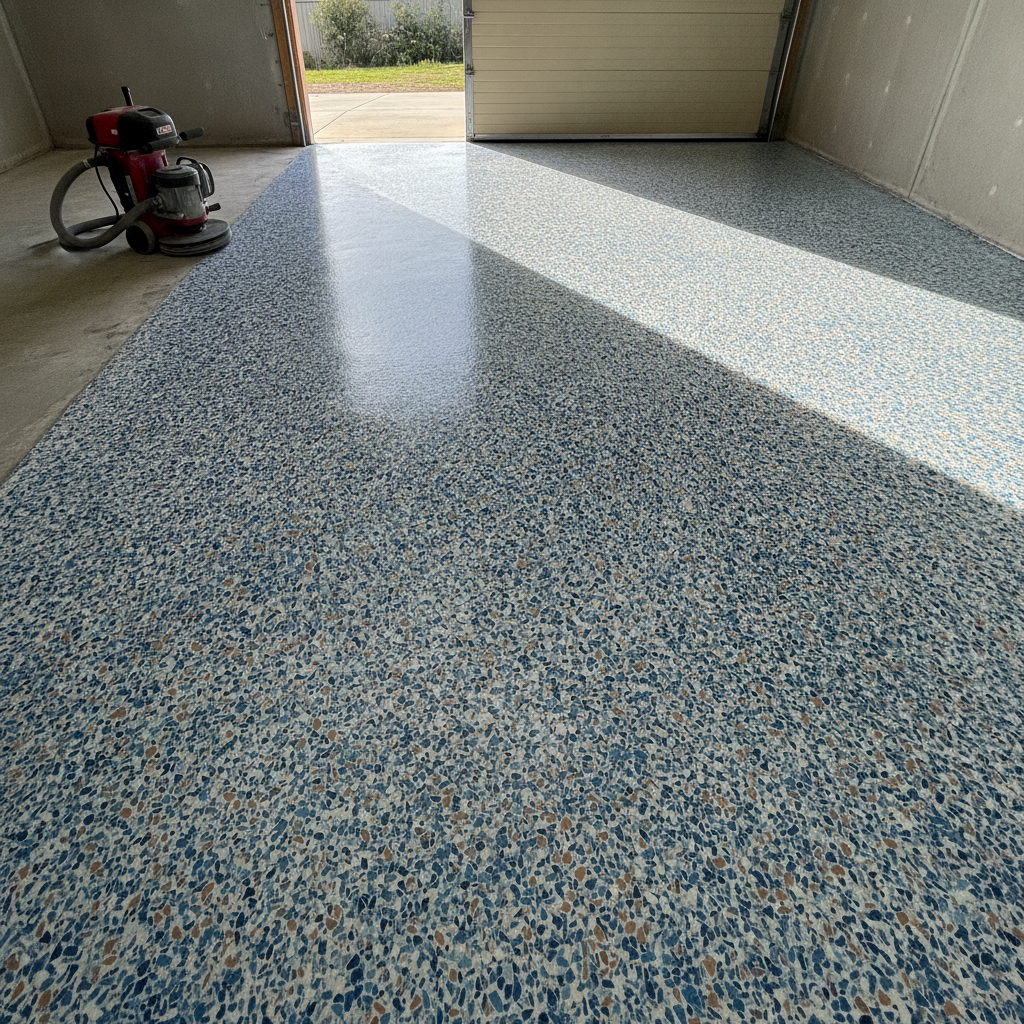
The most common system in residential Melbourne is the full broadcast flake floor. You get a base coat of epoxy, a full scatter of colour flakes across the whole surface, a grout coat of clear epoxy to lock the flakes in, and a polyurethane or polyaspartic topcoat for UV stability and scratch resistance. The topcoat layer is what protects the floor long-term. Skipping it or using a cheap version is where many budget jobs fall apart within a couple of years.
Metallic epoxy floors have grown in popularity for living areas, retail spaces and feature rooms. The product is more sensitive to temperature and humidity during application, so the installer needs experience with it. A botched metallic floor shows every mistake because the swirl pattern makes texture and fish-eyes very obvious.
How important is surface preparation for an epoxy floor?
Surface preparation is the single most important step in any epoxy floor installation. If the concrete is not properly opened up and cleaned before the epoxy is applied, the coating will fail. The industry standard is diamond grinding or shot blasting to create a concrete surface profile of CSP 3 to CSP 4. That roughness gives the epoxy something to mechanically bond to. Acid etching alone is not sufficient for a system expected to last.
Concrete moisture is the other big killer. Epoxy does not bond well to damp concrete. A reliable installer will test moisture vapour emission before they mix a drop of product. If moisture levels are too high, a moisture-tolerant primer or a surface DPM (damp-proof membrane) goes down first. Rushing past this step is the reason so many epoxy floors bubble and delaminate within twelve months.
Cracks and joint lines also need to be addressed before the epoxy goes down. Fine shrinkage cracks can be filled with an epoxy crack filler or flexible polyurethane. Expansion joints should be maintained through the coating rather than buried under it, because the concrete will still move and the floor will crack along those lines regardless of what is sitting on top.
How much does an epoxy floor cost in Melbourne?
Epoxy floor pricing in Melbourne typically ranges from around $30 to $80 per square metre depending on the system chosen, the condition of the existing concrete and the size of the job. A basic two-coat solid-colour system for a single garage of 35 to 40 square metres will come in at the lower end. A full broadcast flake system with polyurethane topcoat on the same area sits in the mid-range. Metallic epoxy or multi-colour custom work pushes toward the upper end.
What drives costs up is concrete remediation. A slab with significant cracking, laitance, old paint, or previous coatings takes more preparation time. Grinding out old coatings, filling cracks and dealing with contamination all add labour hours before a single litre of epoxy is mixed. Always ask your installer to inspect the slab before providing a fixed price. A quote given over the phone without a site visit is not a reliable number.
It is also worth asking what topcoat is included. Some entry-level quotes use a single clear epoxy topcoat rather than a dedicated polyurethane or polyaspartic product. The latter two are UV-stable and far more abrasion-resistant. Over a ten-year horizon, paying a bit more upfront for a quality topcoat is straightforward value.
How long does an epoxy floor take to install and cure?
Most residential epoxy floor jobs in Melbourne take one to two days on site. The preparation work, including grinding and any crack repairs, is done on day one. The epoxy base coat, flake broadcast and grout coat follow. The topcoat is applied once the system has cured sufficiently, usually the next morning. Light foot traffic is typically possible after 24 hours. You should keep vehicles off a new floor for at least 72 hours, and avoid dragging heavy objects across it for a week to allow the full chemical cure to complete.
Temperature affects cure times significantly. In Melbourne winters, a cold slab below 10 degrees Celsius can slow curing and cause amine blush, a waxy surface film that affects adhesion of subsequent coats. A good installer will check slab temperature and ambient conditions before they start and adjust their timing accordingly.
What should you look for when choosing an epoxy floor installer?
Ask about their preparation method first. If the answer is acid wash or a light sand, walk away. Diamond grinding with a commercial grinder is the baseline for a lasting job. Ask what brand of products they use and whether those products are designed for the system being installed, base coat, broadcast medium and topcoat should all be compatible and ideally from the same manufacturer’s system.
Look at their previous work in person if you can. Photos on a phone are easy to stage. An actual floor you can walk on and inspect in natural light tells you far more about their finishing quality. Ask how they handle moisture testing and what their process is if moisture levels come back too high. A contractor who has a clear answer to that question has dealt with it before and knows what they are doing.
References from previous residential or commercial clients in Melbourne are worth chasing. A one-year-old floor in a Melbourne garage tells you a lot more about longevity than a freshly installed showroom floor does.
Ready to move forward? Get a quote for epoxy flooring in Melbourne